Offline Resilience Scanner for Cloud-Dependent Businesses
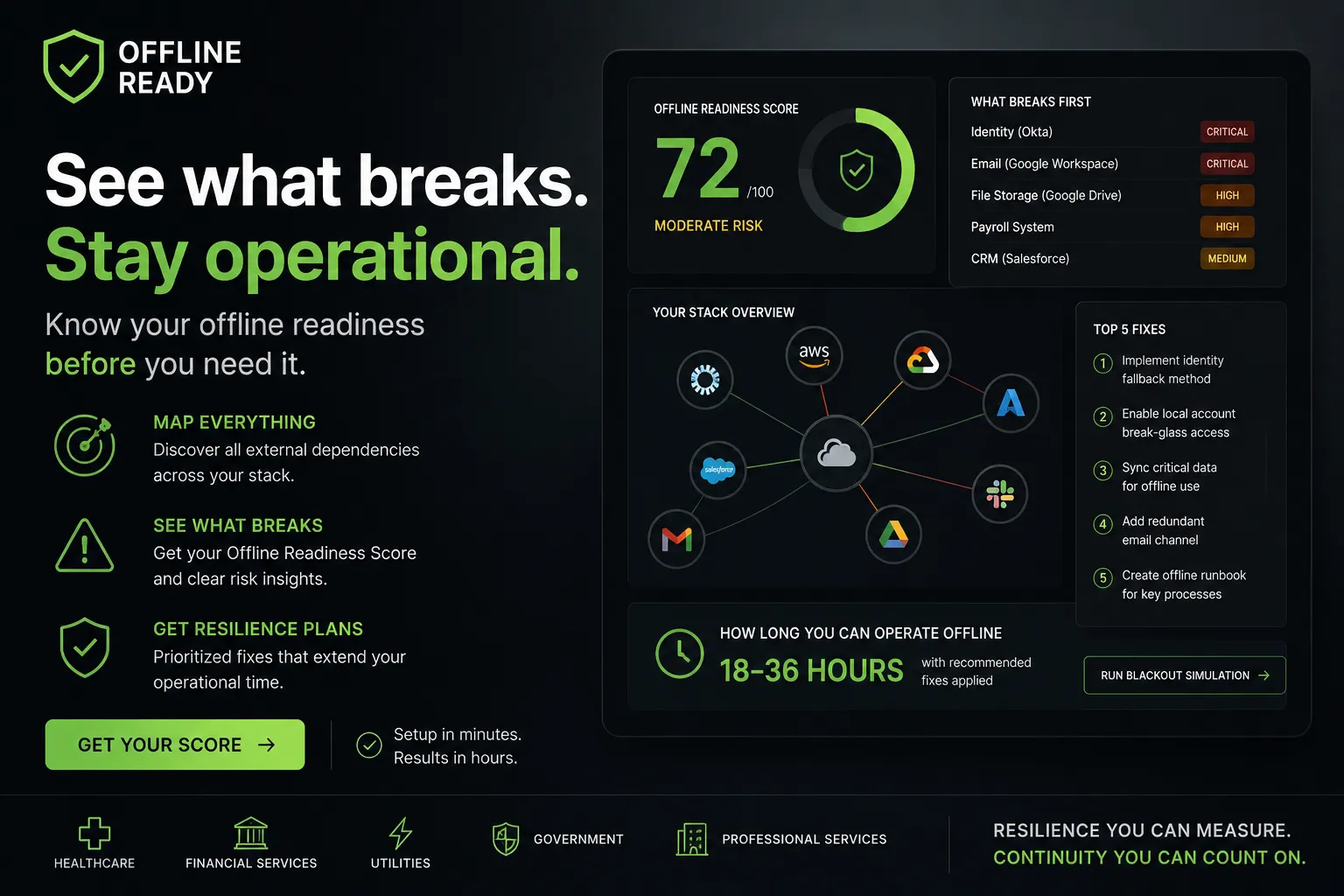
Most businesses have no idea what would stop working if they disconnected from the internet for six hours, and finding out during a cyberattack is too late. Offline Ready is a lightweight resilience scanner that connects to a company’s SaaS stack, cloud infrastructure and identity provider, maps every external dependency, and generates an “Offline Readiness Score” showing exactly what breaks, which operations can continue and the five fixes that would buy the company the most operating time. This becomes useful now as AI agents increase the speed and scale of cyberattacks while companies remain dependent on dozens or hundreds of interconnected cloud services. A 200-person accounting firm connects Google Workspace, Okta, AWS and its core software, discovers payroll and client records become inaccessible the moment Okta goes down, and receives a step-by-step plan for maintaining 24 hours of emergency operations.
Description
No additional description provided.
The Pitch
Companies know they rely on cloud software in the abstract, but they rarely understand the chain of assumptions beneath ordinary work: which logins require which identity provider, which workflows silently depend on email, which “local” processes actually call an external API, which backups are useless without the same credentials that just failed. The valuable thing is not another security dashboard; it is turning a vague fear into a map of operational fragility.
The interesting wedge is that downtime resilience is easier to buy than cybersecurity purity. Most security products sell the promise of preventing bad things from happening, which is hard to prove and often sounds like scolding. This kind of product sells a more concrete question: if the bad thing happens anyway, how long can the business keep operating? That reframes the conversation from fear and compliance to business continuity, where the buyer can immediately see the difference between “we are secure” and “we can still run payroll, serve clients, and recover cash for 24 hours.”
The score matters because resilience is otherwise too amorphous to manage. Every company has an informal sense that some systems are critical, but few have a ranked view of which dependency reductions would create the most operating time. A good assessment would turn resilience into a series of small, high-leverage decisions: maintain a break-glass identity path, export a daily client roster, cache a minimum dataset, preserve offline instructions for finance. The power is in showing that meaningful survivability may come from five practical changes, not a grand transformation.
There is also a durable reason this could become habitual rather than occasional. The dependency graph of a modern company changes constantly as teams add SaaS tools, automate workflows, deploy agents, switch vendors, and centralize authentication. Offline readiness is therefore not a one-time audit but a living property of the business, like credit risk or uptime. The more software a company adopts, the more useful it becomes to have an independent view of whether convenience has quietly erased its ability to function under stress.
The broader insight is that “offline” is not nostalgic; it is strategic redundancy. The most resilient companies of the next decade may not be those with the most advanced defenses, but those that know exactly which parts of the business must keep breathing when the network, identity layer, or cloud stack stops cooperating.