Offline Operating Systems for Critical Institutions
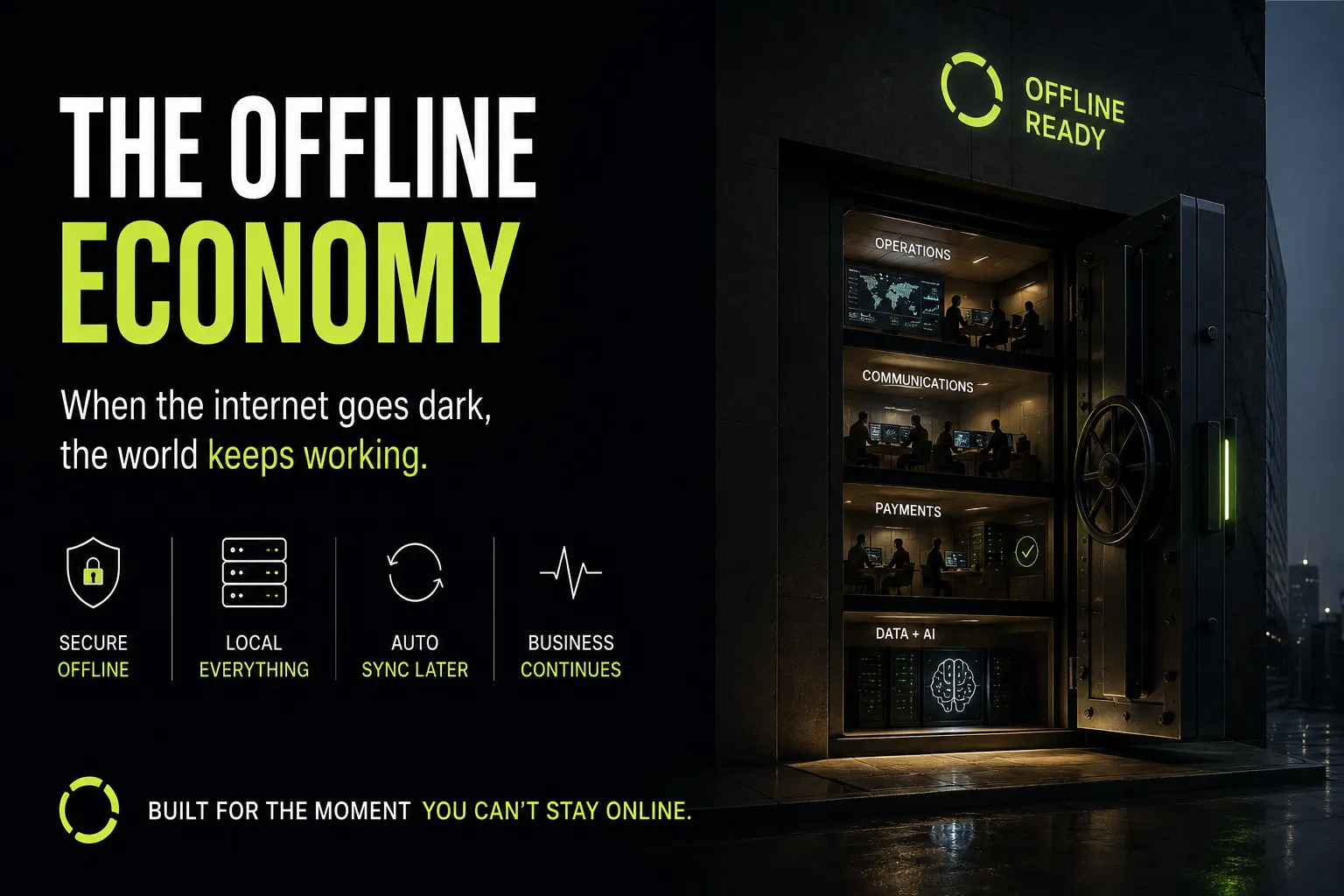
Nearly every important institution now assumes the public internet will always be available and safe enough to use, leaving hospitals, banks, utilities and governments with few good options if an AI-driven cyberattack makes remaining connected more dangerous than disconnecting. The Offline Economy is a parallel operating layer that lets organizations cut themselves off from the public internet while keeping identity, communications, payments, databases, internal AI and critical software running locally, then securely reconcile everything when connectivity returns. This matters now because autonomous AI could turn cyberattacks from occasional incidents into machine-speed events that hit thousands of organizations simultaneously, making the ability to operate disconnected a strategic capability rather than disaster recovery. A hospital could detect a global attack at 9:17 AM, disconnect at 9:18, and continue admitting patients, accessing medical records, dispensing prescriptions and processing transactions for three days while the public internet remains completely unreachable.
Description
No additional description provided.
The Pitch
The interesting truth is that “offline” has stopped meaning primitive. For most of computing history, disconnection implied degraded service, paper fallbacks, and operational paralysis. But local compute, private models, secure enclaves, edge databases, and modern sync protocols make it possible for an institution to keep functioning in a rich digital state without trusting the open internet. That turns offline operation from a backup procedure into an entirely new category of institutional infrastructure.
The business would be compelling because the cost of internet dependence is becoming harder to price. A hospital, bank, or utility does not merely lose productivity when it disconnects; it loses the ability to prove who people are, move information, coordinate staff, authorize actions, and maintain trust. Those are not “IT functions” anymore. They are the nervous system of the organization. A company that preserves those functions during disconnection would be selling continuity at the layer where failure becomes existential.
The non-obvious wedge is that cyber resilience is usually framed as better defense, but the strongest posture may be selective refusal. If attacks become fast, automated, and broadly distributed, the safest system may not be the one that fights every intrusion in real time, but the one that can confidently leave the battlefield. A well-designed offline layer gives leaders an option they currently lack: disconnect without reverting to chaos. That option has enormous strategic value because it changes the decision from “can we survive being attacked?” to “can we choose not to participate?”
There is also a powerful network effect hiding in reconciliation. Offline operation is easy inside a single room and difficult across organizations that eventually need to agree on what happened while disconnected. Payments, medical records, supply orders, credentials, legal approvals, and operational logs all require a shared truth after the fact. The company that becomes trusted to manage that delayed truth could occupy a rare position: not just software vendor, but neutral recordkeeper for discontinuous time.
The deeper business insight is that modern society has optimized for permanent connectivity without building a serious second mode. That creates a market for an operating layer designed around interruption rather than speed. The winners in that market would not be selling fear of catastrophe; they would be selling the ability for critical institutions to remain civilized when the network is not.