Nuclear Reactor Community Safety Monitoring App
When nuclear reactors move from remote government facilities to business parks, hospitals, universities, and industrial campuses, every surrounding community will demand transparency. This startup becomes the public operating system for living near a reactor, providing real-time environmental monitoring, maintenance schedules, emergency information, safety data, and community updates in a format ordinary people can understand. The opportunity exists because public trust will become just as important as reactor technology itself. Before buying a home or opening a business, someone could simply open an app to understand everything happening at the nearby reactor instead of relying on rumors or occasional government reports.
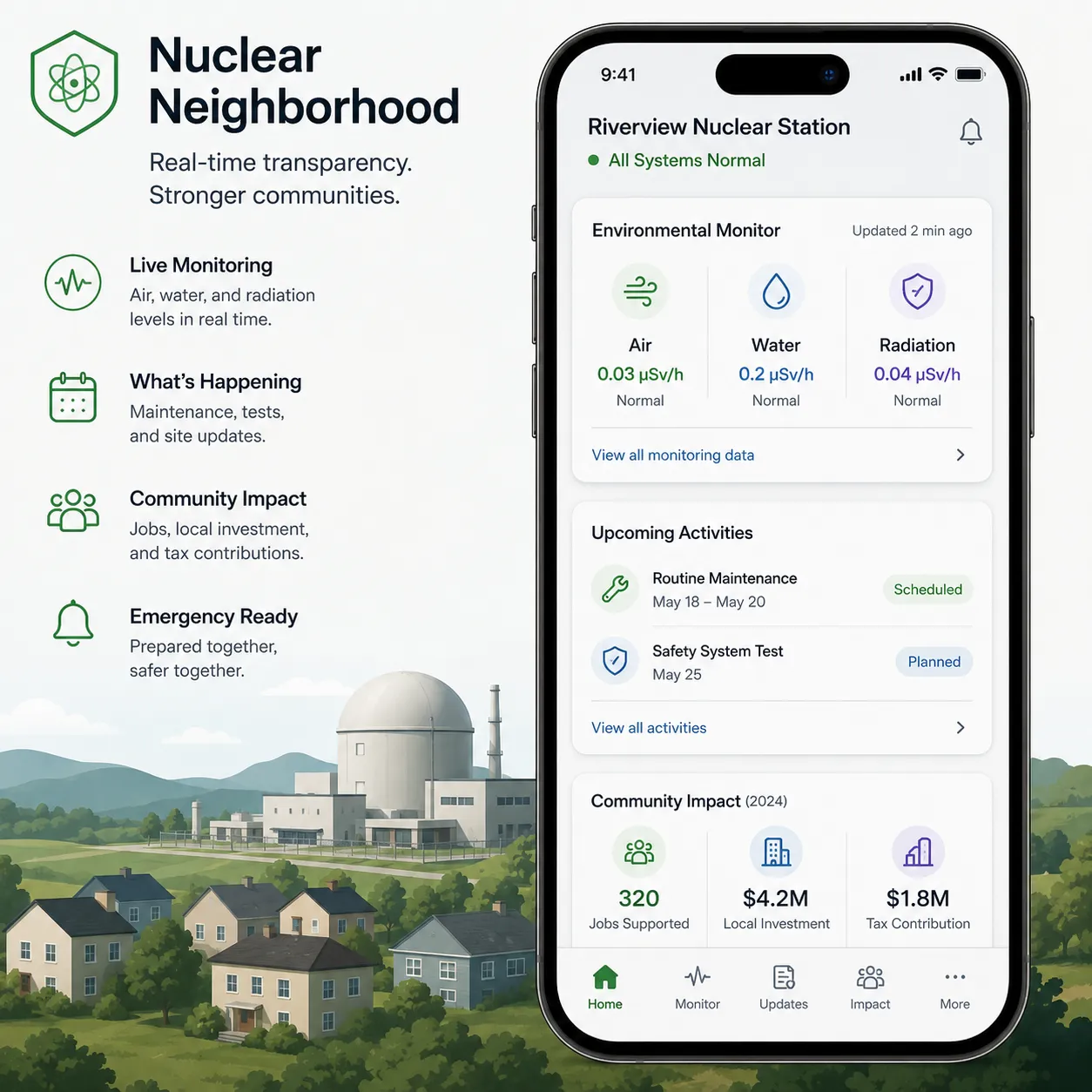
Description
No additional description provided.
The Pitch
A business like this would be compelling because the limiting factor for distributed nuclear power may not be physics, licensing, or capital, but social permission. Small reactors can be engineered to high safety standards, yet communities do not experience safety through engineering documents. They experience it through confidence, routine, and the absence of mystery. A company that turns reactor operations into a legible civic product would sit at the point where technical reliability becomes public acceptability.
The unusual insight is that transparency around nuclear sites cannot be an occasional communication exercise. It has to feel continuous, ambient, and boring in the best possible way. People trust weather apps, flight trackers, package tracking, and air quality monitors because they replace imagination with visible signals. Nuclear has historically offered the public the opposite: long silences interrupted by formal statements. A live, understandable layer of information could make proximity to a reactor feel less like being near a black box and more like being near any other monitored piece of critical infrastructure.
This could become a durable business because every new reactor creates a permanent trust perimeter around it. The operator needs credibility, the host institution needs legitimacy, local officials need a shared source of truth, insurers and lenders need evidence of orderly operations, and residents need reassurance that does not depend on press releases. The value is not just in displaying data, but in becoming the neutral interface through which different parties can agree on what is happening. In contentious environments, the trusted record often becomes more valuable than the raw data itself.
There is also a strong compounding effect: once people expect this level of visibility around one reactor, opacity elsewhere starts to look irresponsible. The company could help define the public norm for what “safe enough to live near” means in the next nuclear era. That is a powerful position because new industries often need a civic layer before they can scale. Railroads needed timetables, aviation needed flight status, finance needed account visibility; distributed nuclear may need a public trust dashboard.
The deeper business is not monitoring reactors. It is reducing the fear premium attached to nuclear proximity. If better information lowers opposition, speeds local acceptance, stabilizes property perceptions, and gives institutions a way to host reactors without becoming permanent crisis communicators, then the product is not a nice-to-have transparency tool. It becomes part of the operating cost of putting nuclear power into normal places.