Neighborhood Shared Ownership for Household Items
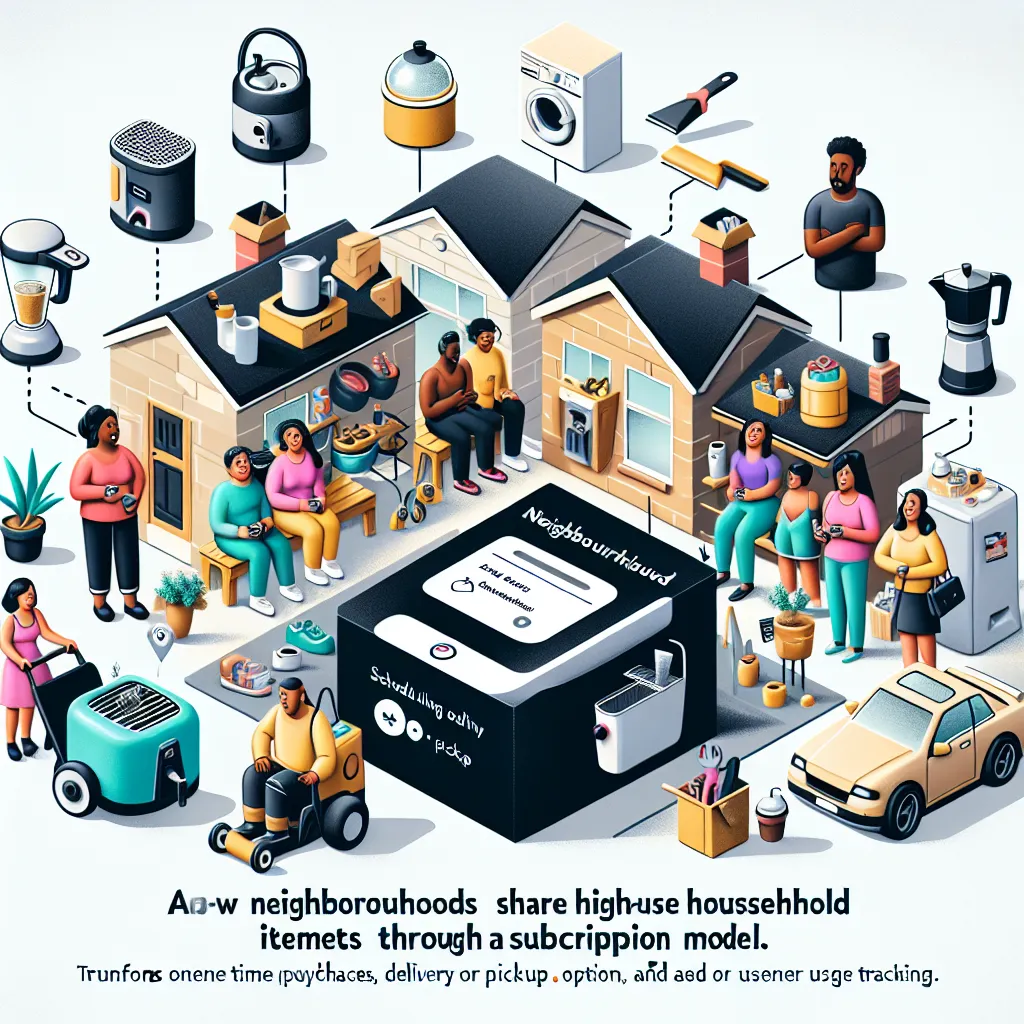
Many high-use household items—like power tools, air fryers, or espresso machines—don’t need to be bought by everyone. This startup enables neighbors to co-own and share products through a subscription model. Members can schedule usage, request delivery or pickup, and track usage via the app. It turns one-time purchases into shared resources. For example, five households on the same street might share a snowblower or pizza oven, splitting cost and usage while reducing clutter and waste.
Description
No additional description provided.
The Pitch
In contemporary society, there is an increasing trend towards minimalism and sustainability, leading to a preference for experiences over ownership. High-use household items such as power tools, air fryers, or espresso machines often sit idle after sporadic use, consuming space and resources. This document outlines the potential development of a startup aimed at revolutionizing the way consumers access and utilize household items through a shared economy model. This platform allows individuals to co-own and share products among neighbors via a subscription service.
#### Backstory
The era of hyper-consumerism is being challenged by a shift towards sustainable living and community-focused lifestyles. With urbanization and shrinking living spaces, people are becoming more conscious of the environmental impact of buying and owning goods they seldom use. Many high-use household items are not utilized frequently enough to justify their purchase by each household. This opens a unique opportunity to transform these one-time purchases into shared community resources.
#### Problem
Consumers face several issues with traditional ownership models:
1. High upfront and maintenance costs for items often used infrequently. 2. Lack of storage space for bulky items that are not regularly used. 3. Environmental concerns related to manufacturing and disposing of underused goods. 4. Limited social interaction and community engagement within neighborhoods.
#### Solution
To address these challenges, the proposed solution is a platform enabling neighbors to co-own and share household items through a subscription service. The key features of this solution include:
1. **Shared Ownership Model**: Households can co-own items, such as power tools or kitchen appliances, reducing the individual financial burden. 2. **Scheduling System**: An integrated app allows members to conveniently schedule times for using the shared items. 3. **Item Delivery and Pickup**: Options for delivery and pickup services facilitate ease of use and accessibility. 4. **Usage Tracking**: Comprehensive tracking of item usage to ensure equitable access and accountability. 5. **Community Building**: Encourages neighbors to connect and collaborate, enhancing community ties.
#### Product Details
The proposed platform consists of:
1. **Mobile and Web Application**: Central hub for users to manage subscriptions, schedule usage, and communicate with fellow co-owners. 2. **Subscription Tiers**: Different membership levels offering varying degrees of access and privileges. 3. **Logistics Network**: Partnerships with local logistics providers to facilitate item transportation. 4. **Community Forum**: An online space for discussions, suggestions, and feedback to nurture community engagement.
#### Tools for MVP Launch
To expedite the MVP launch, the following tools and technologies are recommended:
- **No-Code Platforms**: Utilize tools like Bubble or Glide to create a functional prototype with limited resources. - **Cloud Services**: Leverage AWS or Google Cloud for reliable and scalable backend infrastructure. - **Payment Gateway**: Integrate Stripe or PayPal for seamless subscription management. - **Analytics Tools**: Employ Google Analytics or Mixpanel to monitor user engagement and optimize the platform. - **Logistics API**: Use delivery APIs like those from Shippo or SendGrid for efficient logistics management.
#### Go-To-Market Strategy
The Go-To-Market (GTM) strategy will focus on:
1. **Target Market Identification**: Engage urban neighborhoods with limited storage space and eco-conscious communities. 2. **Partnerships**: Collaborate with local businesses and community centers to spread awareness. 3. **Grassroots Marketing**: Use social media and local events to encourage word-of-mouth promotion. 4. **Pilot Programs**: Launch pilot programs in select neighborhoods to gather feedback and refine the offering. 5. **Referral Incentives**: Implement a referral program to encourage user acquisition and retention.
#### Business Model
The business model revolves around a subscription-based service offering:
- **Monthly/Annual Membership Fees**: Different tiers correlating with access levels and usage frequency. - **Freemium Add-Ons**: Additional charges for premium services like express delivery or exclusive item reservations. - **Revenue Sharing**: Potential partnerships with manufacturers or retail outlets for shared revenue on item usage.
By reshaping the consumption paradigm to prioritize accessibility over ownership, this platform seeks to initiate a transformative trend towards sustainable, community-driven living.