Moderated Communication Platform for Estranged Families
Millions of families are partially or completely estranged, but the available options are usually direct contact, complete silence, or expensive therapy and mediation that both sides must agree to attend. A startup could build a neutral communication layer for high-conflict families, allowing people to exchange moderated messages, set enforceable boundaries, receive important family updates, and gradually reopen contact without immediately exposing themselves to harmful or emotionally charged conversations. This is becoming possible as AI gets better at identifying intent, removing inflammatory language, and translating emotional messages into clear requests while still escalating serious situations to trained human mediators. For example, an adult child who is not ready to speak directly with a parent could agree to receive health emergencies and one moderated message each month, while the platform blocks guilt, threats, or attempts to violate previously established boundaries.
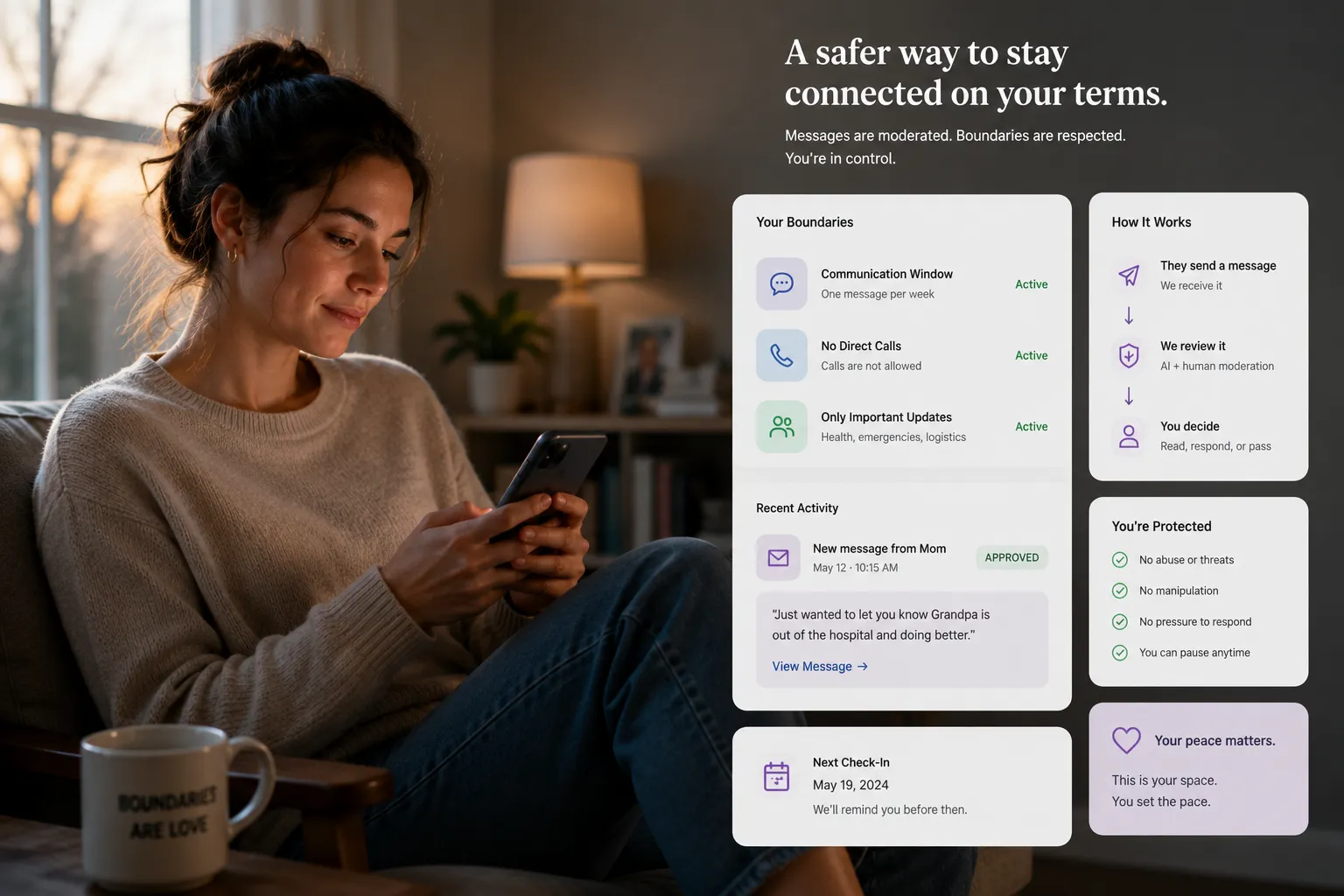
Description
No additional description provided.
The Pitch
Estrangement is not usually a single decision; it is a logistics problem that lasts for years. Families still need to transmit deaths, illnesses, inheritances, emergencies, school events, eldercare details, and apologies through systems that were designed for either intimacy or strangers: text messages, email, lawyers, therapists, or silence. The missing category is a durable relational firewall, something less formal than legal representation but safer than opening the door again.
The strongest insight is that many people do not want “reconciliation” as a product. They want controlled permeability. Total cutoff is often emotionally and practically expensive, but direct contact can be destabilizing. A service that lets someone say, “this kind of information can reach me, in this tone, at this frequency, through this channel” turns boundaries from fragile personal promises into operational rules. That is a much more repeatable business than trying to sell healing.
The trust problem also creates a natural wedge. In high-conflict families, the messenger is often treated as part of the conflict: a sibling forwarding a parent’s message becomes complicit, a spouse becomes the gatekeeper, a therapist is too heavy, a lawyer too adversarial. A neutral layer has value precisely because it is not emotionally entangled. If it becomes the place where the family’s difficult communications are routed, it can become hard to replace, not because of lock-in, but because everyone has come to rely on the same boundary record.
There is also a powerful asymmetry in willingness to pay. The person seeking access often has a strong incentive to fund the channel, while the person protecting themselves needs confidence that payment does not buy influence. That suggests the business works only if neutrality is treated as the core product, not a policy detail. The platform would be judged less by how much communication it enables than by how reliably it refuses the wrong communication.
The broader opportunity is that modern life has created more fragmented families while preserving old obligations. People move away, remarry, recover from abuse, disagree politically, and still remain linked by biology, law, memory, and emergencies. A company that helps people maintain minimal, bounded, humane contact would sit in the uncomfortable space between family and no family. That space is enormous, underserved, and emotionally consequential.