mmWave Tech for Detecting Trapped Disaster Victims
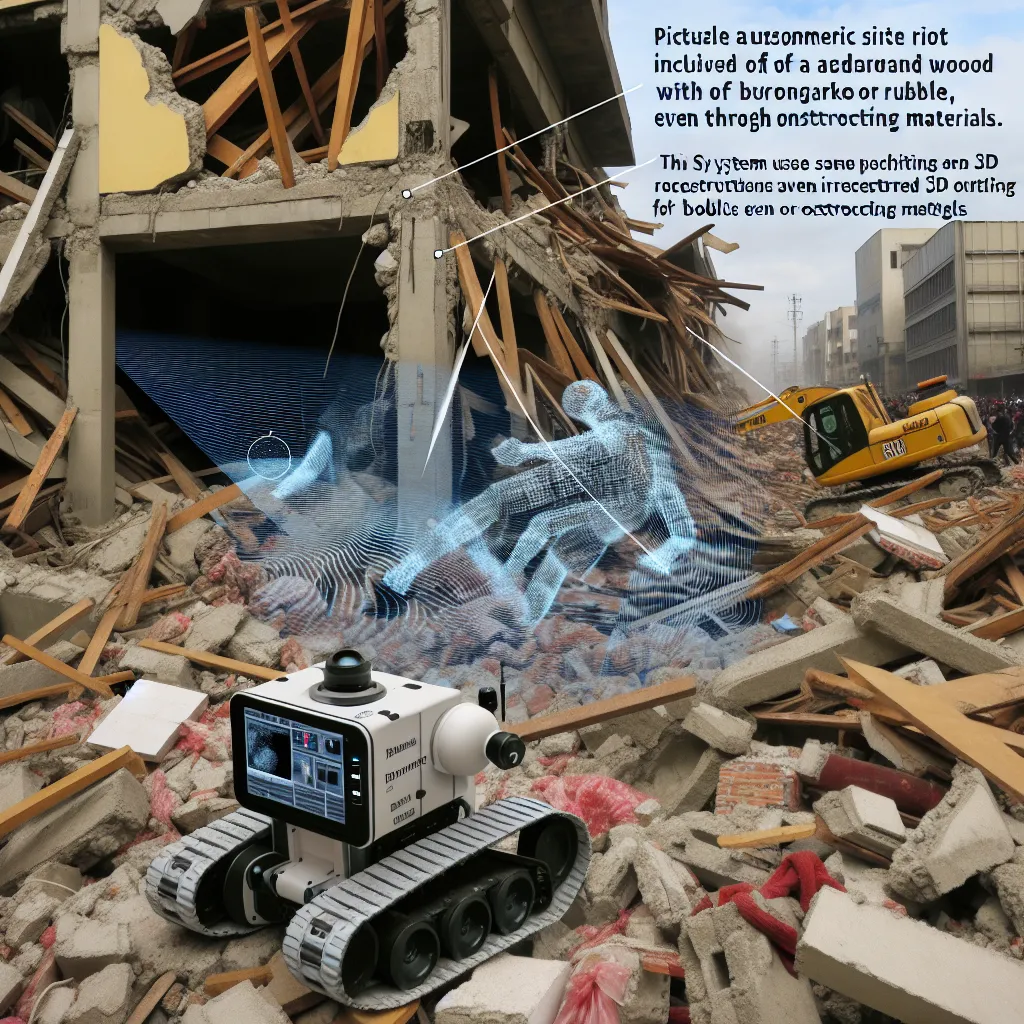
Disaster sites—earthquakes, bombings, or fires—often involve unstable debris, with trapped victims behind concrete or rubble. Traditional thermal or audio-based systems struggle in noisy, chaotic environments. mmNorm can be embedded into autonomous robots or drones to reconstruct the shape of humans through collapsed structures using mmWave reflections. Unlike thermal imaging, this works through wood or concrete and provides accurate 3D outlines of bodies. This is now feasible due to the model’s ability to interpret complex mmWave signals into real-world geometries. Imagine a robot scanning a pile of rubble and identifying a human outline behind a wall—pinpointing a trapped victim without digging blind, saving precious time and lives.
Description
No additional description provided.
The Pitch
Rescue operations at disaster sites—whether triggered by earthquakes, bombings, or fires—face significant challenges. One of the critical hurdles is locating victims trapped behind unstable debris, such as concrete or collapsed structures. Current technologies, which rely heavily on thermal or audio systems, often fall short because they struggle to perform effectively in the noisy and chaotic environment of a disaster site. This is where mmNorm comes in.
### Problem Identification
The main problem in such scenarios is the difficulty in accurately detecting and locating victims who are trapped under or behind debris. Traditional systems have a limited ability to penetrate obstacles like concrete or thick layers of rubble, making it hard to achieve reliable results. The inability to quickly and accurately identify trapped individuals can result in delayed rescues and an increased risk of fatalities.
### The mmNorm Solution
mmNorm is a cutting-edge innovation designed to overcome the limitations of existing rescue technologies. By embedding mmNorm into autonomous robots or drones, teams can use millimeter-wave (mmWave) reflections to reconstruct the three-dimensional shapes of humans through collapsed structures. Unlike thermal imaging, mmNorm is capable of seeing through materials like wood and concrete, providing precise 3D outlines of bodies even in the most challenging environments.
### Product Details
- **Technology**: Utilizes mmWave technology capable of penetrating various materials to generate accurate 3D models of human shapes. - **Integration**: Can be incorporated into autonomous robots or drones for mobility and flexibility at disaster sites. - **Capabilities**: Capable of scanning through debris and walls to identify human outlines, improving rescue accuracy and efficiency. - **Model Interpretation**: Sophisticated algorithms interpret complex mmWave signals to provide clear, actionable data for rescue teams.
### Tools and Launch Strategy
To bring mmNorm to market as a Minimum Viable Product (MVP), the following tools and strategies can be considered:
- **Development Tools**: Utilize simulation and modeling software to test and validate mmWave technologies for this application. - **Prototyping**: Create prototypes using off-the-shelf components to reduce initial costs and accelerate the development process. - **Testing**: Conduct field tests in simulated disaster environments to refine the technology and ensure reliability.
### Go-To-Market Strategy
- **Partnerships**: Collaborate with disaster response organizations and first responder units for pilot projects and feedback. - **Awareness Campaigns**: Launch campaigns to raise awareness among stakeholders about the benefits of mmNorm technology. - **Regulatory Compliance**: Work with regulatory bodies to ensure the technology meets safety and operational standards for use in disaster zones.
### Business Model
- **Sales**: Offer mmNorm as a product to government agencies, military contractors, and international disaster relief organizations. - **Subscription Service**: Provide ongoing updates, maintenance, and support through a subscription model, ensuring the technology remains at the cutting edge. - **Training Packages**: Develop training programs for rescue teams to effectively operate and interpret data from mmNorm-equipped devices.
Through the successful implementation and deployment of mmNorm technology, rescue operations can become significantly more efficient and effective, ultimately saving lives by reducing the time taken to locate and extract trapped victims in disaster scenarios.