Mini Golf Style Bowling Alleys
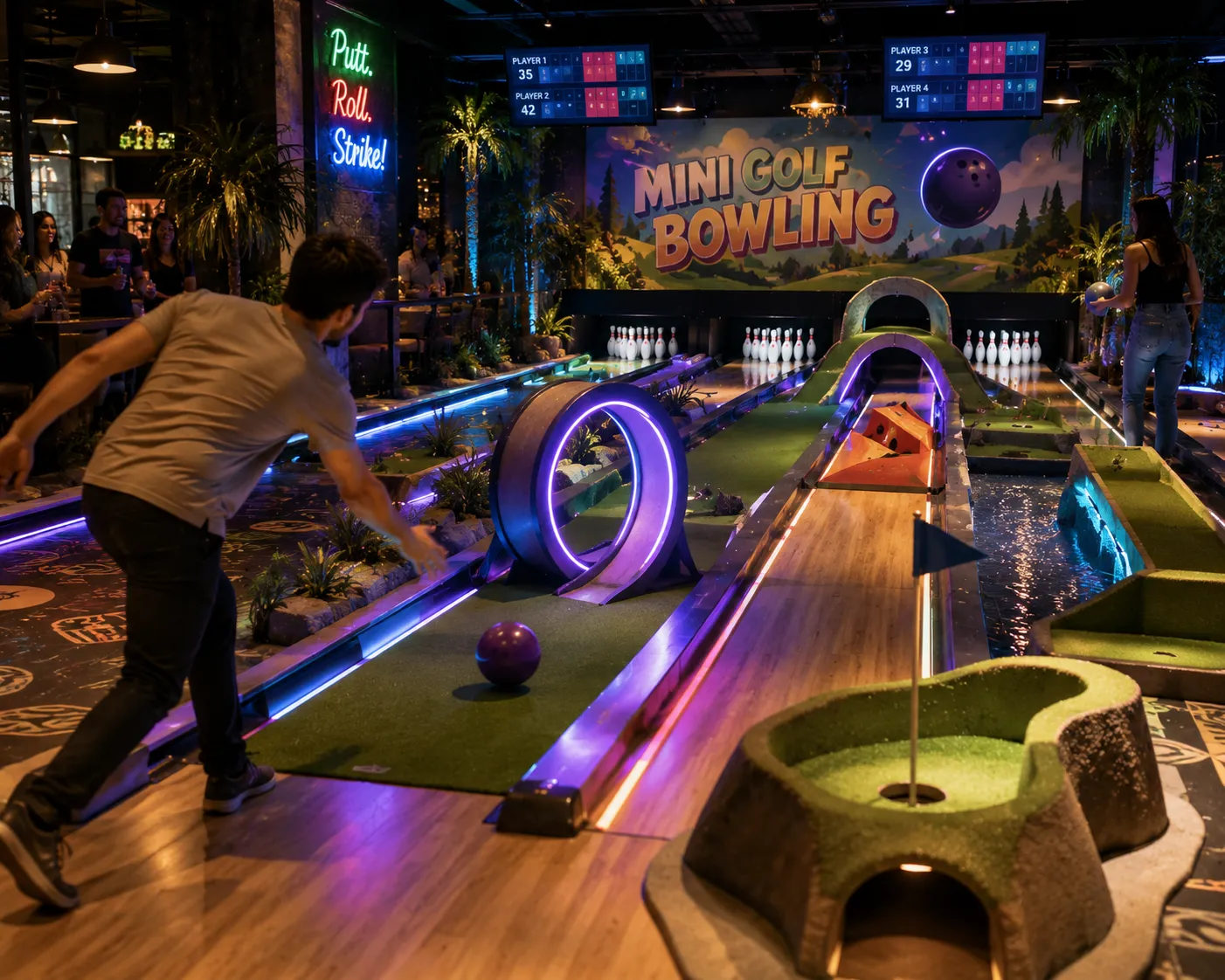
Traditional bowling has changed very little in decades, leaving many bowling centers struggling to attract younger audiences looking for more interactive experiences. Mini Golf Bowling reinvents the sport by replacing straight lanes with imaginative obstacle courses inspired by miniature golf, complete with ramps, loops, tunnels, moving obstacles, water features, and creative pin layouts. Every lane becomes its own unique challenge instead of simply rolling straight toward ten pins. As experiential entertainment continues replacing passive recreation, consumers increasingly seek activities that are as fun to watch as they are to play. Imagine spending an evening navigating bowling balls through giant loop-de-loops, bouncing off moving platforms, and banking shots around obstacles before finally knocking down creatively arranged pins.
Description
No additional description provided.
The Pitch
The weakness is that traditional bowling asks casual players to repeat the same motion for two hours. By turning each lane into a small physical puzzle, the activity becomes less about skill mastery and more about shared reaction. Bad players can still create memorable moments. Good players still have something to solve. That is a rare entertainment format.
The most interesting business insight is that the lane becomes content. A normal bowling alley is visually static; the tenth frame looks like the first. But an obstacle-based lane creates anticipation before the ball is even rolled. People watch because they want to see what happens. The business benefits from the same behavioral loop that makes escape rooms, arcade bars, and social darts work: the game is enjoyable for the participant, but also legible and funny to everyone nearby. That matters because modern group entertainment is often chosen by the person planning the outing, not the most serious player.
It also changes the economics of novelty. Bowling centers have historically depended on food, alcohol, leagues, and location because the core game does not refresh itself. In this model, the physical course can become the reason to return. New layouts, seasonal obstacles, local themes, or competitive “impossible hole” designs give customers a new story without changing the underlying habit: show up, play rounds, laugh, eat, drink, compare scores. The business does not need to teach people a new occasion; it makes an old occasion feel new again.
There is a deeper cultural fit here too. Many people now want social activities that produce a memory, not just a result. A perfect bowling score is impressive but rare and mostly private; a ball ricocheting through a ridiculous contraption before knocking down one stubborn pin is instantly communal. The appeal is not precision, but suspense. That makes the format unusually friendly to dates, families, work groups, and mixed-skill friend groups—settings where the best game is often the one that keeps everyone emotionally included.
If this worked, it would be because it understands that the future of location-based entertainment is not simply better games. It is more theatrical games: activities where the room itself helps create the fun.