Member-Owned Data Cooperatives for AI Insights
Consumers generate enormous amounts of valuable data through shopping, banking, healthcare, travel, and online activity, yet nearly all of its value is captured by large technology companies. Individuals receive free products while corporations build trillion-dollar businesses using collectively generated information. This company enables people to pool their data into member-owned cooperatives that train private AI models. Companies pay to access insights from these models without ever owning the underlying data, and cooperative members share in the revenue generated. Growing consumer awareness around data ownership, stronger privacy regulations, and advances in privacy-preserving AI make this possible today. Imagine one million diabetes patients collectively owning the world’s smartest diabetes AI and earning recurring income every time pharmaceutical companies use it for research.
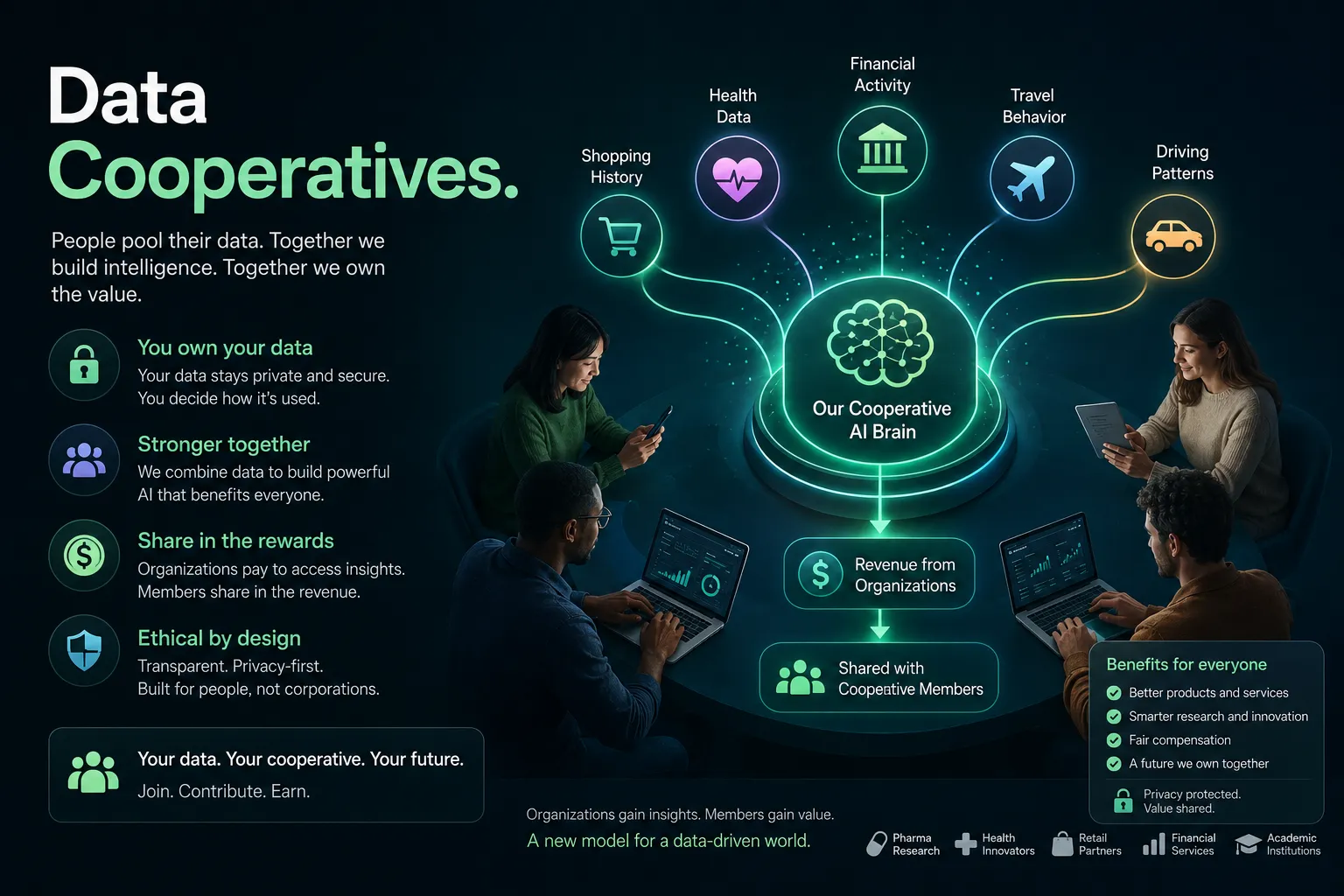
Description
No additional description provided.
The Pitch
Turn data from an exhaust trail into an owned asset class. Today, a person’s purchase history, health records, location patterns, and financial behavior are valuable mainly after they have been aggregated by someone else. The individual sees only the utility of the app; the aggregator captures the compounding value of the pattern. A cooperative model changes the unit of ownership from the platform to the population that makes the model intelligent in the first place.
The deeper opportunity is that many of the most valuable datasets are not merely large; they are socially clustered. Patients with the same condition, gig workers on the same platforms, parents navigating the same education systems, small merchants using the same payment tools—these groups produce data whose value increases when combined with others like them. A single person’s data is rarely worth much. A trusted pool of highly specific, continuously updated, permissioned data can become the best representation of a real-world market or condition. That is a much harder asset to replicate than a generic consumer panel.
The business also benefits from a structural tension inside companies that want data. They increasingly need granular, real-world intelligence, but owning sensitive raw data is becoming more legally risky, reputationally dangerous, and operationally burdensome. A model that lets companies ask questions of a dataset without taking possession of it aligns with where the world is moving: more demand for insight, less tolerance for surveillance. The cooperative is not just selling information; it is selling a cleaner relationship between institutions and the people they study.
What makes the model especially interesting is that trust can become a moat. People are unlikely to hand intimate data to a random analytics vendor, but they may contribute it to an entity whose rules, economics, and governance are visibly aligned with them. If the cooperative becomes known as the place where a particular group’s data is represented fairly, participation itself improves the product. Better participation creates better models, which creates more income, which gives members a reason to keep contributing and invite others.
This could become one of the few ways for ordinary people to participate economically in the AI era without needing to build AI companies themselves. If models are trained on human behavior, then ownership of the underlying behavioral commons may matter as much as ownership of the algorithms. The most interesting version of this company would not feel like another privacy tool. It would feel like a new institution for collective bargaining in a world where data is labor, capital, and identity all at once.