Marketplace for Verified Unmet Consumer Demand
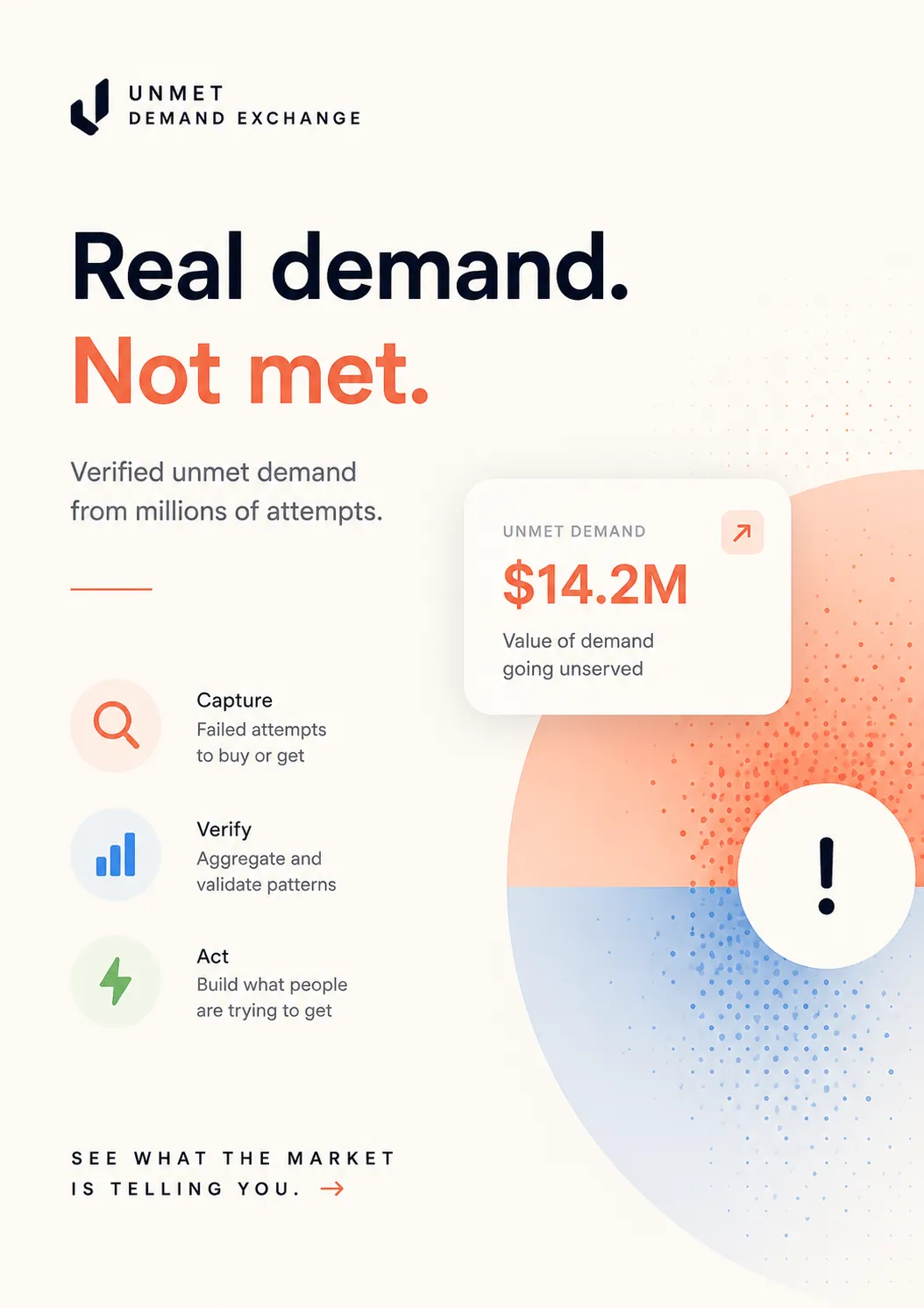
Companies spend billions measuring what people buy while almost no infrastructure measures what people tried to buy but couldn't. Unmet Demand Exchange would let browsers, shopping agents, search engines, and consumers anonymously register failed purchasing attempts: products that didn't exist, combinations nobody offered, prices nobody would meet, or services unavailable in a location. Similar failures aggregate into verified pools of unmet demand that businesses can buy access to or compete to fulfill. Instead of entrepreneurs guessing what people want from surveys and search trends, they could see $14 million of authenticated demand sitting unserved and build directly against it.
Description
No additional description provided.
The Pitch
The most valuable market signal is not preference, but friction. A person who searches, configures, compares, adds constraints, and still fails to buy has revealed something stronger than interest: they had enough intent to reach for their wallet and were stopped by the market. Today that signal disappears into private logs, abandoned carts, customer support transcripts, and browser histories. A business that could capture it across many endpoints would turn market absence into a measurable asset.
The compelling part is that unmet demand is currently discovered backwards. Companies infer it from sales, which only show what existing supply made possible, or from surveys, which ask people to imagine behavior detached from the moment of need. Failed purchasing attempts are different because they are time-stamped, constraint-rich, and naturally priced. “I wanted this exact product under this budget in this place by this date” is not a vague consumer preference; it is a partial purchase order for something the economy has not yet learned to provide.
This creates a strange inversion of competition. Businesses normally fight over visible demand once it has already formed around a product category. Here, the demand becomes visible before the category fully exists. That could reward companies that are good at listening and assembling supply quickly, not just those that are good at advertising. It would also expose opportunities too small or oddly shaped to appear in traditional market research, but large enough in aggregate to support profitable niches.
The exchange would become more useful as it became more neutral. No single retailer or platform can see the whole pattern, because each only observes failures inside its own walls. But unmet demand is often fragmented across many places: one shopper fails on Amazon, another on Google, another in a travel site, another in a local services marketplace. Pooling those failures anonymously could reveal that what looks like isolated disappointment is actually a market waiting for coordination.
The deepest business insight is that capitalism has excellent instruments for clearing existing markets and poor instruments for discovering missing ones. A shared ledger of failed intent would make absence legible. It would not merely help companies sell more of what they already make; it would help them see where the current map of supply is wrong. In a world where production can be spun up faster than ever, the scarce input is increasingly knowing what should exist next.