Marketplace for Trading Asset Lockup Risk
Enormous amounts of wealth spend years trapped behind lockups, vesting schedules, withdrawal windows and settlement periods. Today escaping usually means selling the asset itself. Waiting Exchange would separate the asset from the inconvenience of waiting. An employee could keep the upside in $500,000 of private-company stock while paying an investor to absorb part of the economic cost of its two-year lockup. Once waiting can be separated from ownership, illiquidity becomes an asset someone else can buy.
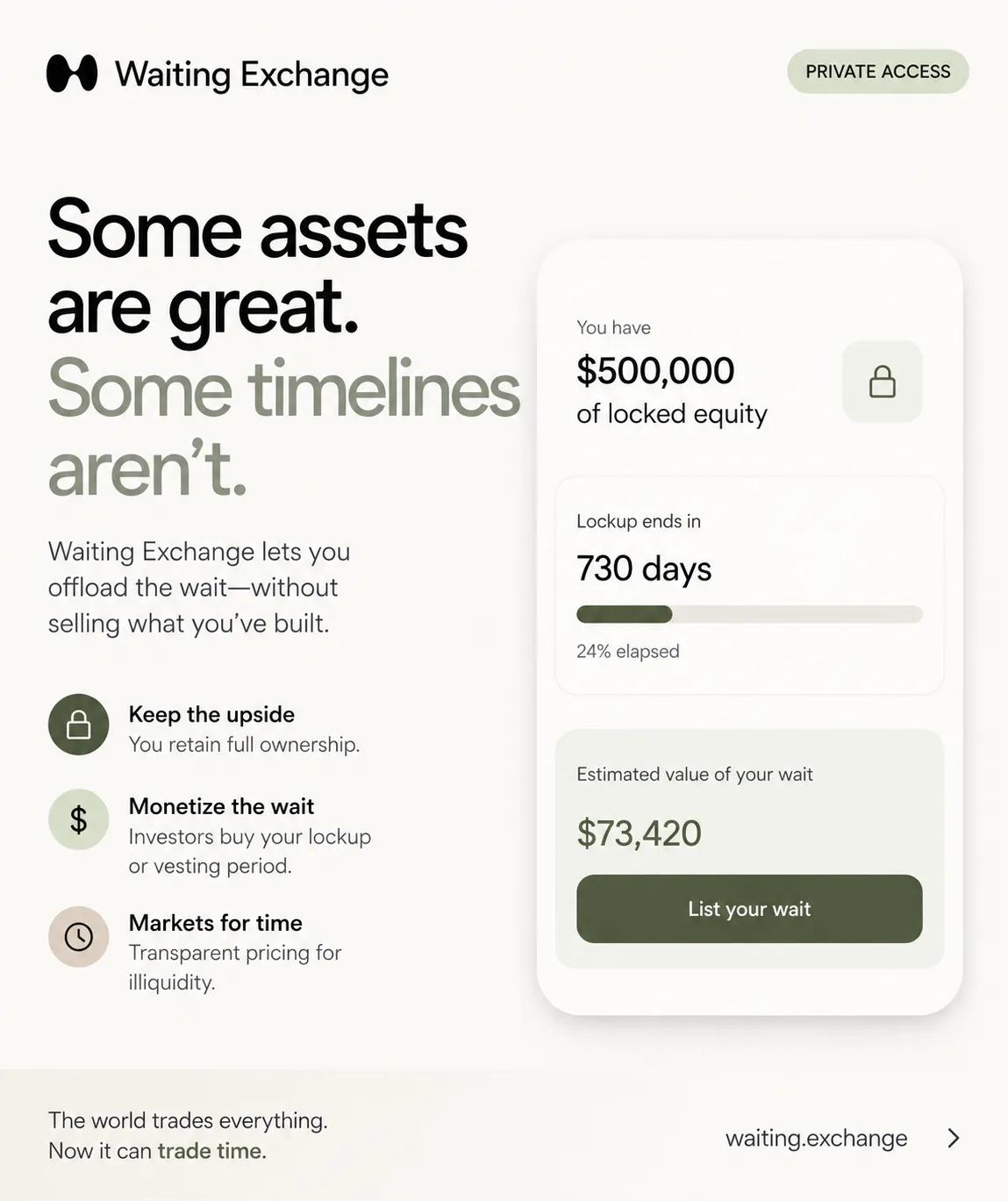
Description
No additional description provided.
The Pitch
Would recognize that time is often mispriced inside private wealth. Investors obsess over valuation, volatility, and access, but the inability to act for two years is usually treated as an unfortunate footnote rather than a separable economic burden. If a market could isolate that burden, it would reveal a hidden price for patience across private stock, funds, structured products, and other assets where the owner is rich on paper but constrained in practice.
The powerful insight is that many asset owners do not want liquidity because they hate the asset; they want liquidity because their life has a different timeline than the instrument. An employee may believe deeply in the company but still need cash to buy a home, diversify, pay taxes, or reduce anxiety. Today those needs are bundled into a binary choice: hold everything or sell exposure. A waiting market would create a middle state where the owner keeps the thing they are most attached to—the upside—while transferring the thing they resent most—the delay.
The other side of the market is equally interesting because waiting is not equally painful to everyone. A pension fund, family office, credit fund, or long-duration investor may be structurally better suited to absorb illiquidity than an individual employee or founder. That difference creates the basis for trade. The business works if it can match impatient capital with patient capital without pretending the underlying asset has become liquid. It is not eliminating illiquidity; it is assigning it to the party that can bear it most cheaply.
This could also make opaque private markets more legible. Lockups currently hide inside discounts, side letters, tender offers, and informal financing arrangements. A dedicated exchange would produce a visible market price for waiting, which would become a useful signal in its own right. The cost of a two-year lockup in a hot AI company would say something different from the cost of waiting on a late-stage company with uncertain exit prospects. Over time, “the price of waiting” could become a parallel data layer for private markets.
The most interesting part is that the business would not need to convince people that illiquidity is bad. Everyone already knows that. It would only need to prove that illiquidity is not a permanent property of an asset, but a tradeable exposure. Once that mental shift happens, waiting stops being dead weight and starts looking like a financial product hiding in plain sight.