Marketplace for Shared Local Energy Resources
Sunlight-as-Infrastructure Marketplace A marketplace that helps nearby farms, greenhouses, warehouses, data centers, and municipalities exchange underused resources such as sunlight, shade, waste heat, water, and electricity. A greenhouse could use solar power during the day, absorb waste heat from a nearby facility at night, and shift growing schedules around energy prices. The platform would identify facilities whose needs complement one another, model the economics, and help coordinate the contracts and infrastructure. Instead of every site paying to solve the same energy and climate problems independently, local businesses could operate as a shared environmental network.
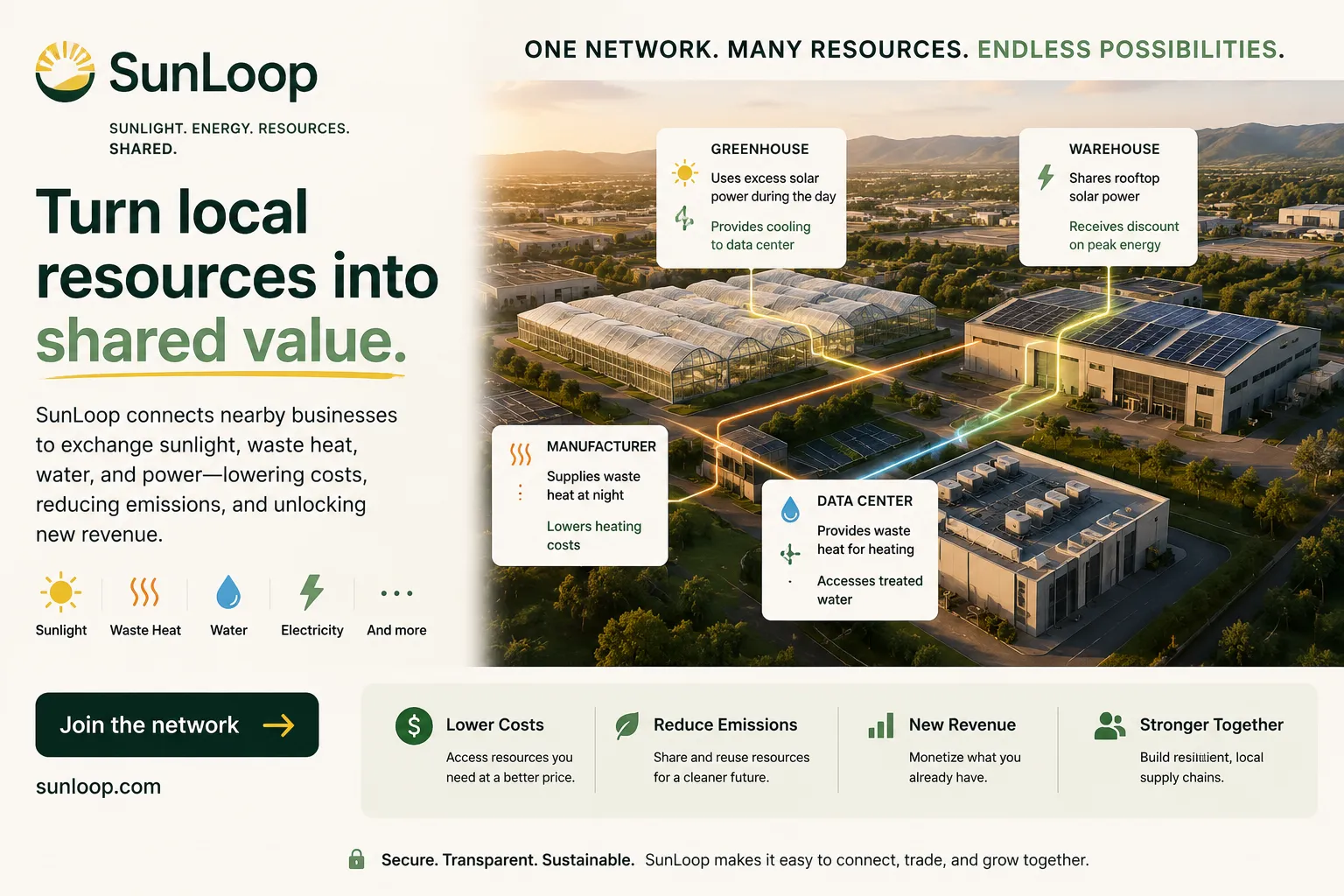
Description
No additional description provided.
The Pitch
The cheapest clean resource is often not a new asset, but a nearby mismatch. A data center trying to dump heat and a greenhouse paying to create heat may sit close enough to help each other, yet exist in completely separate economic worlds. The business is interesting because it turns physical proximity into a balance sheet advantage: the same waste stream that is a liability for one site becomes input cost reduction for another.
The deeper shift is that many local environmental resources are time-sensitive, not just location-sensitive. Sunlight, shade, heat, cooling demand, irrigation needs, and electricity prices all fluctuate by hour and season. Most facilities currently optimize inside their own fence line, which forces them to overbuild backup systems and tolerate waste. A marketplace that understands timing could make neighboring sites behave less like isolated buildings and more like a small operating system for a district.
This is also a rare kind of marketplace where supply and demand are both already spending money. The warehouse is already paying for cooling, the greenhouse is already paying for heating and power, the municipality is already managing water and land, and the data center is already dealing with heat and grid constraints. The opportunity is not to invent a new behavior, but to reveal trades that existing accounting systems make invisible. If the platform can prove that two parties can lower costs without adding operational risk, the transaction has a practical reason to happen.
The most defensible part of the business would not be the directory of nearby facilities; it would be the accumulated understanding of local resource compatibility. Every successful exchange teaches the system which pairings work, which fail, what distance kills the economics, what contract structures reduce anxiety, and what infrastructure costs are tolerable. Over time, it becomes less like a marketplace for commodities and more like a map of hidden industrial metabolism.
The broader appeal is that climate adaptation is becoming a local coordination problem. Electrification, water stress, grid congestion, food resilience, and heat management are all pressing on the same places at once. Cities and businesses will increasingly need ways to share capacity rather than endlessly duplicate it. A company that makes those exchanges legible could become part of the quiet plumbing of a more resource-efficient economy.