Marketplace for Shared Business Operating Capacity
Businesses with fixed delivery capacity lose money in two directions: too much demand overwhelms them, while too little demand leaves expensive capacity unused. Capacity Exchange would let companies buy, sell or reserve specialized operating capacity across a verified network, turning implementation teams, concierge operations, claims reviewers, underwriting capacity or even physical assets into flex capacity. Why now: companies increasingly share standardized workflows through APIs, while AI makes it easier to route work, enforce quality and package fragmented capacity as one service. Example: an insurtech hits a seasonal implementation spike and automatically buys 2,000 hours of certified deployment capacity from the network rather than hiring a team it will not need six months later.
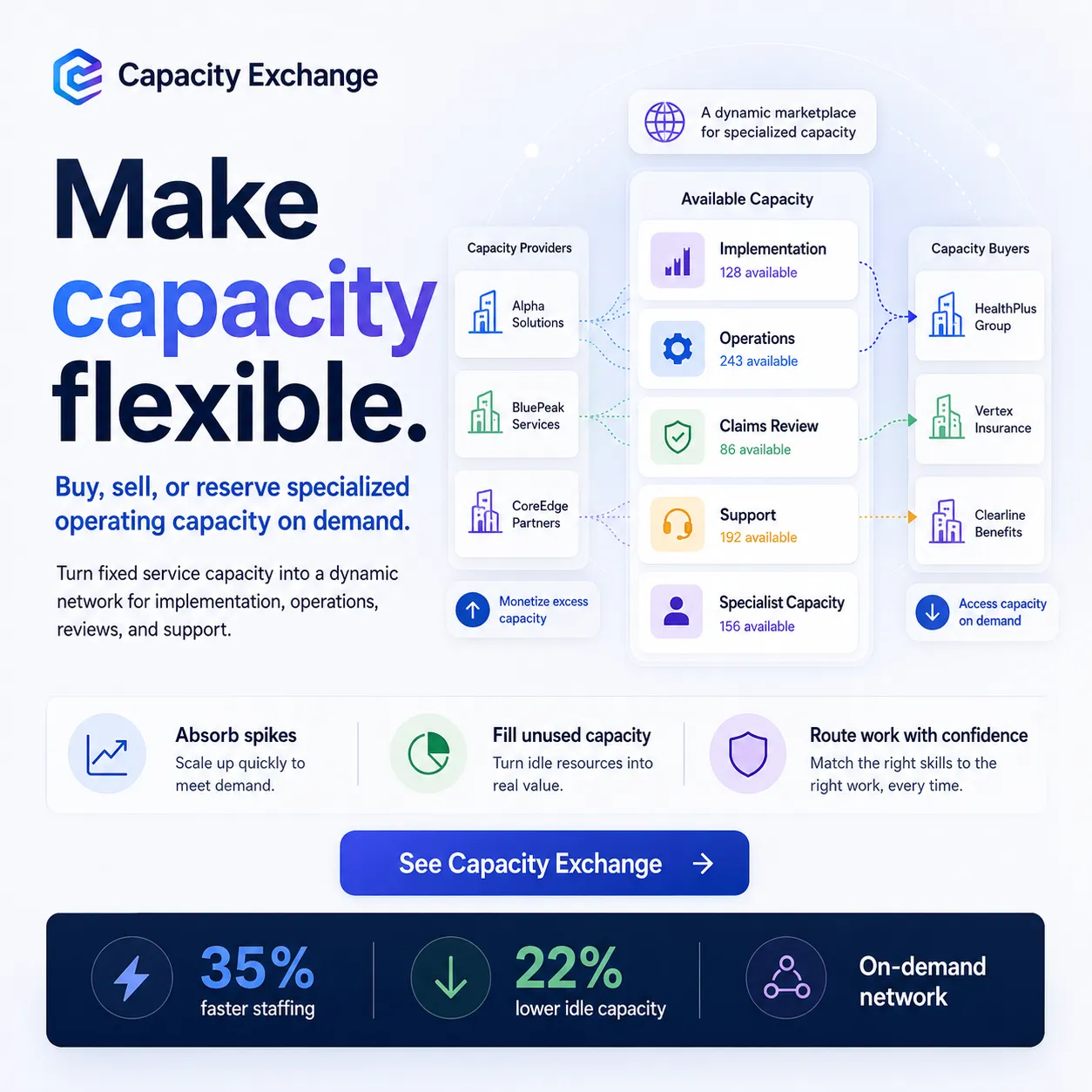
Description
No additional description provided.
The Pitch
Capacity is one of the last large balance-sheet problems still managed with phone calls, hiring plans, and heroic internal scrambling. Software made demand more fluid, but the organizations fulfilling that demand are still built around annual headcount plans and static utilization targets. A market that turns excess operating ability into something discoverable and reservable would make capacity behave less like a fixed cost and more like working capital.
The hidden supply is larger than it first appears. Many companies have teams that are underused not because they are unskilled, but because their demand arrives in waves: onboarding specialists after a sales push, reviewers after a regulatory change, implementation teams after quarter-end buying, field service crews between projects. Today, that idle expertise usually expires unused. The interesting arbitrage is not generic labor; it is already-trained, context-aware capacity trapped inside organizations that have no easy way to sell it.
The most valuable exchange would not be matching bodies to tasks, but translating trust. Companies do not outsource sensitive operating work because they cannot easily verify whether an outside team follows the right process, meets compliance expectations, or can be held accountable. If the network can certify capabilities, log performance, standardize handoffs, and make quality auditable, it creates a new category between hiring and outsourcing: borrowed operational muscle that feels institutionally safe.
This also changes how companies design themselves. If reliable overflow capacity exists, a business no longer has to staff for its worst week of the year or turn away demand it worked hard to create. Smaller firms could take on larger customers without pretending they already have enterprise-scale delivery teams. Larger firms could protect margins by avoiding the quiet tax of permanent overcapacity. The exchange becomes more valuable as more participants realize that resilience does not have to mean owning every resource.
The most interesting version of this company would become a market map of how work actually moves across an industry. It would see where bottlenecks form before any individual company does, which skills are scarce, which processes are becoming standardized, and which providers reliably absorb complexity. That intelligence is hard to build from the outside. A business that starts by renting capacity could end up defining the operating layer beneath entire sectors.