Marketplace for Satellite Power Trading
As satellites begin wirelessly transferring electricity to one another, they’ll need more than the hardware to make it work. The Orbital Power Exchange would be the marketplace where satellites automatically find available energy, compare prices, reserve transmission windows, verify who they’re dealing with, and pay for power in real time. A spacecraft running low could request energy, receive bids from nearby satellites with excess capacity, and complete the entire transaction without human involvement. Companies are starting to build the technology that can beam power through space, but no one appears to be building the neutral exchange that turns orbital energy into something satellites can actually buy and sell. If space becomes crowded with autonomous machines, energy may become one of its first true commodities.
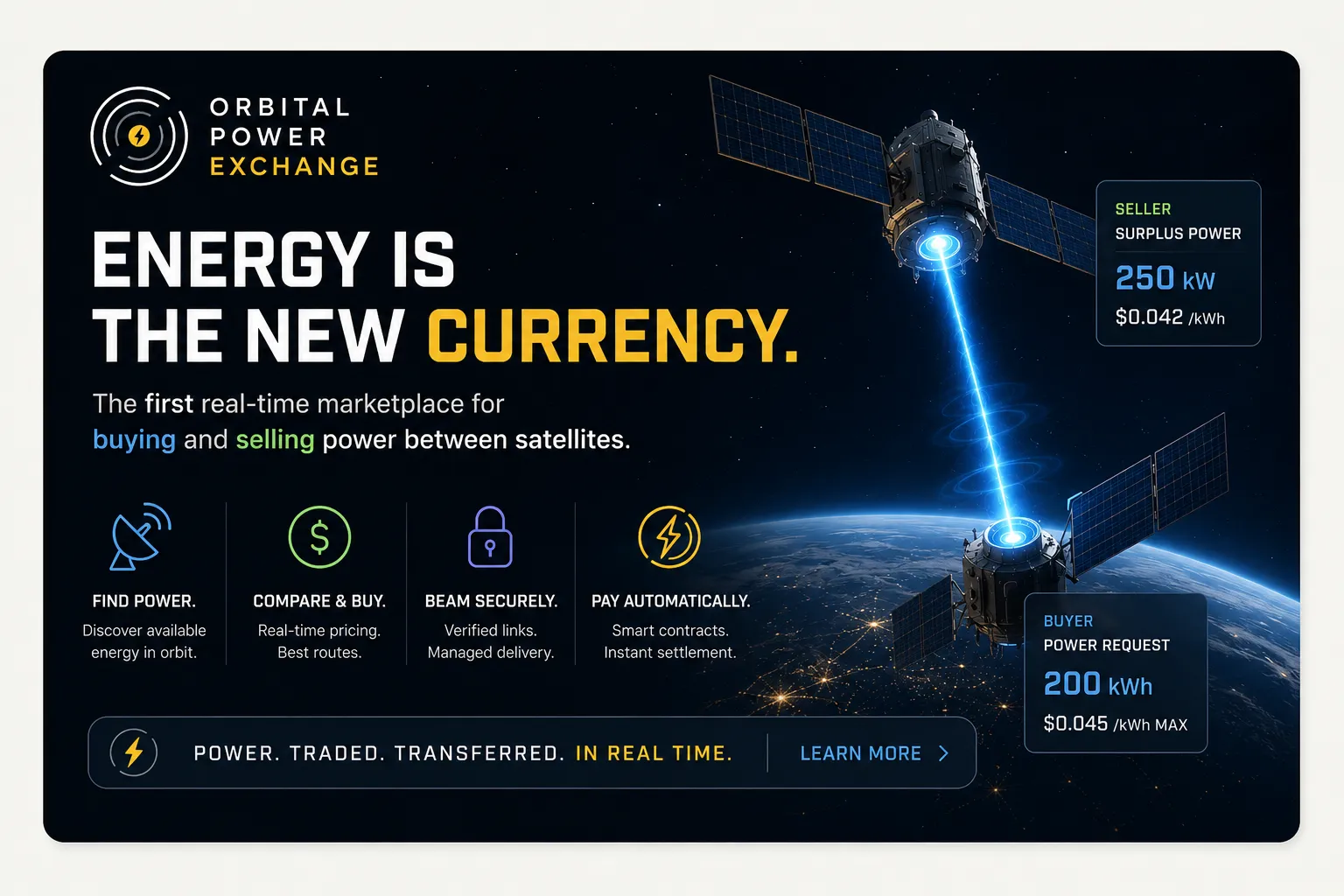
Description
No additional description provided.
The Pitch
Power in orbit is not just another input; it is the constraint that silently governs what spacecraft can do, when they can do it, and how long they remain useful. Satellites already make tradeoffs around sunlight, eclipse periods, battery degradation, peak loads, maneuver timing, and mission priority. If wireless power transfer becomes technically viable, the most valuable layer may not be the beam itself, but the system that lets energy move from where it is temporarily abundant to where it is temporarily more valuable.
The important shift is that orbital power would be highly local and time-sensitive. A kilowatt available in the wrong orbit, at the wrong angle, or ten minutes too late is not the same product as a kilowatt delivered during a critical maneuver or communication window. That makes space energy less like a simple commodity and more like a market for perishable logistics capacity. The exchange would exist because the hard problem is matching physics, trust, timing, and payment fast enough for machines to act on it.
It could also change the economics of spacecraft design. Today, satellites are built with large safety margins because running out of power is mission-ending. If reliable external energy were available, operators could design around access rather than self-sufficiency: smaller batteries, different duty cycles, longer operating lives, more aggressive compute loads, and new mission profiles that would otherwise be power-limited. The exchange captures value not only from emergency refueling, but from making every connected spacecraft less isolated.
Neutrality matters because no satellite operator will want a rival to become the default gatekeeper of orbital energy. The more strategic power becomes, the more the market needs a trusted coordination layer that can verify counterparties, enforce rules, and settle transactions without owning every generator or every receiver. In terrestrial energy, exchanges emerged because bilateral deals could not scale across millions of changing supply and demand events. Orbit may reach the same point much faster because the participants are already software-controlled.
The deepest business truth is that autonomy creates markets where humans used to make schedules. As satellites become agents that sense conditions, value options, and transact in real time, they will need machine-native infrastructure for scarce resources. Power is a natural place for that to begin: measurable, transferable, mission-critical, and unevenly distributed. If orbital machines start buying anything from one another, electricity is a strong candidate to become the first thing they trade continuously.