Marketplace for Reusable Startup Code Assets
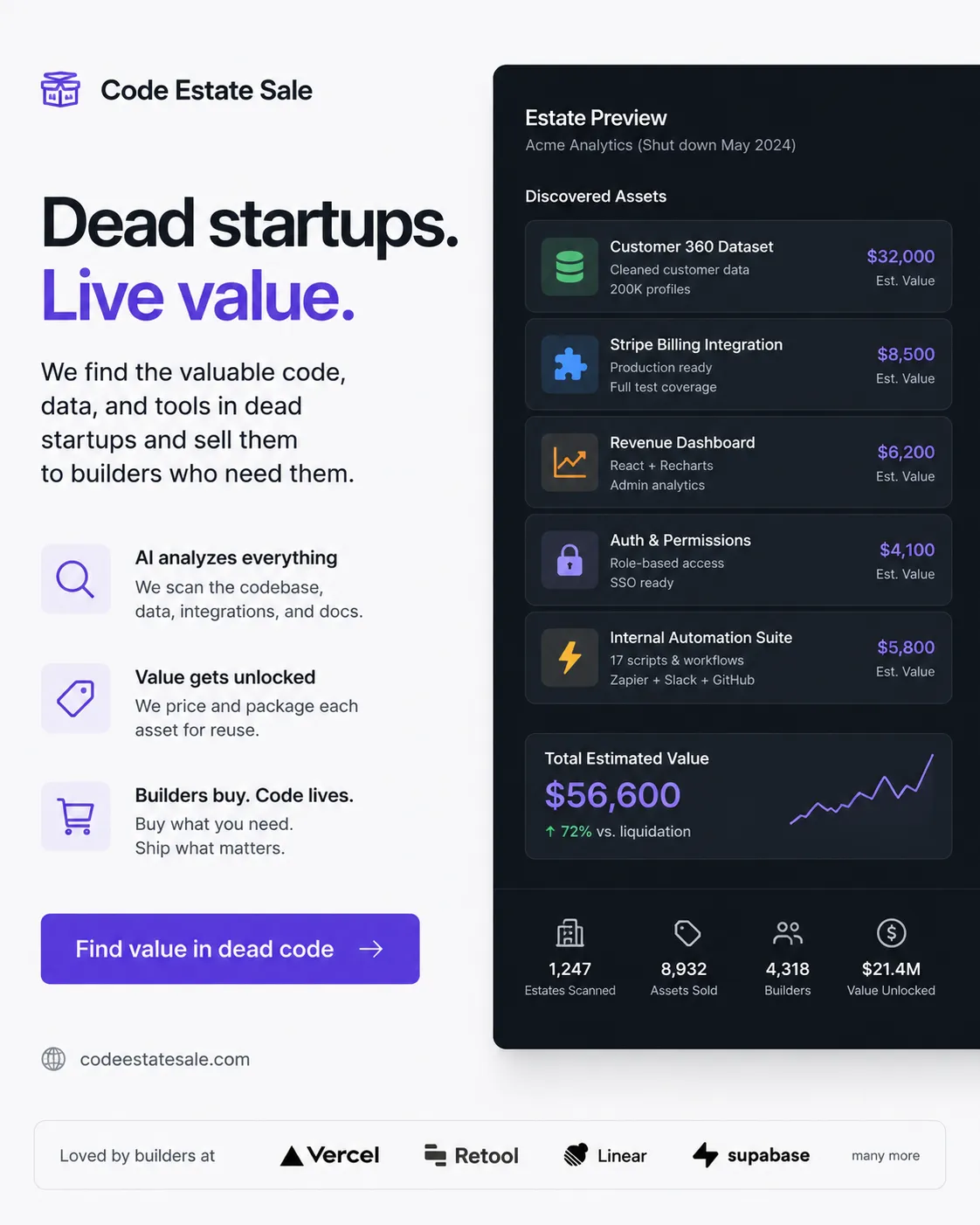
When a startup dies, most of what it built dies with it. Years of integrations, internal tools, datasets, workflows, APIs, and infrastructure get abandoned because nobody has time to figure out what is reusable. AI changes that. Code Estate Sale connects to a company's codebase, inventories its transferable digital assets, estimates what each is worth, packages them for reuse, and auctions them individually. A failed $5M startup might contain a $30K dataset, a $10K billing system, and a dozen integrations someone else would happily buy. We have marketplaces for dead companies. We need an estate sale for everything they leave behind.
Description
No additional description provided.
The Pitch
Software companies are increasingly asset-rich but liquidation-poor. The visible company may fail, but beneath it sits a pile of specialized work that has already survived the most expensive stage: getting built, debugged, and used in anger. Today that work is treated as inseparable from the failed entity, so the market prices it near zero. The interesting opportunity is not “selling code,” but making software legible enough that it can be unbundled from the company that created it.
The asymmetry is unusually strong because the seller has almost no remaining ability to extract value, while the buyer may avoid weeks or months of dull, risky engineering. Nobody wants to buy an abandoned startup’s entire codebase. But many teams would buy one well-documented Salesforce integration, one cleaned dataset, one niche scraper, one migration script, or one production-tested Terraform module if they could understand it quickly and trust its boundaries. The business works if it turns dead complexity into small, comprehensible objects.
The deeper insight is that the value of these assets is not only technical; it is historical. A failed startup often encodes a map of some market: which APIs are painful, which vendors matter, what edge cases exist, what data is hard to normalize, which workflows real customers demanded. That accumulated scar tissue can be more valuable than polished software, because it compresses mistakes a new entrant has not yet made. The estate sale is really selling time and negative knowledge.
This could also become a new layer in the startup failure ecosystem. Shutdowns are chaotic, emotional, and administratively messy, so any buyer of remnants needs speed and finality. Founders, creditors, acquihirers, accelerators, and investors all have incentives to recover some value without running a bespoke salvage process. If the inventorying and packaging are credible, the company becomes the default place where digital remains go before they are forgotten.
What makes the idea especially durable is that AI does not merely lower operating cost; it changes what is economically worth examining. Human diligence could never justify combing through thousands of small dead repositories for $5,000 or $20,000 assets. Automated analysis makes the long tail searchable, describable, and tradable. That is the business: not a marketplace for startups, but a market-maker for software fragments that were previously too illegible to have a price.