Marketplace for Paid AI Agent Access
AI agents may eventually be able to browse almost any business, but the most valuable capabilities—holding scarce inventory, bidding, getting early access, writing to accounts, or guaranteeing checkout—will still require trust and commercial terms. Build a marketplace where businesses turn those privileges into machine-readable products that agents can discover, qualify for, and purchase automatically. An airline could charge for temporary fare holds, a retailer could sell early inventory access to approved agents, and a ticket marketplace could offer bidding rights only to agents that meet certain trust or financial requirements. This becomes possible now because agent identity and interoperability are standardizing while businesses are beginning to separate basic access from higher-value actions. Imagine your travel agent automatically paying $2 for a 20-minute fare hold because it calculates that the option value is worth more than the fee.
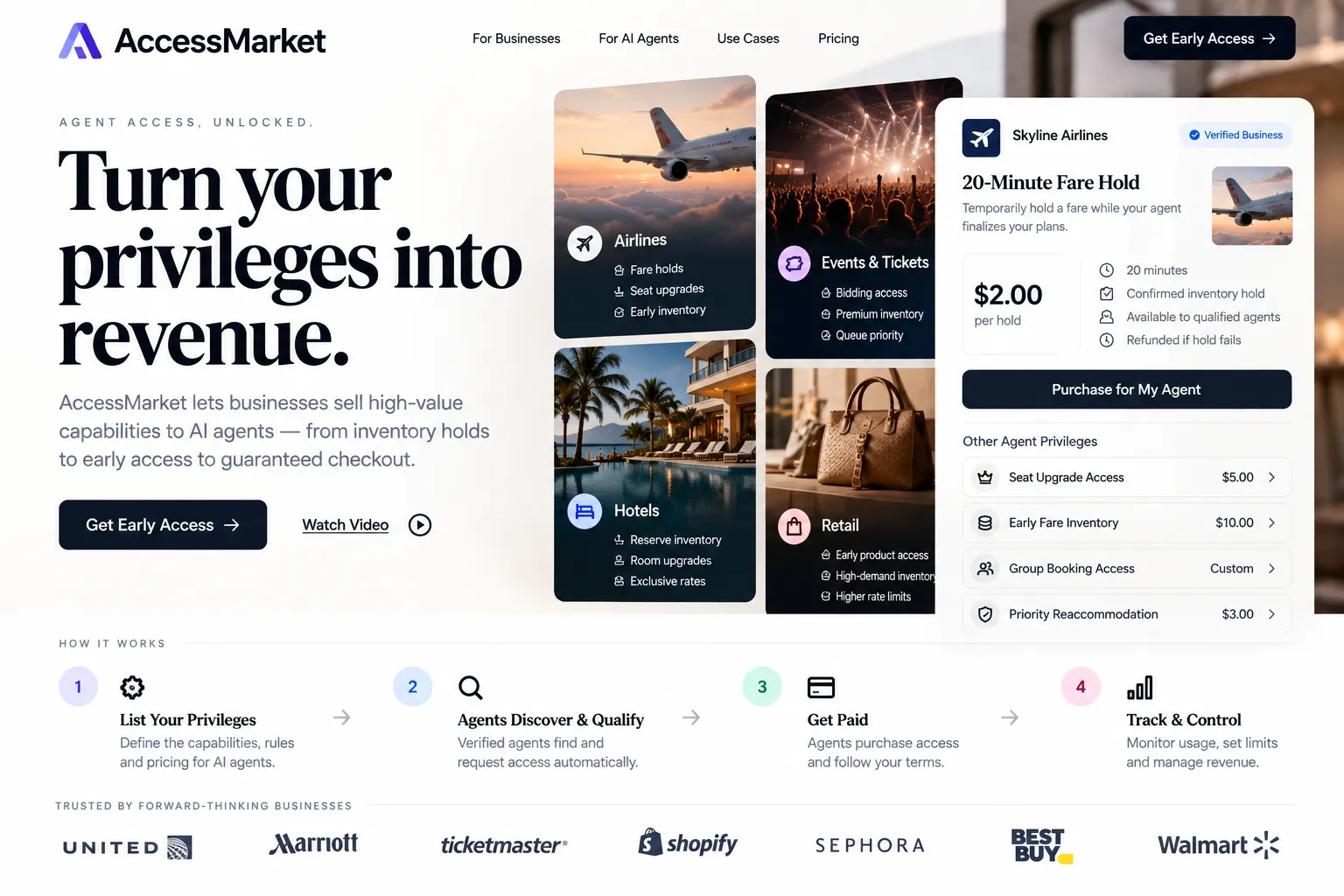
Description
No additional description provided.
The Pitch
The compelling business is not “agents shopping online.” It is the creation of a new commercial layer between ordinary web access and full business integration. Today, a company either exposes a public interface to everyone or negotiates bespoke partner access with a few large counterparties. There is very little in between. But agents will create demand for thousands of small, situational permissions that are too valuable to give away and too granular to negotiate one by one.
The non-obvious shift is that many digital actions are really options, not transactions. A fare hold, a queue position, a bid right, an early look at inventory, or a checkout guarantee all have economic value before the final purchase happens. Humans often fail to price these moments because they are intermittent and hard to evaluate manually. Agents, by contrast, can calculate expected value in real time. That turns previously invisible micro-privileges into purchasable goods.
The marketplace works because businesses will not want every agent to have the same powers. The difference between “can read prices” and “can reserve inventory” is enormous. A trusted agent with payment credentials, fraud history, identity, refund rules, and liability terms is more like a commercial counterparty than a browser session. Once that trust can be expressed in a reusable format, businesses can sell access without building a custom partnership program for each agent developer.
It is also compelling because the supply side already has the asset: constrained access. Airlines, retailers, marketplaces, hotels, clinics, logistics networks, and event platforms all ration valuable actions today, but they usually do it crudely through loyalty tiers, manual approvals, bot defenses, or private APIs. A market for agent privileges would let them price scarcity directly instead of hiding it inside opaque rules or giving it away to whoever reverse-engineers the system best.
If agents become the interface through which people and companies make decisions, then the most important question for many merchants will be not “Can an agent see us?” but “What is the agent allowed to do on our behalf, and under what terms?” The company that standardizes that answer could sit at a surprisingly fundamental point in the machine economy: where intent becomes permission, and permission becomes revenue.