Marketplace for Licensing Organizational AI Expertise
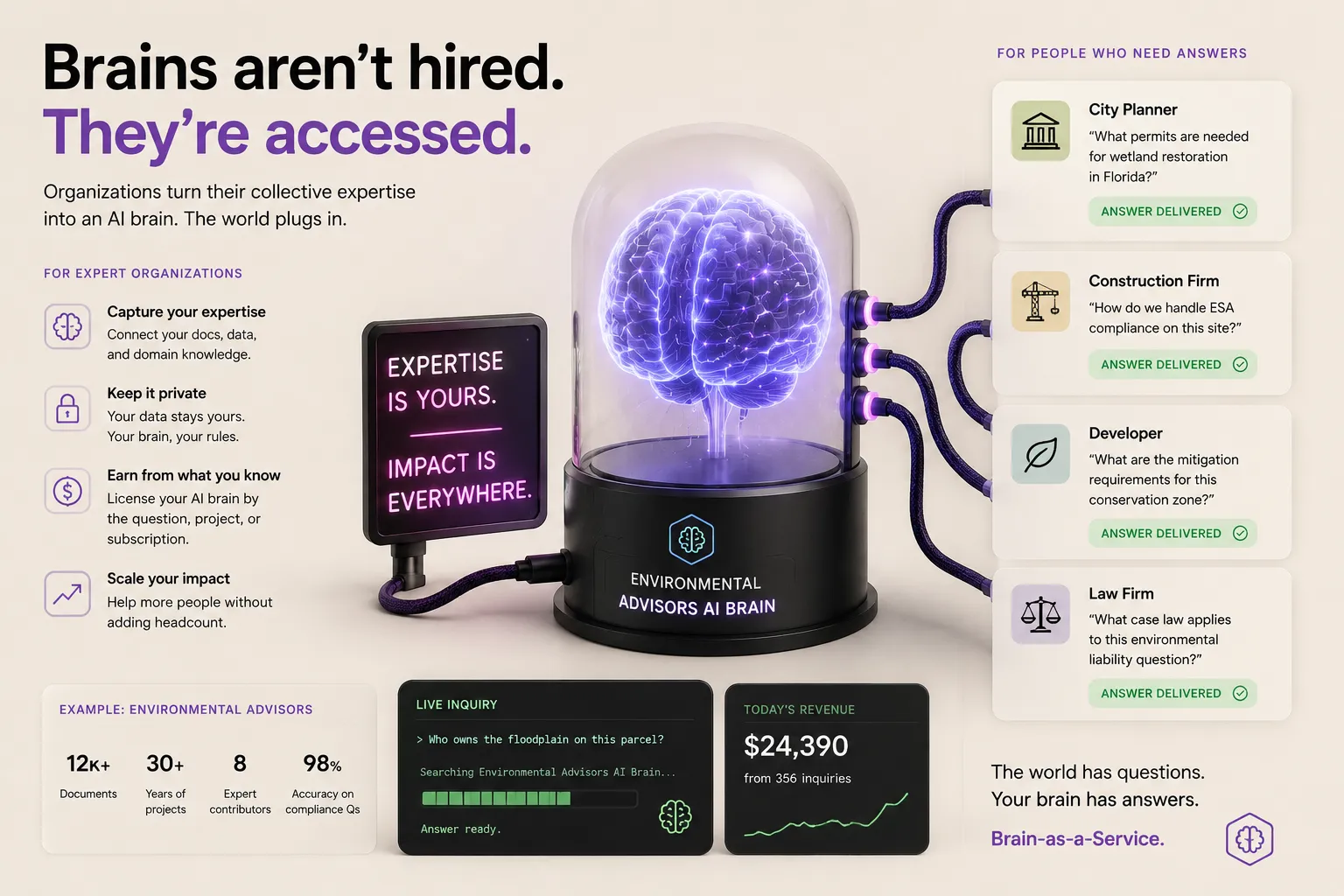
The world’s most valuable expertise is trapped inside organizations that have no practical way to monetize it beyond consulting or hiring. Law firms, hospitals, engineering companies, and investment firms collectively possess specialized intelligence that outsiders would gladly pay to access without needing the underlying people. This startup creates a marketplace where organizations license their private AI brains instead of their employees’ time. Customers pay per question, project, or subscription while the organization earns recurring revenue from expertise it has already accumulated. Advances in fine-tuned open models and secure private inference now make it possible to commercialize organizational intelligence without exposing confidential data. Imagine the country’s leading environmental consulting firm generating recurring revenue by allowing developers to query its AI for permitting, compliance, and regulatory guidance 24 hours a day.
Description
No additional description provided.
The Pitch
This turns expertise from a service into an asset. Most expert organizations still sell knowledge in the most perishable form possible: hours on a calendar. That creates an artificial ceiling on revenue, because the best people cannot be in two places at once. But much of what clients actually need is not original genius every time; it is structured judgment, accumulated precedent, pattern recognition, and institutional memory. If that can be packaged safely, the economics of expertise change.
The most interesting customers would not be trying to replace elite professionals. They would be buying access to the layer below them: the repeatable questions, first-pass analysis, edge-case reminders, and domain-specific interpretation that normally require an expensive human gatekeeper. In many fields, a wrong general answer is worse than no answer, which is why generic AI tools are insufficient. The value is not that the model is intelligent in the abstract; it is that it has been shaped by a trusted institution with a reputation to protect.
For the organizations supplying these systems, the attraction is that the product gets stronger precisely because they are already doing their core work. Every memo, case, design review, diagnosis protocol, regulatory filing, and investment analysis can become part of a compounding knowledge base. Unlike a traditional software company, they do not need to invent a new body of content; they are sitting on one. The hidden business is the conversion of internal residue into external utility.
There is also a trust arbitrage here. People may hesitate to rely on an anonymous AI answer, but they already rely on named firms, hospitals, universities, and specialist consultancies. A model associated with a respected institution could carry the kind of authority that standalone software struggles to earn. In that sense, the brand is not a marketing wrapper; it is part of the product’s accuracy, accountability, and perceived safety.
If this category existed, it could create a new middle market for expertise. Today, the richest clients buy direct access to the best minds, while everyone else settles for generic information. Licensed institutional AI could make premium judgment available in smaller increments, at the exact moment of need. The result is not just cheaper advice; it is a new way for scarce knowledge to circulate without requiring scarce people to do all the circulating.