Marketplace for Human Movement Data Licensing
A marketplace where companies and workers can license real-world human movement data for training robots. Manufacturers could request recordings of specific tasks such as assembly, inspection, lifting, or tool handling, while workers could opt in, get paid, and retain clear rights over how their movement data is used. The platform would manage consent, anonymization, sensor capture, quality scoring, and royalties when the data helps improve commercial robot models. As physical labor becomes training data, a new market will be needed to decide who owns that data and who gets paid for it.
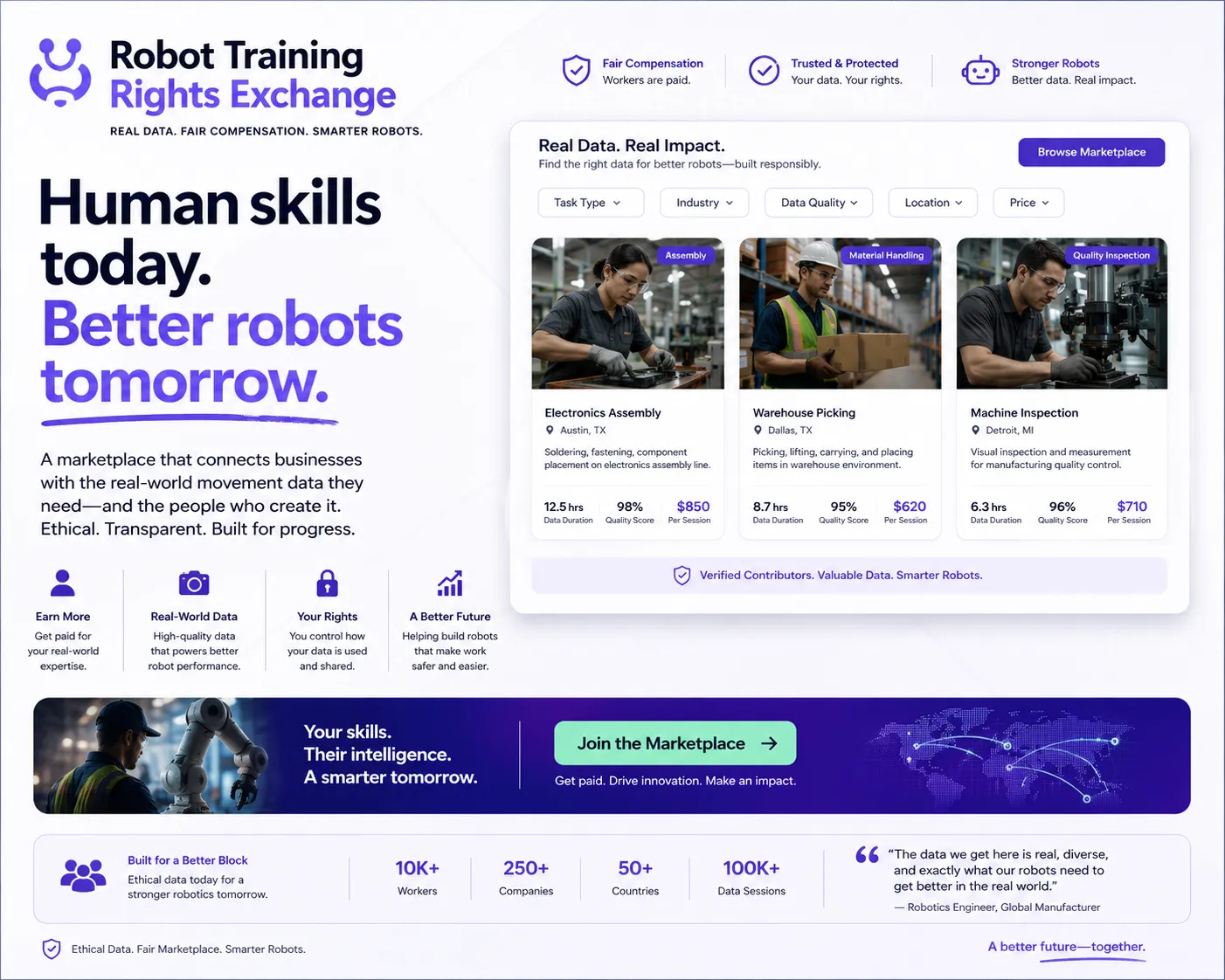
Description
No additional description provided.
The Pitch
The valuable asset is not video of work, but the tacit motion hidden inside skilled work: the wrist angle of someone who has packed fragile goods for ten years, the micro-adjustment a mechanic makes before a bolt strips, the way a warehouse worker stabilizes an awkward load without thinking. Robotics companies can buy cameras, sensors, and simulations, but they cannot easily buy the embodied judgment accumulated in millions of repetitive human actions. A market for movement data would turn that invisible know-how into an ownable input.
This business is compelling because robot training data will not be evenly distributed. The most useful movements are often trapped inside factories, warehouses, repair shops, hospitals, farms, and construction sites that were never designed to be observed by machines. A marketplace can solve the coordination problem: robot makers know what motions they need, but not where those motions happen; workers and employers generate the data constantly, but have no mechanism to package, price, or control it. The company that standardizes this exchange could become the default layer between physical AI developers and the real world they need to learn from.
There is also a labor story that is unusually durable. If robots are trained on human bodies, then the humans who supply that training data should not be treated as incidental exhaust. Clear licensing and compensation could make automation feel less like extraction and more like a new royalty-bearing use of skill. That matters because the best data will come from people and workplaces that trust the system enough to participate repeatedly, not from one-off scraped recordings or coerced capture.
The non-obvious advantage is that rights management may become as important as data collection. As robots move from demos into workplaces, manufacturers will need to prove where training data came from, what it was permitted to train, and whether it can be used in a commercial model. A trusted ledger of consent, provenance, and usage could be more defensible than any individual dataset, because it makes the data legally and commercially usable.
If the robotics industry grows, the bottleneck shifts from building bodies to teaching competence. Human movement is the curriculum. A company that makes that curriculum legible, licensable, and fair could sit at a strange but powerful intersection: part labor market, part data exchange, part rights society for the physical world.