Marketplace for Future Consumer Intent Reservations
Advertising markets sell today's attention even when the customer has no reason to care. Attention Reservations would let people sell access to specific future buying moments instead. Someone planning to replace a car next summer could reserve three opportunities for automakers to reach them once the search begins. A homeowner expecting to refinance could auction a small number of lender introductions when rates hit a threshold. The consumer controls the number of slots, timing and category, while advertisers compete for access. Intent is currently inferred from behavior after it appears. This would let consumers sell future intent before anyone has to infer it.
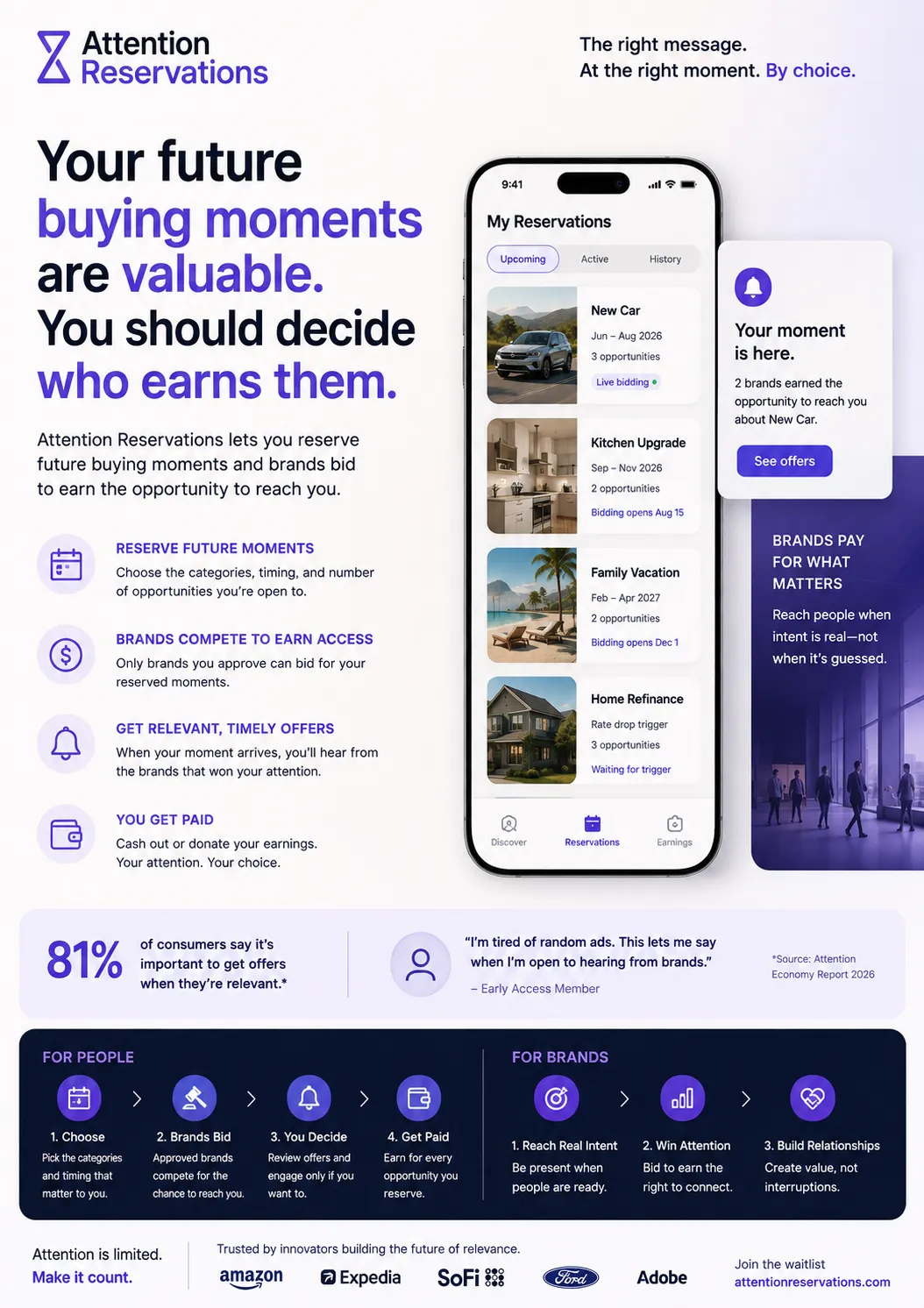
Description
No additional description provided.
The Pitch
Advertising would stop treating intent as a secret to be extracted and start treating it as an asset the consumer can disclose deliberately. Today, the most valuable commercial signals are collected indirectly: searches, clicks, location, browsing patterns, life-event guesses. That makes the market noisy and adversarial. A declared future purchase is cleaner than a thousand behavioral inferences because it contains timing, category, and permission in the same package.
The business works because high-consideration purchases are already auction-like, but the auction is hidden and inefficient. Mortgage lenders, car companies, insurers, universities, remodelers, and enterprise software vendors all spend heavily to intercept buyers at the moment they become visible. By then, they are competing in crowded channels where everyone has the same signal. If access to a qualified upcoming buyer were scarce, scheduled, and consented to, it would be more valuable than ordinary leads because it is not merely contact information; it is a pre-committed window of attention.
The non-obvious advantage is that limiting access may increase value. Most lead-generation businesses degrade because the same person is sold too often, creating spam for the buyer and low trust for the seller. Here, scarcity is the product. If a consumer offers only three conversations, advertisers have a reason to behave well, and the buyer has a reason to engage seriously. The market becomes less about harvesting as many names as possible and more about earning one of a few sanctioned chances.
This also changes the psychology of advertising. People dislike being targeted when targeting feels like surveillance, but they may welcome competition when it feels like representation. A person about to make a major purchase often wants options, leverage, and timing discipline. Turning that moment into a controlled market could make the consumer feel less like the prey in an ad system and more like the owner of a scarce commercial opportunity.
The deepest business thesis is that intent has usually been monetized by everyone except the person who creates it. Search engines, social networks, data brokers, comparison sites, and lead sellers all profit from the fact that a human being is about to spend money. A company that lets people package and sell that intent directly would not just improve ad efficiency; it would redraw the boundary of who owns the economic value of demand.