Marketplace for Franchised Brand Social Channels
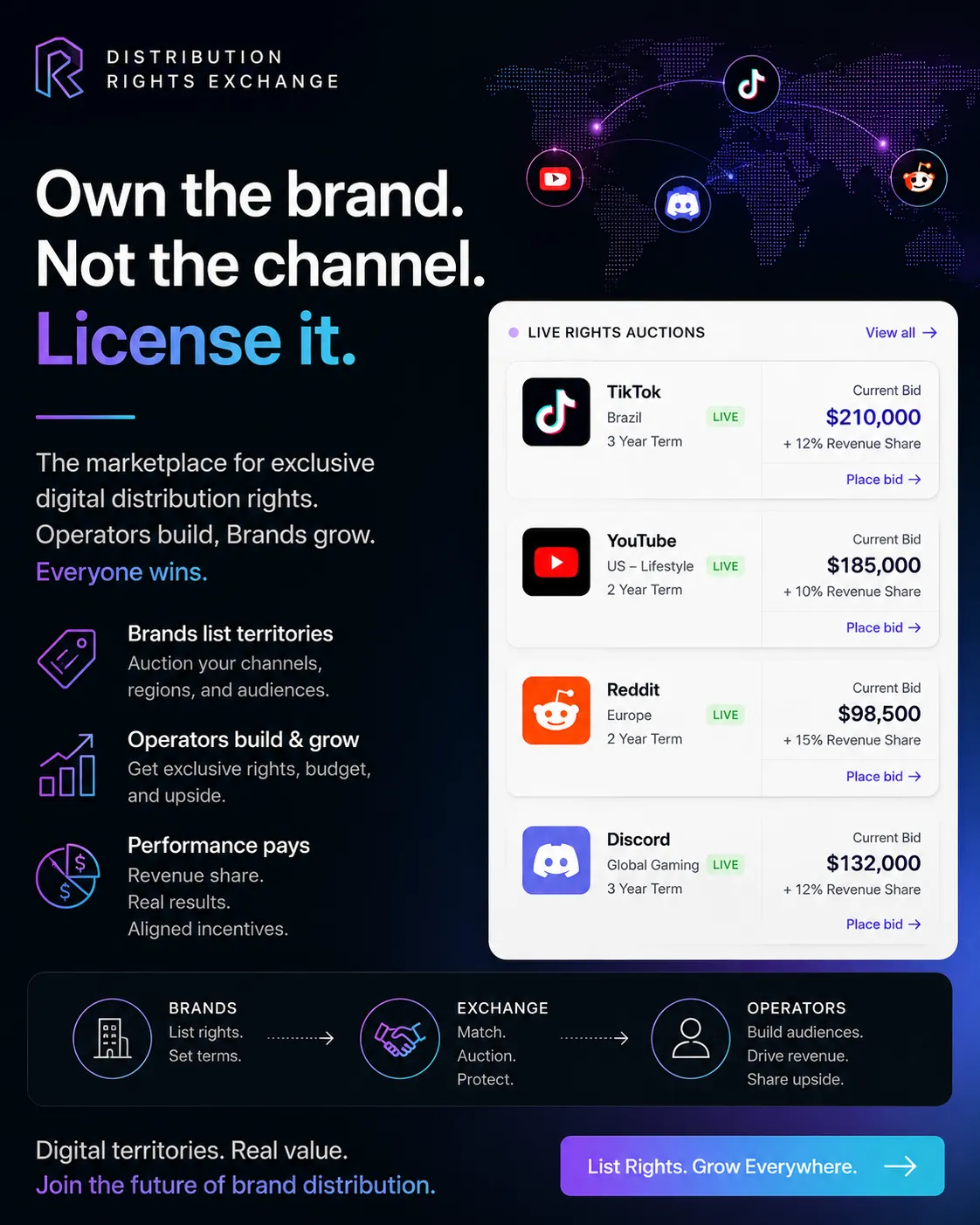
Brands rent distribution from platforms while treating the channels they control like corporate social accounts. Distribution Rights Exchange would let brands turn those channels into territories that independent operators can bid to build and operate. Liquid Death could auction the exclusive rights to run its Brazilian TikTok presence for three years in exchange for $200,000 plus 12% of commerce generated; if the operator turns it into a valuable distribution asset, those rights could eventually be sold to another operator. As every platform develops its own culture, creative language and commerce ecosystem, centralized social teams make less sense. McDonald's franchised physical geography. The next generation of brands could franchise digital geography.
Description
No additional description provided.
The Pitch
Attention has become local again, but not in the old geographic sense. A brand’s TikTok in Brazil, Discord in Korea, YouTube Shorts in India, or WhatsApp community in Mexico are not merely translations of a central message; they are distinct cultural markets with their own jokes, creators, buying behaviors, and platform-native grammar. Most companies are structurally bad at this because they try to manage these surfaces as extensions of brand control, when they increasingly behave like semi-independent media properties.
The non-obvious asset here is not the account itself, but the operating right. A brand with demand but limited local fluency owns dormant territory: distribution that could exist but does not yet produce much value. An independent operator may have the inverse: cultural fluency, hustle, and platform instincts, but no underlying brand powerful enough to compound their work. A market that pairs these two sides turns unused brand reach into something closer to commercial real estate. The brand provides the address; the operator makes the neighborhood valuable.
This works especially well because social distribution has become too fragmented for headquarters to master, but too economically important to outsource casually. Agencies are usually paid for effort, not ownership, so they rarely behave like proprietors. Employees have ownership of standards but not upside. Independent operators with tradable rights would think differently: they would build recurring formats, creator relationships, affiliate loops, community rituals, and commerce habits because the asset they are improving could become more valuable over time. The shift is from “posting for a brand” to “building a channel-level business under a brand’s umbrella.”
It is also compelling because it gives brands a way to expand without pretending they can centrally understand every subculture. The old fear was that local operators would dilute the brand. But platform culture already dilutes brands when they show up awkwardly or not at all. A governed rights model could make decentralization safer than the current alternative: thousands of unofficial resellers, fan pages, gray-market creators, and disconnected local agencies shaping perception with no shared incentives.
The deeper business insight is that brands may have underestimated how much unused distribution sits on their balance sheet in invisible form. Their names, products, and audiences can be licensed into digital territories just as restaurants were once licensed into physical ones. If commerce keeps collapsing into content, then the people best at making a market care may deserve something more durable than a contract. They may deserve the territory.