Marketplace for Embedded Product Partnerships
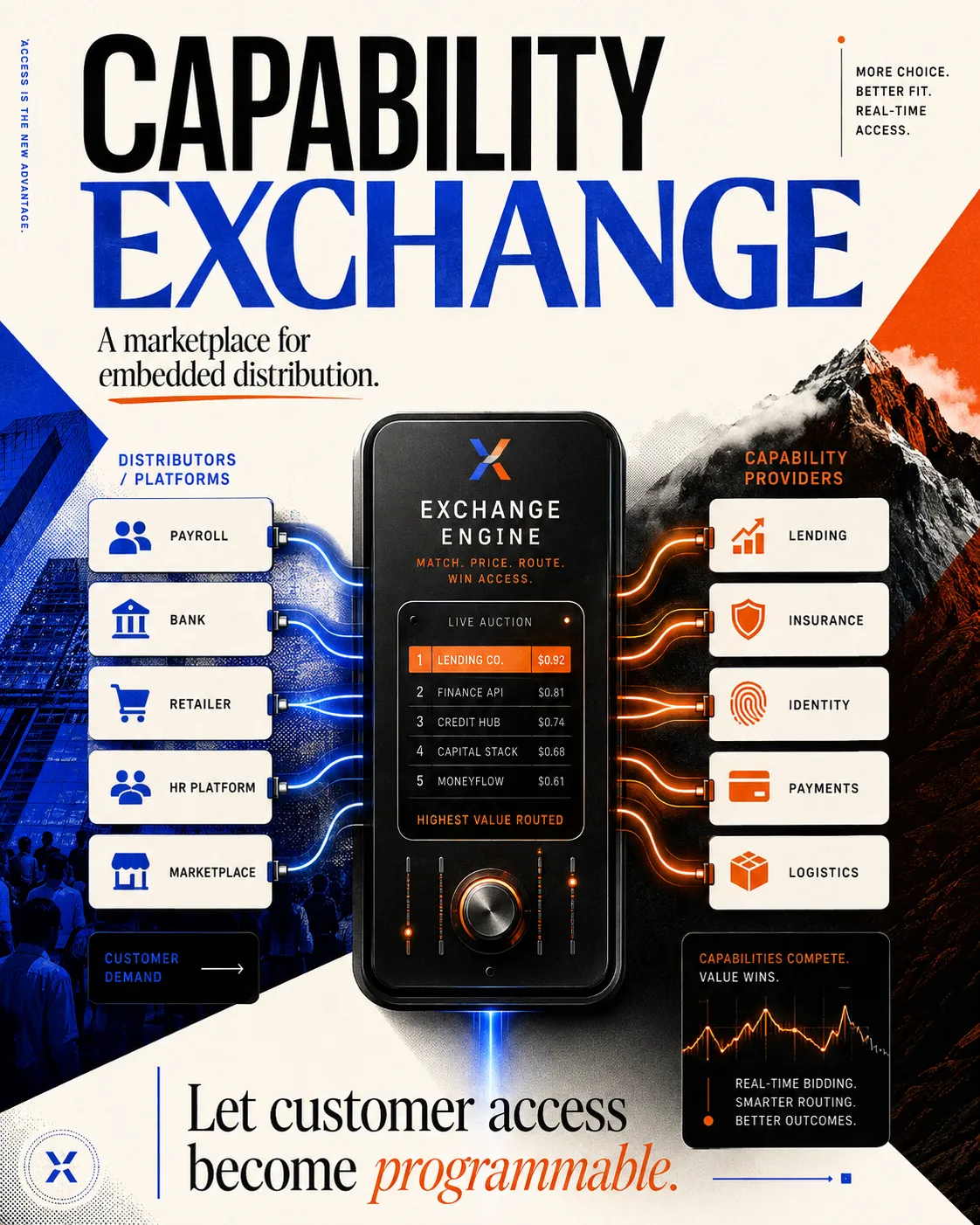
Startups spend enormous amounts acquiring customers while banks, payroll platforms, retailers, marketplaces, and software companies already sit in front of millions of people with unmet needs they don't want to build products for themselves. Capability Exchange would let those distributors publish specific customer opportunities and allow outside providers to compete to fulfill them, turning distribution into a programmable marketplace rather than a series of one-off partnerships. Providers could bid based on revenue share, approval rates, economics, or performance, while the distributor swaps capabilities in and out without rebuilding its product. APIs have made technology easy to embed, but there is still no liquid market for deciding whose product gets embedded into an existing customer relationship. A payroll platform with 400,000 workers needing occasional emergency liquidity could open that demand to multiple lenders and automatically route each customer to the provider offering the best economics and outcome.
Description
No additional description provided.
The Pitch
Distribution is becoming more valuable than product creation, but it is still allocated through an absurdly manual process. The company that owns the customer relationship often knows exactly what its users need next, yet each new offering requires months of partner sourcing, negotiation, compliance review, integration, and internal debate. That means enormous latent demand sits unused, not because nobody can serve it, but because there is no efficient way to decide who should be allowed into the channel.
The non-obvious insight is that many embedded products are not really products from the distributor’s point of view; they are fill rates, conversion rates, margins, risk policies, and support burdens. A bank does not need to “launch a lending product” so much as it needs a reliable way to monetize or help a specific subset of customers without damaging trust. Once those capabilities can be compared and routed like performance inventory, the distributor stops thinking in terms of exclusive partnerships and starts treating its audience as a portfolio of addressable opportunities.
This would also change the power balance for providers. Today, a strong product can still die because it cannot buy attention cheaply enough or convince a large platform to take a meeting. In a functioning exchange, the scarce asset is not another landing page or sales team; it is measurable performance against a distributor’s customer need. That creates a path for specialized providers to win distribution through superior economics or outcomes rather than brand recognition, which is especially powerful in regulated or operationally complex categories where the best underwriter, insurer, lender, or workflow tool may not be the best marketer.
The business becomes more defensible as it accumulates proof about what works for whom. Each opportunity, bid, approval, conversion, repayment, churn event, and complaint teaches the marketplace how to route demand more intelligently. Over time, the exchange would not merely match distributors with providers; it would become the memory layer for embedded commerce, knowing which capabilities perform under which constraints. That kind of intelligence is difficult for any single distributor or provider to build alone because each only sees its own slice of the market.
The larger shift is from partnerships as bespoke business development to partnerships as infrastructure. When a company can expose demand without surrendering its customer relationship, and when providers can compete continuously rather than negotiate once, embedded products become fluid. The winning company would sit at the point where unused customer intent becomes monetizable without forcing every distributor to become a product conglomerate.