Marketplace for Embedded B2B Customer Distribution
If every company is trying to replace rented acquisition at the same time, there is potentially a marketplace hiding underneath the problem. Distribution Exchange would let companies expose unused customer access to complementary companies. A payroll platform has SMB employers. An accounting platform has accountants. A bank has newly incorporated businesses. A benefits company has HR teams. Instead of everyone rebuilding demand independently, the network matches products to relevant moments inside other companies’ customer bases and handles economics, targeting, tracking and payout. This is different from affiliate networks because the unit isn’t a link or publisher. It is verified customer context inside an operating product. Example: a business opens payroll in a new state. The Exchange knows that three compliance products are relevant, chooses the best-performing one, inserts it into the workflow and splits the economics with the payroll platform.
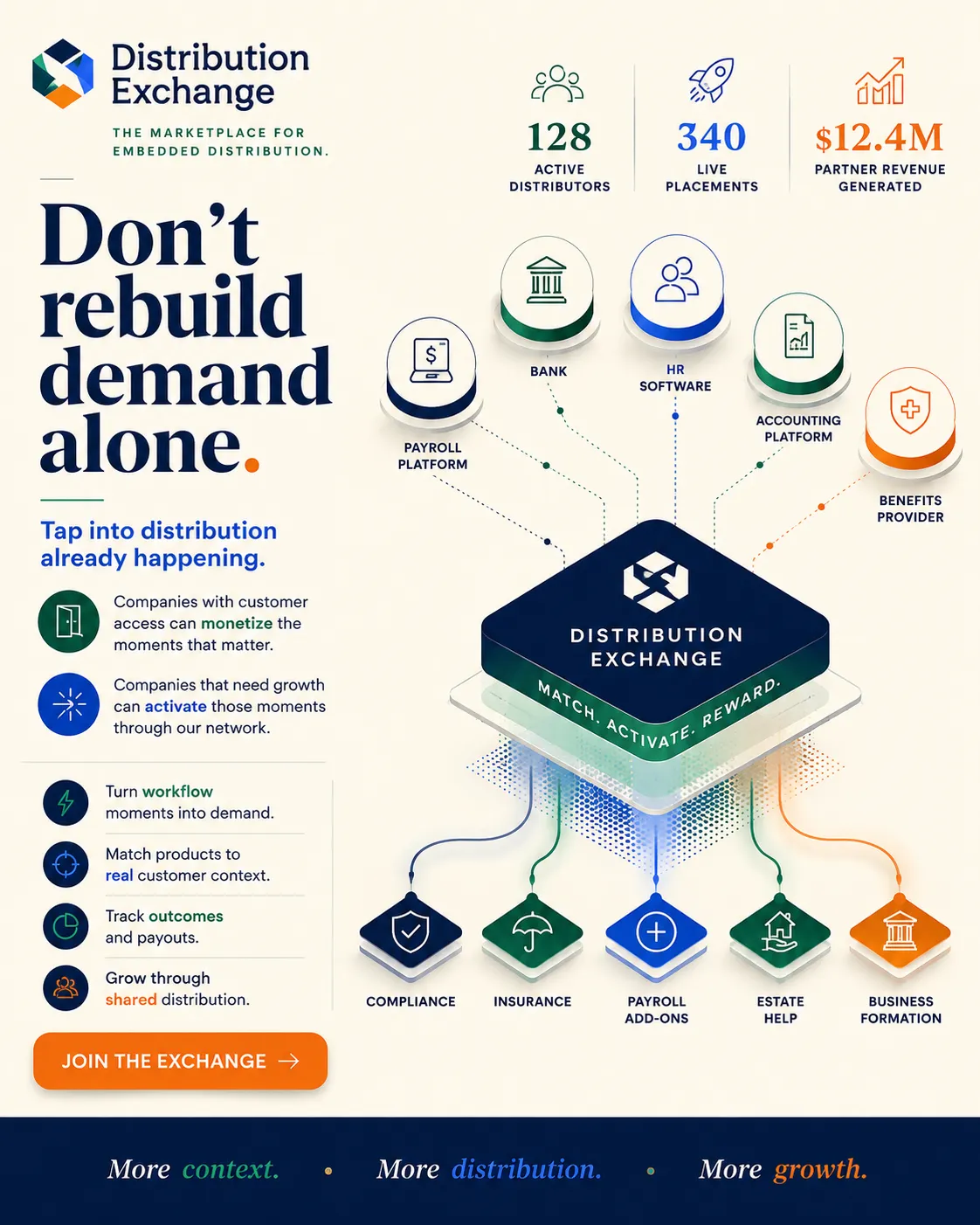
Description
No additional description provided.
The Pitch
Most companies are sitting on distribution they cannot fully monetize without betraying the product experience. The valuable asset is not “traffic,” but trusted context: knowing that a customer just hired their first employee, opened a subsidiary, switched banks, missed a compliance deadline, or crossed a revenue threshold. Those moments are commercially valuable, but they are usually too narrow, operationally messy, or politically sensitive for each company to sell directly. An exchange could turn those scattered moments into a usable market.
The deeper insight is that customer acquisition is becoming less like advertising and more like logistics. The winning placement is not where attention is cheapest, but where need is already verified. A company that appears at the exact operational moment a customer needs it does not have to manufacture urgency with copy, retargeting, or discounts. That changes the economics: distribution becomes closer to embedded procurement than media buying.
This would also work because many software companies have asymmetric audiences. They may own a valuable customer relationship in one domain while needing access in another. A payroll company might be a perfect channel for compliance tools but a poor seller of them; an accounting platform might know which businesses are growing but have no reason to build every adjacent product. The exchange lets companies profit from adjacency without becoming conglomerates. It preserves specialization while allowing the customer relationship to become more economically complete.
The defensibility would come from performance memory across contexts. Over time, the system would know not just which products are good, but which products convert, retain, and satisfy customers in very specific situations. That data is hard to recreate from outside because it depends on closed-loop outcomes from operating systems, not surface-level clicks. The more partners participate, the more the network understands commercial intent at the moment it becomes actionable.
The most interesting possibility is that it could create a new middle layer between software and commerce. Today, companies either interrupt customers through ads or manually negotiate partnerships. A distribution exchange would make customer access programmable, but only where relevance is real enough to protect trust. If it worked, it would make growth less dependent on renting attention from giant platforms and more dependent on being useful at the precise moment another product knows usefulness is needed.