Marketplace for Customer-Priced Bank Deposits
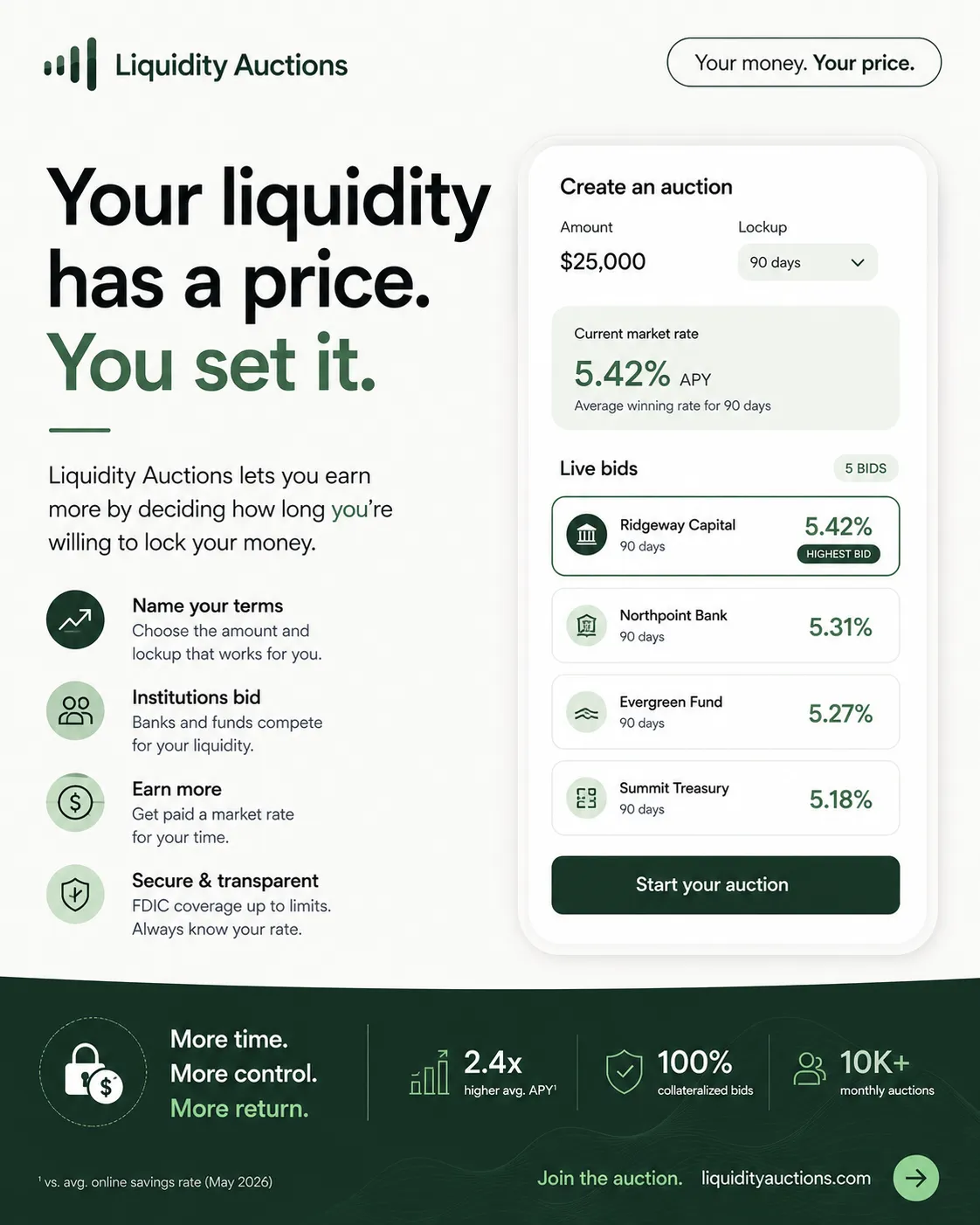
Banks decide how much they pay depositors and then impose the same liquidity terms on millions of people with completely different needs. Liquidity Auctions would let customers name their price for giving up access to their money. Someone might offer to lock $25,000 for 90 days at 5.2%, while another requires 6.1%, and institutions bid against those offers according to how badly they need stable funding. Instead of banks guessing what liquidity costs their customers, customers could continuously price it themselves.
Description
No additional description provided.
The Pitch
Turn deposits from a blunt retail product into a market for time. Today, banks treat liquidity as if it has a uniform value, but the value of access to cash is wildly personal. A retiree with six months of expenses in checking, a startup founder waiting on payroll, and a high-earning household saving for taxes all have different true costs of locking money away. The hidden opportunity is that banks are already paying for this uncertainty; they just pay for it inefficiently through broad rates, promotions, and balance-sheet guesswork.
The interesting part is that customers often know more about their own liquidity than banks do. A person may know with high confidence that $40,000 is untouchable until a tuition bill, tax payment, home purchase, or bonus date. In the current system, that knowledge is mostly wasted. A marketplace that captures those private liquidity preferences could create better matching than standardized CDs or savings accounts, because it lets customers sell a very specific promise: not just “I have money,” but “I can reliably part with this money until this date at this rate.”
For financial institutions, the appeal is not merely cheaper deposits; it is more precise deposits. A bank may not want generic balances that disappear when a competitor posts a slightly higher savings rate, but it may value committed 45-day, 120-day, or 9-month funding in very different ways depending on loan demand, regulatory ratios, or maturity gaps. That means the same customer deposit could be worth materially different amounts to different institutions at the same moment. The business works if it exposes those differences instead of hiding them behind a single advertised rate.
The most powerful behavior change is psychological: people are far more willing to give up liquidity when they feel they are being paid for a choice they made, rather than trapped inside a product someone else designed. A depositor naming a required return reframes saving from passive rate-shopping into active allocation. That sense of control could matter as much as the extra yield, because financial products often fail when customers feel the institution knows more than they do and captures the spread.
If this existed at scale, it could become a strange but useful new price signal: the real-time retail cost of liquidity. Banks would see where depositor patience actually sits, customers would see what their flexibility is worth, and money that currently sloshes between accounts chasing teaser rates could become a more stable, better-priced supply of funding. The business is compelling because it does not invent a new financial need; it reveals a market that has always existed inside deposit accounts but has never been allowed to clear.