Marketplace for Customer Acquisition Channels
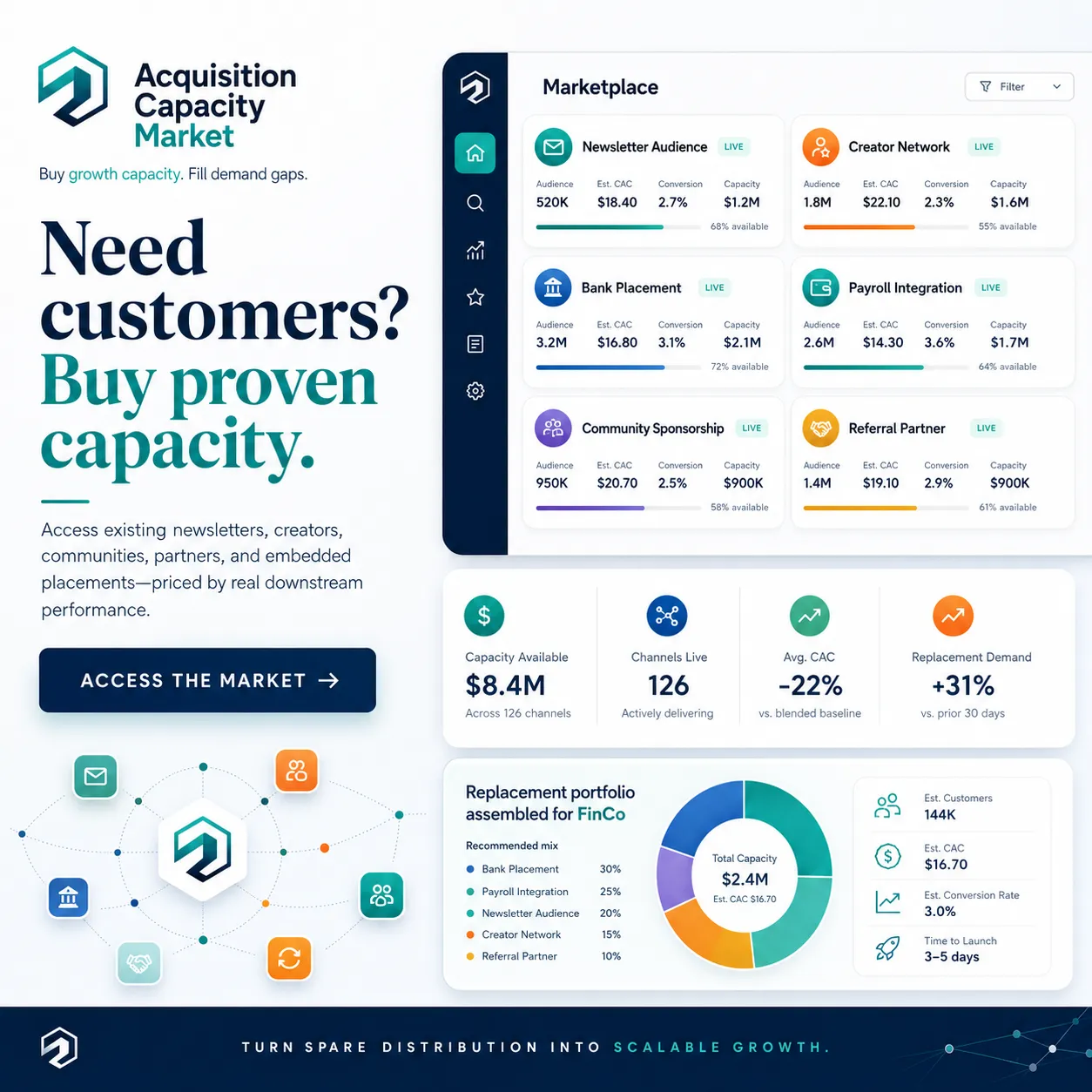
The deeper issue in your cohort is that replacement channels take years because a company needs capabilities it does not currently possess: partner relationships, newsletters, distribution agreements, creators, affiliates, embedded placements. Instead of software teaching the company to build all of those, create a marketplace for existing acquisition capacity. Companies with excess distribution capacity list it. Companies with demand risk buy access. The platform prices inventory based on actual downstream conversion rather than impressions or clicks. A fintech losing Google traffic might purchase access to: 200K relevant newsletter subscribers 14 community-bank placements 30 personal-finance creators 8 payroll integrations 4 employer-benefits marketplaces The platform assembles this into a replacement portfolio.
Description
No additional description provided.
The Pitch
Distribution has become the scarce asset, not content, capital, or even product quality. Many companies can build something useful faster than they can earn the right to be seen. The strange asymmetry is that one company’s existential bottleneck is often another company’s under-monetized asset: a newsletter with trust but limited offers, a payroll platform with unused surface area, a trade association with member attention, a creator with audience depth but inconsistent monetization. The market is full of distribution that is valuable but not legible.
The most interesting insight is that acquisition channels are usually treated as tactics, when they are closer to infrastructure. A company dependent on Google, Meta, or outbound sales is not merely choosing a marketing mix; it is choosing a fragility profile. When that channel degrades, the company cannot instantly manufacture trust in ten new places. A marketplace for acquisition capacity would make distribution more modular, letting companies rent or assemble trust from places where it already exists rather than trying to build every relationship from zero.
This would also change how distribution is valued. Today, many audience owners sell crude proxies: impressions, sponsorship slots, clicks, lead lists. But the buyer does not really want attention; it wants converted demand from a specific audience under specific conditions. If the platform can connect inventory to downstream performance, it turns scattered media assets into something more like yield-bearing commercial real estate. The owner of a niche audience may discover that its most valuable asset is not its content business at all, but the purchasing intent embedded in its relationships.
The portfolio concept is especially powerful because no single replacement channel needs to be perfect. A company trying to replace a collapsing acquisition source does not need one miracle partner; it needs a basket of imperfect, partially correlated channels that together reduce dependency. This is how sophisticated companies already think internally, but the supply side is fragmented and relationship-driven. Packaging distributed trust into a managed acquisition portfolio would make a defensive capability available to companies that could never build it alone.
The business works if it becomes the place where latent distribution is made tradable without destroying the trust that makes it valuable. That constraint is what keeps the idea from being a generic ad network. The platform would have to reward fit, outcomes, and restraint, because the inventory only remains valuable if audiences do not feel sold to. If done well, it would not just help companies buy growth; it would reveal a hidden economy of trusted access that has been sitting inside thousands of businesses all along.