Marketplace for Business Banking Upgrades
Most business banking products are built around what a company needs today, even though the financial stack changes predictably as the business grows. A two-person company may need a checking account and card; later it needs payroll, treasury, FX, lending, insurance, or a more sophisticated bank. Business Account Graduation Market watches operating behavior and identifies when a company is approaching one of those transitions, then lets qualified providers compete for the next relationship before the founder starts shopping. A business hitting $5M in revenue, hiring internationally, and accumulating excess cash could automatically receive competing treasury proposals from banks that know exactly why the company is ready to graduate.
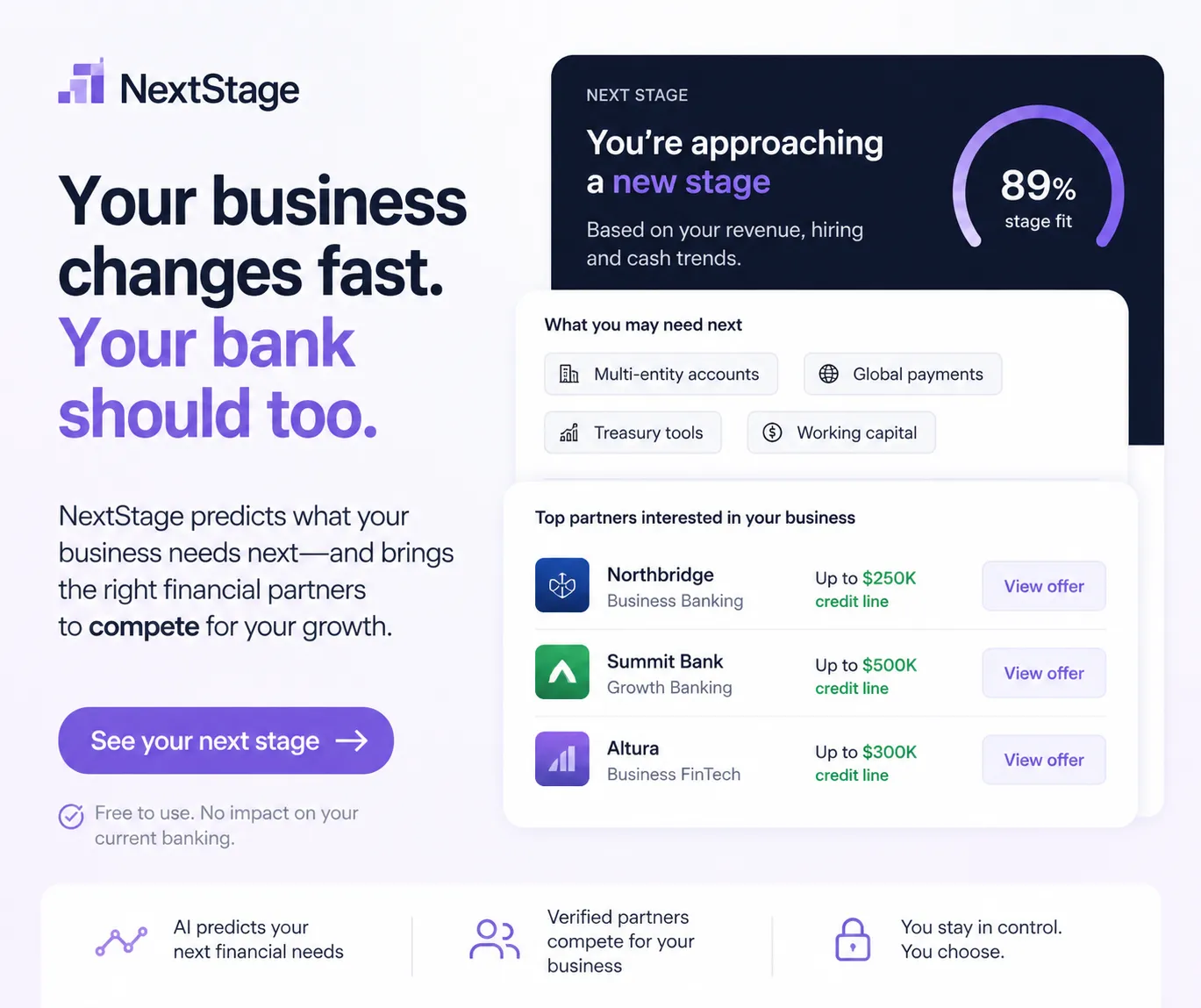
Description
No additional description provided.
The Pitch
Business banking is one of the few markets where the customer’s future needs are unusually legible from present behavior. Revenue cadence, payroll growth, cash balances, vendor geography, card usage, and payment flows are not vague intent signals; they are the operational exhaust of a company becoming something else. That makes timing more valuable than branding. The best provider is often not the loudest bank, but the one that appears in the narrow window when the company’s current setup has become slightly too small.
The most interesting insight is that “graduation” is a recurring event, not a one-time switch. Companies do not simply choose a bank and stay fixed forever; they outgrow accounts, credit limits, cash-management tools, insurance coverage, and cross-border capabilities in stages. Yet the market treats each change as if it begins with customer search. In reality, the need usually exists before the search does. A market that can recognize those thresholds turns financial services from a reactive category into an anticipatory one.
This also changes the sales problem for banks and financial providers. Today, much of business banking acquisition is wasted on companies that are too small, too early, too risky, or not actually ready to move. A graduation market would filter for businesses at moments of structural change, when switching costs are emotionally and operationally easier to justify. That is a rare kind of lead: not just a company that matches a profile, but a company whose current financial architecture is becoming misaligned with its business.
The defensibility would come from understanding transitions better than any individual provider. A bank can see its own accounts, but it rarely sees the broader pattern of when a company should consider payroll, treasury, FX, credit, or insurance alternatives. The graduation layer becomes valuable because it is not tied to one product; it learns the sequence of needs across many products and many company types. Over time, it could know that a certain pattern of invoices, hiring, and idle cash usually precedes a financial decision months before the founder names the problem.
The business works because it creates a cleaner match at a moment when both sides are underserved. Founders do not want to become experts in banking procurement, and providers do not want to chase companies that are years away from needing them. The company that knows when a business is about to outgrow its financial stack could become the quiet switchboard for commercial finance.