Marketplace for Authenticated Product Experience Data
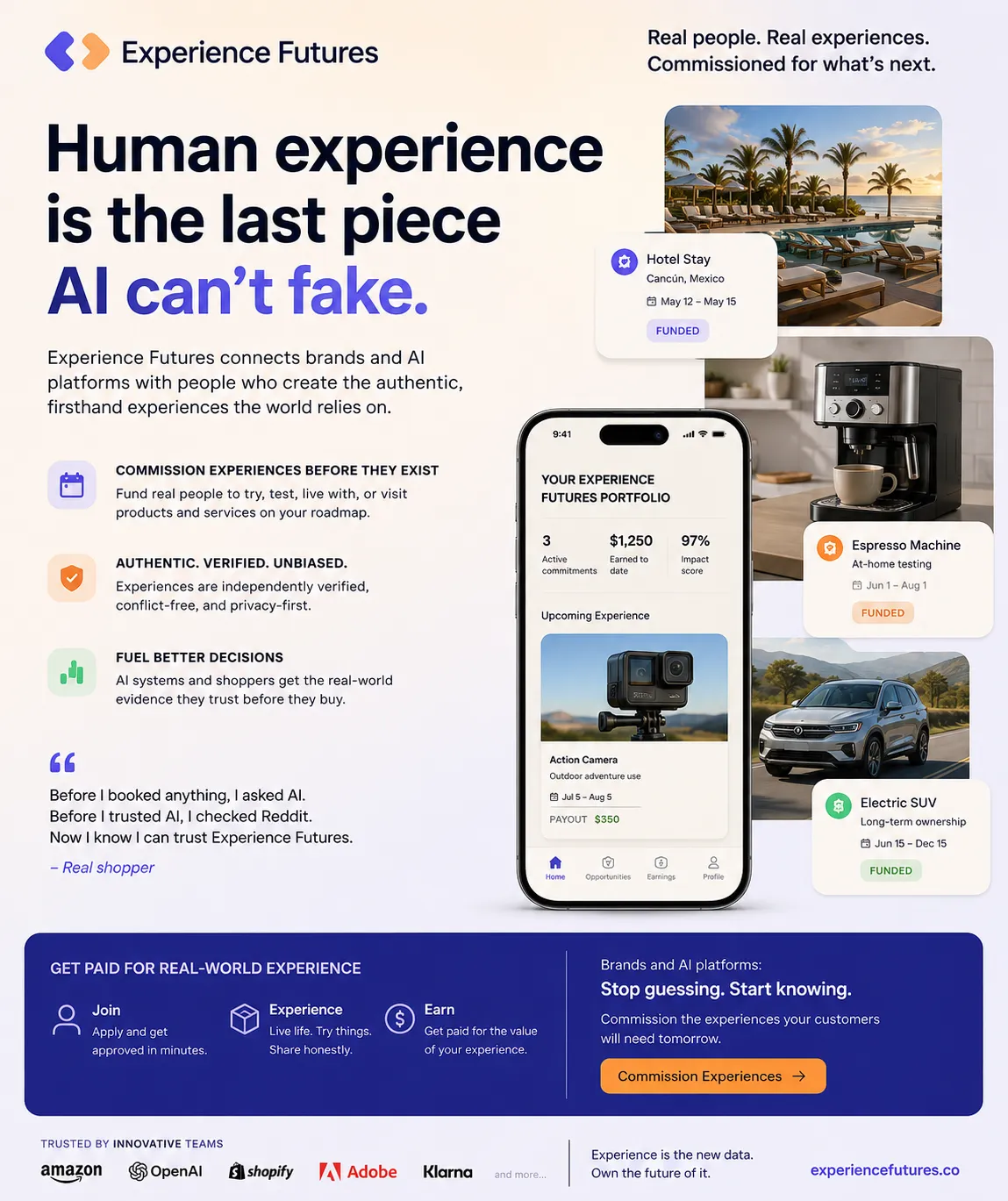
People increasingly ask AI what to buy, then look for someone who has actually used the thing before they trust the answer. That makes firsthand experience a new kind of data supply. Experience Futures would let companies contract with people before that experience exists. A hotel chain could pay 500 frequent travelers to independently stay at new properties over the next year. An AI shopping platform could commission long-term ownership data on appliances before users start asking about reliability. Participants get paid for producing authenticated experience, with compensation increasing when their experience is rare or frequently consulted. We already pay people to produce content. AI could create a market where people get paid to produce experience.
Description
No additional description provided.
The Pitch
Firsthand experience becomes more valuable precisely as synthetic content becomes cheaper. When anyone can generate a polished review, comparison, or recommendation, the scarce asset is no longer articulation but provenance: proof that a real person lived with the product, visited the place, endured the inconvenience, or discovered the flaw. A market for authenticated experience would turn “I was there” from a casual claim into a tradable input for trust.
This business would sit upstream of recommendation, not downstream of advertising. Most commerce companies currently learn about products after consumers have already taken the risk, which means the data arrives late, unevenly, and often from people motivated by anger, status, or incentives hidden inside platforms. Commissioned experience changes the shape of the data: it can be specified in advance, diversified across use cases, and collected over time. That makes it closer to a private weather network for product reality—messy human observations organized before the market needs them.
The non-obvious power is that rarity can be priced. A week at a popular resort is easy to source; eighteen months owning a specific heat pump in a cold climate is not. The more particular the question AI systems need to answer, the more valuable the matching experience becomes. This creates a new labor category for people whose lives contain commercially useful edge cases: parents of twins using strollers on subway stairs, rural drivers testing EV charging reliability, allergy sufferers trying hotel cleaning protocols. Ordinary circumstances become economically legible.
It also solves a looming trust problem for AI commerce. AI recommendations will be judged less by whether they sound persuasive and more by whether they can cite lived evidence that maps to the buyer’s situation. The winning systems will not merely summarize the internet; they will have access to verified reservoirs of experience that competitors cannot scrape after the fact. If those reservoirs are continuously replenished, they become a defensible layer between generic model intelligence and actual purchasing confidence.
The elegant part is that the company would not need to own the hotels, appliances, cars, or marketplaces. It would own the coordination layer that turns future human encounters with those things into reliable evidence. In a world overflowing with opinions, the durable business is the one that can manufacture trustworthy contact with reality.