Managed Customer Activation for Consumer Fintechs
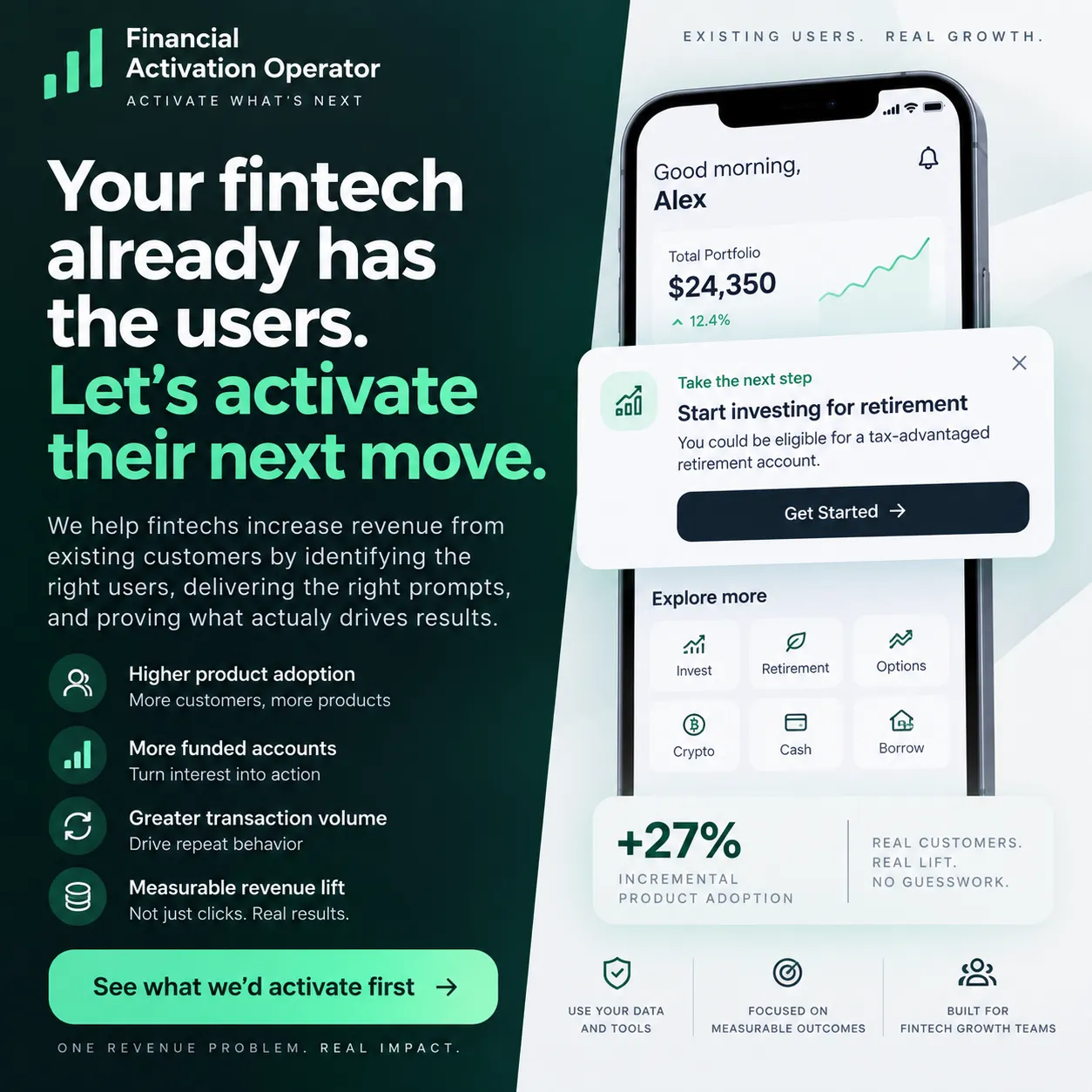
Consumer fintechs spend heavily acquiring users and launching more products, but many existing customers never take the next commercially valuable action even when the company already has enough behavioral and financial data to identify likely intent. The opportunity is a managed activation layer that takes responsibility for one specific revenue problem—such as recurring deposits, brokerage transfers, retirement-account adoption, or funded-account conversion—and uses the fintech’s existing data, decisioning, messaging, and experimentation tools to identify the right customers, run interventions, and measure incremental economic lift. Why now: sophisticated personalization infrastructure is increasingly available off the shelf, so the bottleneck is shifting from having the technology to knowing how to use it against a measurable financial outcome, especially for mid-sized fintechs without the internal growth and decision-science capabilities of the largest platforms. For example, a brokerage could identify funded customers who have never enabled recurring deposits, test different in-app interventions against a holdout group, and determine which treatments actually increase incremental deposits rather than simply generate clicks or engagement.
Description
No additional description provided.
The Pitch
This monetizes a gap most fintechs already know exists but rarely organize around: the distance between account creation and economically meaningful behavior. A customer who opens an account, links a bank, passes KYC, or makes one transaction is not yet a good customer. In many financial products, the real value appears only after a second-order habit forms: recurring deposits, balance consolidation, automatic repayment, card-on-file usage, or long-term asset retention. That is a narrower and more profitable problem than “engagement,” because it ties directly to balances, interchange, net interest income, assets under management, or fee-generating activity.
What makes this especially interesting is that the raw material is already inside the company. Fintechs often treat under-activation as a marketing problem, but the clues are usually behavioral rather than demographic: payroll timing, cash-flow surplus, abandoned linking attempts, dormant funded balances, repeated quote checks, tax refund deposits, or signs that a customer is using the product as a secondary account. The business works if it can turn these latent signals into accountable action. It is less like buying more traffic and more like extracting ore from land the customer already owns.
The non-obvious wedge is that many fintechs do not lack tools; they lack an operating discipline for choosing the one behavior that matters, isolating causality, and forcing messaging, product prompts, risk constraints, and compliance review to work together. Internal teams often optimize local metrics: open rates, click-throughs, completed flows, campaign volume. But financial products are full of false positives, where the people most likely to respond were going to act anyway. A company that is paid to create measured incremental lift becomes valuable because it attacks the waste hidden inside apparently successful campaigns.
There is also a structural reason this could become durable. Activation knowledge compounds across clients in a way that generic personalization software does not. The exact customer data stays with each fintech, but the pattern library improves: which moments predict readiness, which interventions backfire, which holdout designs survive seasonality, which behaviors are leading indicators rather than vanity signals. Over time, the company would understand the grammar of financial intent across products better than any single mid-sized fintech could.
The best version of this business would not feel like an outsourced marketing agency. It would feel like a revenue function for financial behavior change: part analytics, part experimentation, part product psychology, and part operational accountability. That is compelling because fintech growth is becoming less about convincing strangers to download an app and more about helping known customers cross the small, consequential thresholds that make the product financially central.