Machine-Readable Rights Layer for Tokenized Stocks
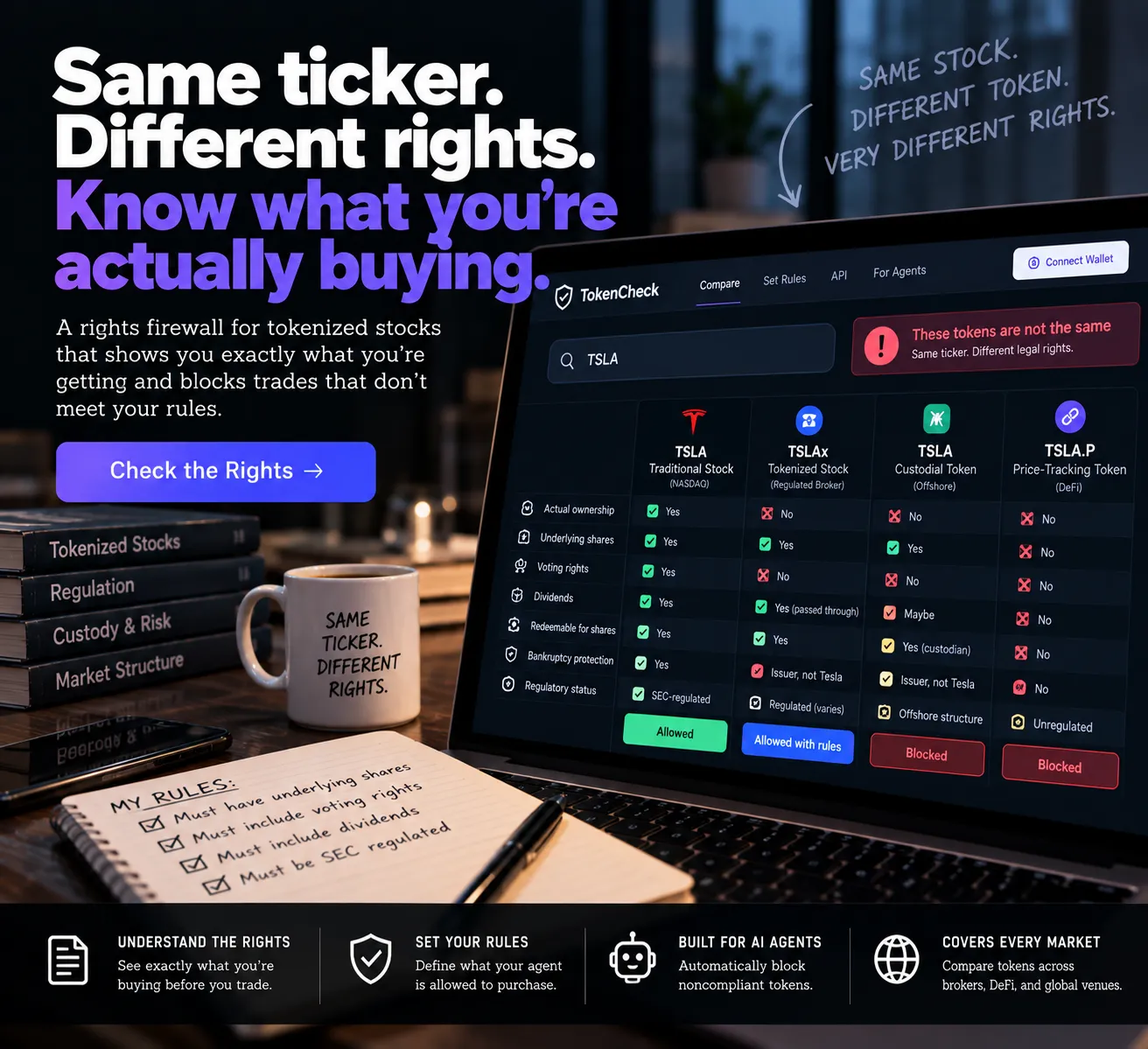
Tokenized stocks can look identical on a trading screen while representing completely different legal rights underneath. One token might represent actual ownership, another a custodial claim, and another only the economic price of the stock, leaving investors and AI trading agents to figure out voting rights, dividends, redemption, and bankruptcy protection after the fact. Build a machine-readable rights layer that sits in front of every tokenized-stock transaction, explains exactly what the buyer is getting, and blocks purchases that fail the investor’s rules. This becomes important now as tokenized equities move from crypto-native experiments into mainstream brokerage and agentic investing, where software will increasingly make trades on a user’s behalf. Imagine telling your investing agent, “Only buy tokenized stocks with real underlying shares, dividend rights, and redemption,” and having every noncompliant version of TSLA automatically rejected before the order is placed. That's a product that needs to exist.
Description
No additional description provided.
The Pitch
The compelling business is not in making tokenized stocks safer in the abstract; it is in becoming the interpreter between financial appearance and legal reality. Markets have always tolerated ambiguity when humans had time to read documents, call counsel, or rely on familiar intermediaries. But tokenized assets compress that ambiguity into milliseconds. If two instruments share the same ticker, price chart, and logo, the market interface lies by omission. The company that can reliably say “these are not the same thing” becomes part of the transaction fabric.
The deeper opportunity is that rights, not assets, are what investors ultimately buy. A share is valuable because of a bundle of enforceable claims: dividends, voting, transferability, redemption, priority, disclosure, jurisdiction. Tokenization separates the visual representation of an asset from that bundle, which creates a new category of risk that normal market data does not capture. Bloomberg can tell you the price; a brokerage can show you liquidity; a block explorer can show you movement. None of those tell a machine whether the instrument satisfies the buyer’s legal intent.
This becomes especially powerful because AI trading agents will need constraints that are executable, not advisory. A human can be warned with a disclosure and still choose to proceed. An agent needs a yes-or-no permissioning layer that translates policy into action. In that world, the valuable product is not another research screen but a rights firewall: a system that prevents a trade from happening when the legal object fails to match the investor’s mandate. The more autonomous finance becomes, the more pre-trade interpretation matters.
There is also a trust asymmetry that favors an independent layer. Issuers and platforms have incentives to make instruments look familiar and liquid; buyers need a neutral way to compare what is actually being offered. If tokenized equities proliferate across chains, custodians, jurisdictions, and broker interfaces, the market will not converge on one perfect standard quickly. It will need a shared translation layer before it has shared infrastructure.
The most interesting version of this company becomes boring in the best way: invisible, embedded, and treated as a necessary check before money moves. It would not be selling “crypto compliance” so much as defining what a financial instrument is allowed to mean in software. As ownership becomes more programmable, the scarce resource is not more tokens. It is certainty about the rights behind them.