Machine-Readable Jurisdictions for Autonomous Commerce
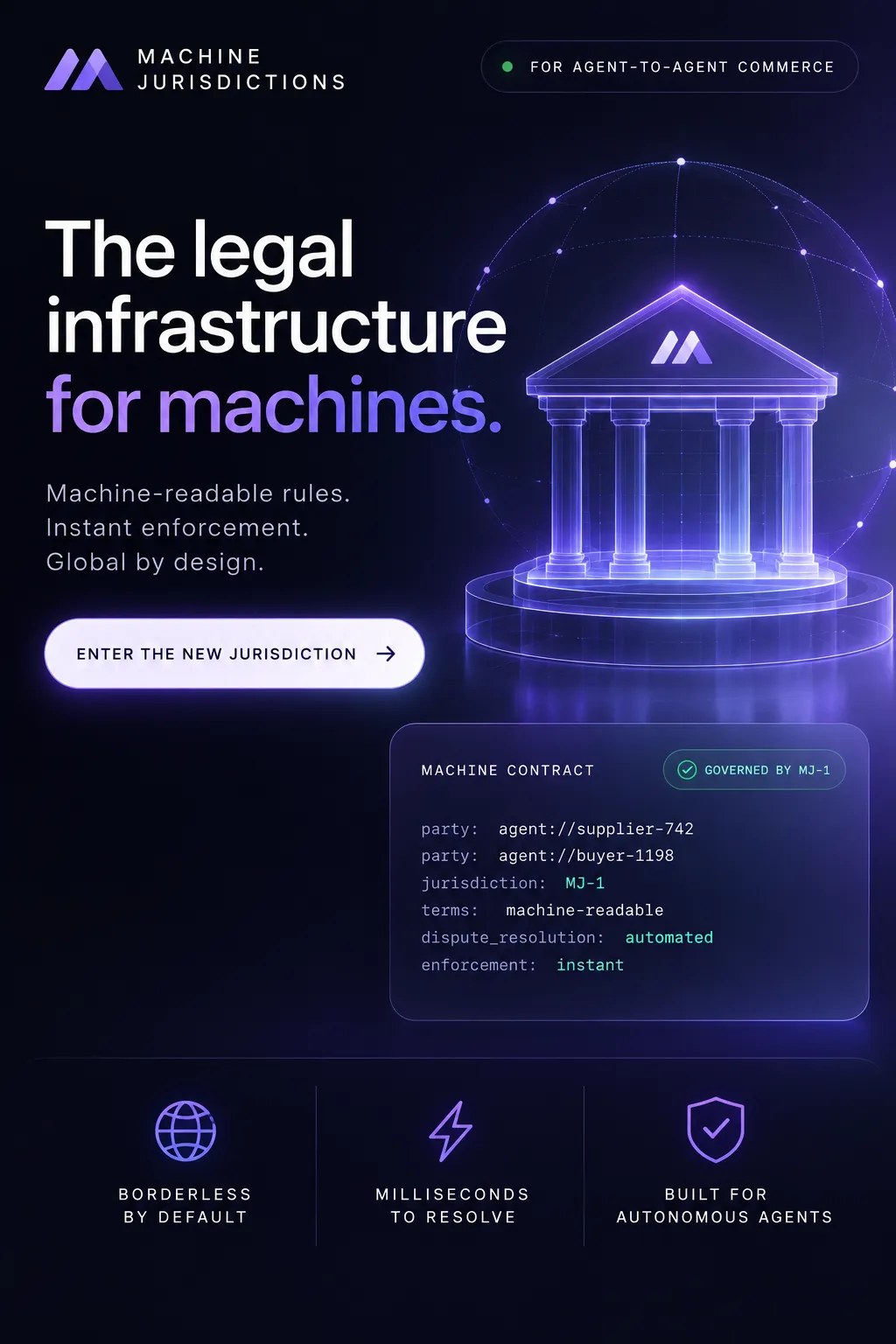
Autonomous agents will eventually negotiate, purchase, hire, sell, and contract with other autonomous agents millions of times per day, yet every dispute ultimately falls back onto legal systems designed for humans moving at human speed. Machine Jurisdictions would be voluntary commercial rule systems built specifically for autonomous commerce. Agents could agree that a transaction is governed by a particular jurisdiction whose contracts, evidence standards, dispute procedures, penalties, and appeals are machine-readable and automatically executable. Delaware became infrastructure for corporations. Something similar may eventually be needed for machines.
Description
No additional description provided.
The Pitch
Autonomous commerce will not just need faster payments or better identity; it will need a shared sense of consequence. Markets work because counterparties know what happens when someone lies, fails to deliver, or interprets an agreement differently. If agents are going to transact with strangers at scale, they need a lightweight substitute for institutional trust that is cheaper than suing and more credible than “the platform will decide.”
The deep opportunity is that law, in this context, becomes a protocol layer. Human legal systems are written for interpretation after the fact; machine jurisdictions would be written for execution before the fact. That flips the value of rules from eloquent ambiguity to operational clarity. A jurisdiction that can define default terms, admissible evidence, remediation logic, escrow behavior, and appeal paths in a form agents can reason about could become part of the transaction itself, not a separate system invoked only when things break.
This business would also benefit from a rare network effect: the more agents accept a jurisdiction, the more valuable it becomes as a default venue. Parties do not want to negotiate a fresh rulebook for every interaction, especially when transactions are small, frequent, and automated. They want a trusted off-the-shelf legal environment. The winning machine jurisdiction might not be the fairest in some abstract sense; it may be the one that is predictable, legible to agents, and broadly recognized by wallets, marketplaces, insurers, auditors, and human courts.
The most interesting wedge is that machine disputes will often be too small for human adjudication but too economically important to ignore in aggregate. A $7 failed API purchase, a mispriced compute rental, or a malformed data license is not worth a lawsuit, but millions of such failures create enormous friction. A system that makes small contractual obligations enforceable without human attention could unlock categories of commerce that are currently impossible because trust costs more than the transaction.
If this existed, it would not merely be a legal-tech product. It would be a new kind of commercial institution: a venue where machines can safely take each other seriously. The prize is becoming part of the background assumptions of autonomous trade, the way corporate law, payment networks, and domain names quietly shape what economic activity is possible.