Machine-Readable Businesses for AI Purchasing Agents
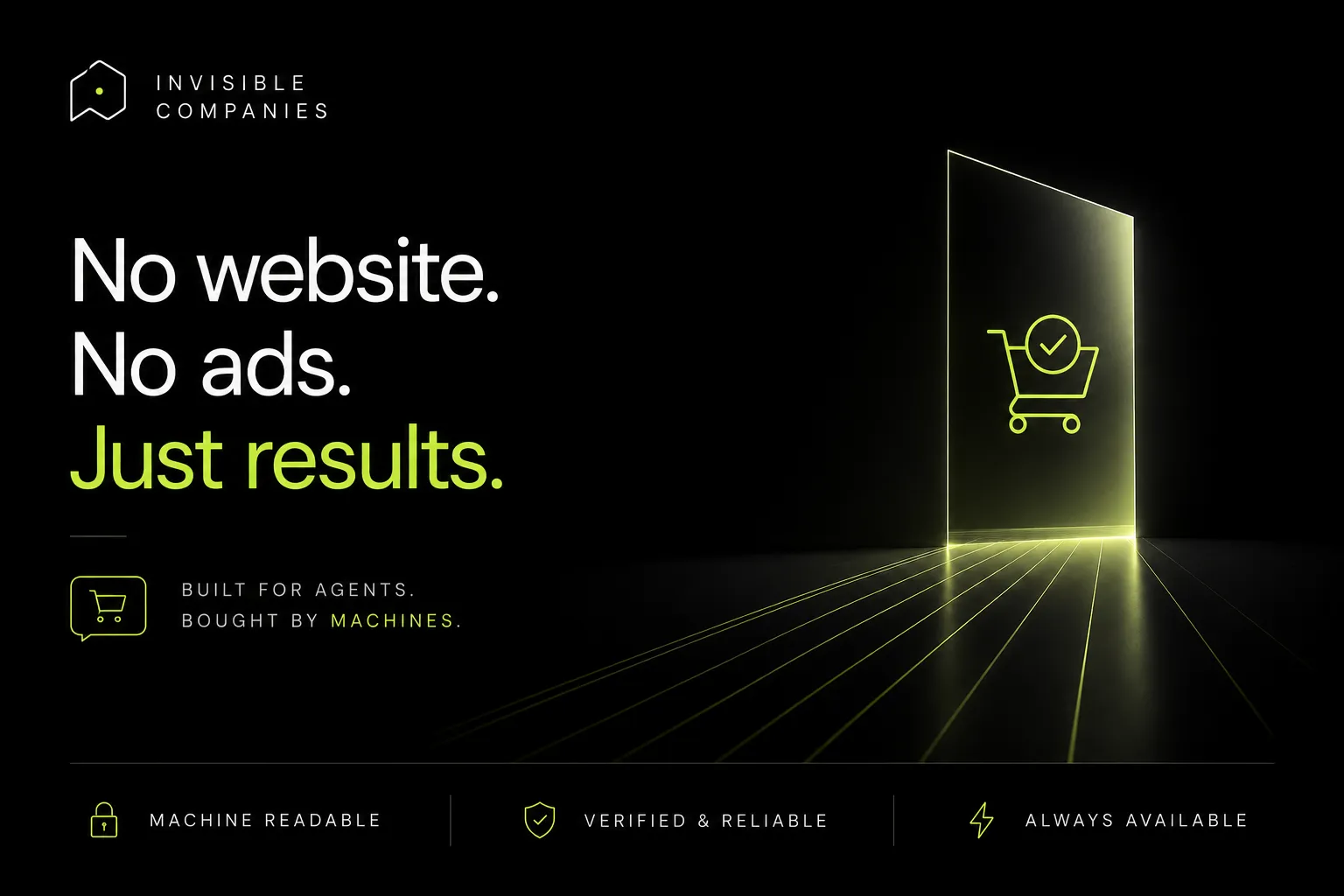
Websites, packaging, advertising, and sales teams exist because businesses have historically had to persuade humans to buy things. Purchasing agents change that. Invisible Companies would be businesses deliberately built with no meaningful human storefront at all. Their products, pricing, guarantees, inventory, reputation, and contracts would exist primarily in machine-readable form so purchasing agents could discover and evaluate them directly. A consumer might ask an agent to replace a broken dishwasher and receive one from a company whose name, website, and advertising they have never encountered. Entire brands could become successful without ever being seen by their customers.
Description
No additional description provided.
The Pitch
A company built to be chosen by purchasing agents would win by treating the agent, not the human, as the real surface area of commerce. Today, most businesses still spend heavily to look trustworthy to people: visual identity, copywriting, endorsements, shelf placement, sponsored results. But an agent does not need to be charmed. It needs structured evidence. That shifts advantage away from companies that are good at performance and toward companies that are good at being legible, comparable, and contractually reliable.
The most interesting part is that this could invert the value of brand. For humans, brand compresses uncertainty into feeling: “I have heard of this, so it is probably safe.” For agents, brand can be decomposed into data: failure rates, refund behavior, delivery accuracy, compatibility, total cost over time, and the exact consequences when something goes wrong. A business that cannot afford to become famous could still become preferred if it is unusually explicit about what it sells and unusually dependable about honoring those claims. Obscurity stops being a disadvantage if the buyer’s representative can verify quality without recognition.
This also creates a new kind of distribution moat. Human-facing commerce rewards attention; agent-facing commerce rewards integration into decision criteria. Once a supplier’s catalog, guarantees, substitutions, and constraints are continuously readable by agents, it becomes part of the automated purchasing environment. The company is not fighting for a click each time. It is being evaluated at the moment of need, against the exact job to be done, with far less room for theatrical marketing to distort the choice.
The business would be especially compelling in categories where consumers do not actually enjoy shopping but care a lot about outcomes: replacement appliances, insurance, maintenance, supplies, commodity electronics, home services, routine business procurement. In these markets, the emotional value of browsing is low, while the cost of making a bad choice is high. An invisible company could thrive by being the easiest safe answer for an agent to recommend.
The deeper thesis is that commerce may separate into things people want to experience and things they simply want resolved. The second category is enormous. If agents become trusted delegates, the winners will not necessarily be the companies people remember. They will be the companies machines can confidently choose.