Machine-Readable Business Claim Verification Registry
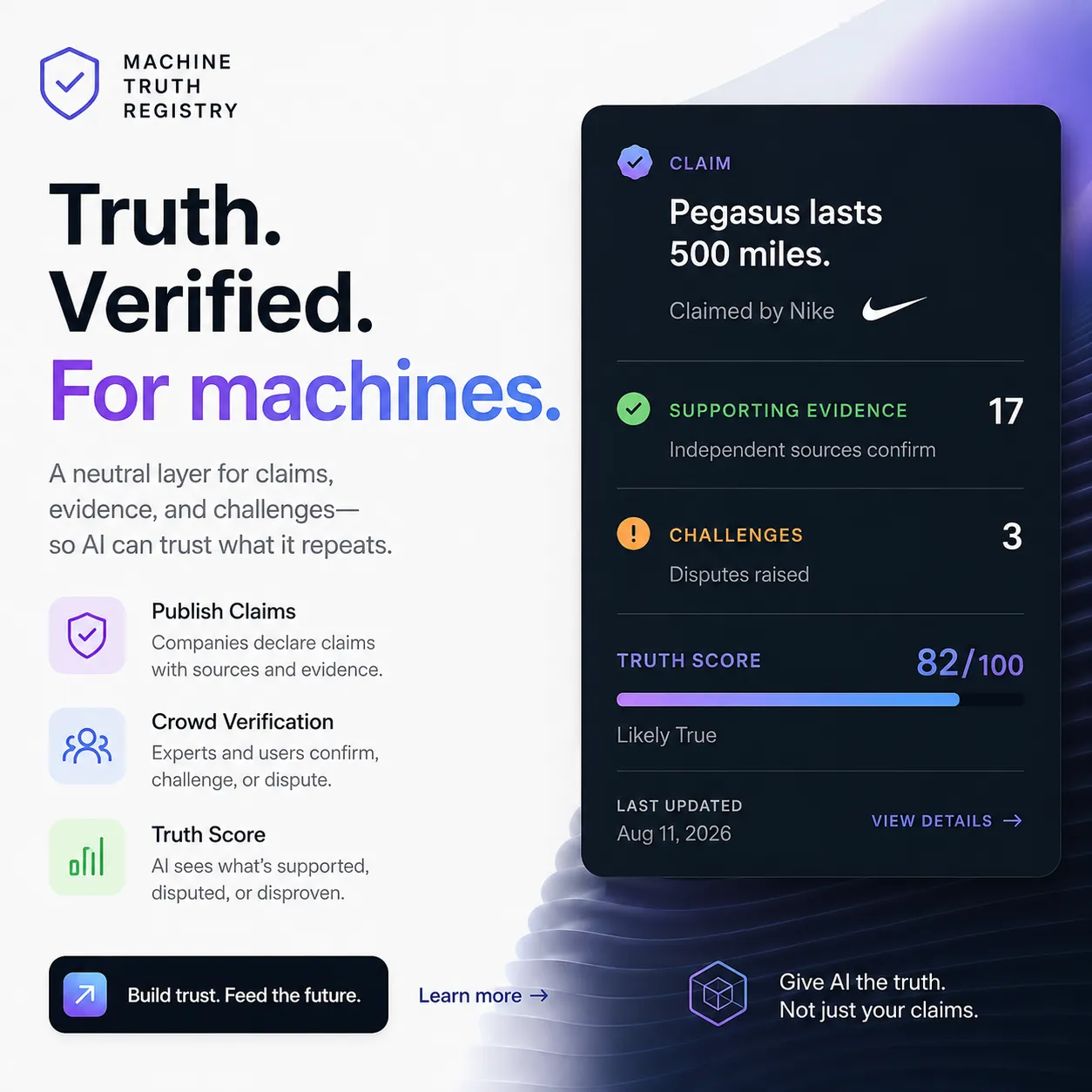
AI increasingly decides what consumers believe about companies, but there is no neutral infrastructure separating a company's claims from independently supported facts. Machine Truth Registry would let organizations publish structured claims alongside evidence while allowing researchers, customers and other trusted parties to confirm, challenge or disprove them. AI systems could then see not merely that Nike says a shoe lasts 500 miles, but that Nike made the claim, 14 independent sources support it and three dispute it. As AI becomes an intermediary for research and purchasing, the internet needs a credit-rating system for facts—and machines need somewhere to check before repeating them.
Description
No additional description provided.
The Pitch
AI search turns reputation into structured input. In the old web, a company could shape perception through copy, SEO, PR, and the slow accumulation of reviews. In an AI-mediated world, those signals get compressed into answers. The important question is no longer simply “What did the company say?” but “What can a machine safely repeat?” A business that becomes the place where claims are attached to provenance, dispute, and confidence would sit upstream of countless consumer decisions.
The most valuable asset here is not the claims themselves, but the graph of disagreement around them. Most markets are full of statements that are technically checkable but practically annoying to verify: durability, origin, sustainability, security, compatibility, clinical backing, labor practices, service levels. A registry that records who asserted something, who examined it, and how the evidence has aged would make commercial truth less like marketing and more like a living public file. That file becomes more useful precisely where the claim is consequential and trust is expensive.
The timing matters because AI systems create a new kind of liability for ambiguity. If an assistant recommends a product based on a stale, exaggerated, or contested claim, the damage is not just a bad search result; it can steer purchases at scale. Model providers, marketplaces, enterprise buyers, journalists, regulators, and insurers all have reasons to prefer facts with lineage over facts scraped from persuasive pages. The registry’s power would come from being boring in the right way: a neutral layer that makes verification machine-readable before anyone needs it in a dispute.
It is also one of the rare trust businesses where participation could become self-reinforcing without everyone being altruistic. Honest companies would want a way to distinguish substantiated claims from louder competitors. Skeptics would want a canonical place to challenge weak statements. AI platforms would want cleaner inputs than the open web. Over time, absence from the registry could itself become a signal, especially in categories where claims influence safety, health, cost, or compliance.
The deeper idea is that brands are entering an era where they are no longer judged only by what humans perceive, but by what machines can justify. Companies that cannot express their truth in verifiable, structured form may become invisible or distrusted inside AI answers. The business works if it becomes the memory layer for commercial credibility: not the arbiter of what is true, but the place where truth has to leave a trail.