Live Streaming Transparent Company Operations
Build a company where almost everything happens in public. Every employee has a Twitch-style channel and streams themselves working. Product meetings are live. Sales calls are live when customers agree. The CEO's staff meeting is live. People can watch an engineer build a feature, a designer argue about a button, or a salesperson try to close a deal. The company itself becomes the content. You get recruiting, marketing, customer research, accountability, and an audience simply by letting people watch the thing companies normally spend enormous amounts of time pretending didn't happen.
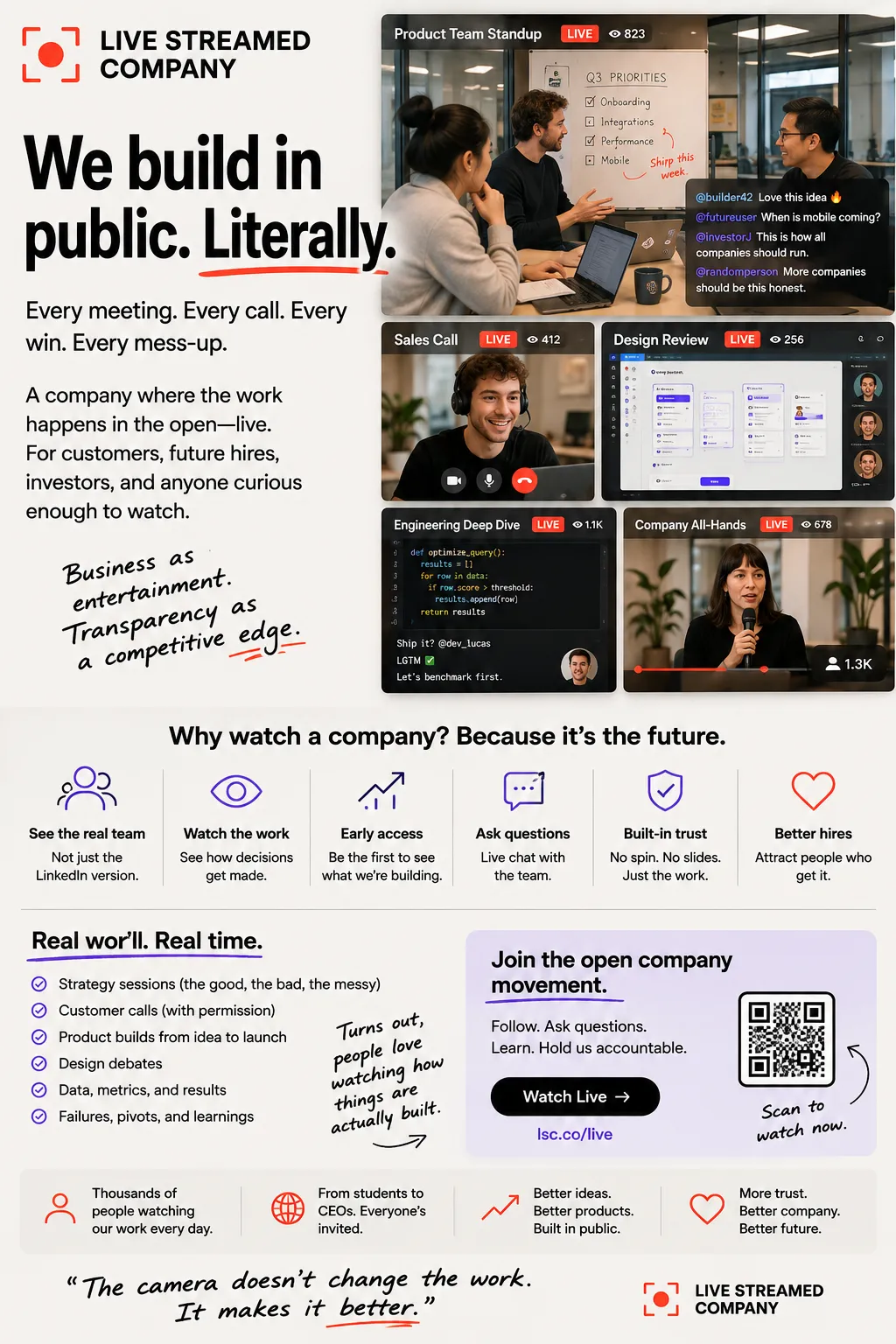
Description
No additional description provided.
The Pitch
A company run in public would turn the most expensive hidden asset inside a business—its daily operating reality—into a compounding media property. Most companies manufacture content after the fact: polished case studies, sanitized launch posts, executive interviews, employer-brand videos. But the raw material people actually trust is the messy middle: how decisions are made, how tradeoffs happen, how skilled people think under constraint. If captured continuously, that work becomes more credible than marketing because it was not created to persuade.
The unusual advantage is that transparency would not just attract attention; it would filter it. People who enjoy the company’s pace, taste, arguments, standards, and culture would self-select long before applying, buying, partnering, or investing their time. Most organizations discover mismatch late, after long hiring loops, sales cycles, onboarding calls, or churn. A public company would make mismatch visible early. The audience would not merely be larger; it would be better sorted.
There is also a strange intimacy in watching competence happen live. Software companies often struggle to explain why their product, process, or team is meaningfully better, because the finished artifact hides the quality of the work. A live operating company makes judgment observable. Customers could see how bugs are handled, how feedback is debated, how urgently problems are treated, and whether the people behind the product seem worth relying on. Trust would come less from brand claims and more from repeated exposure to behavior.
The model would also create a different kind of accountability. Public work changes internal norms because explanations become part of the work itself. People prepare more carefully when reasoning is visible, but they also become more forgiving of imperfection when they see how much uncertainty is inherent in good decisions. That combination—higher standards without the theater of perfection—is rare. It could make the company both more disciplined and more human.
The larger insight is that many companies already behave like media companies, but with the least authentic parts of themselves. They publish announcements, not judgment. They showcase culture, not work. They promote outcomes, not the thinking that produced them. A company that made the work itself observable would collapse the distance between operating, storytelling, recruiting, and trust-building. In a world saturated with polished corporate speech, the business that lets people watch what actually happens may become the one that feels most real.