LifeScript: Interactive Imaginary Biology in Your Browser
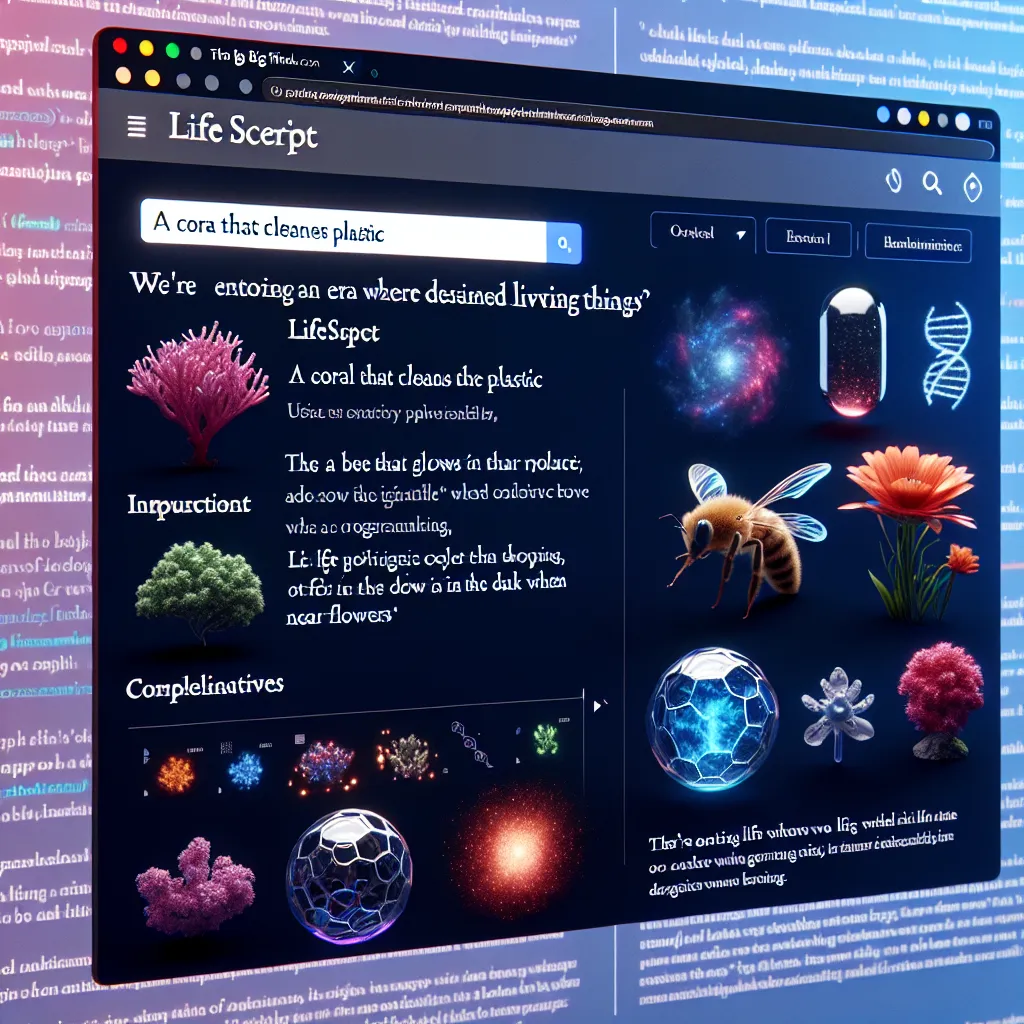
The next revolution in biology won’t happen in a lab — it’ll happen in a browser. For the first time in history, we can write life instead of just reading it. But to most people, that sounds like science fiction. “LifeScript” makes it real — a simple web app where anyone can describe a living thing in plain English (“a coral that cleans plastic,” “a bee that glows in the dark when near flowers”), and AI instantly visualizes it, writes a fake genome, and explains how it would behave in nature. It’s not real bioengineering — it’s creative biology, built for the imagination. The goal isn’t accuracy, it’s literacy: helping people see life as programmable. As AI art taught people to think like designers, LifeScript would teach them to think like biologists. The Big Think article says we’re entering an age where life is written, not discovered — this tool would let anyone pick up the pen.
Description
No additional description provided.
The Pitch
In a world where technology continuously pushes the boundaries of what's possible, the potential to bring biology into the digital space has sparked a thrilling conversation. While traditionally confined to laboratories, the next evolution of biology is poised to take place in an entirely new realm: the web browser. Introducing LifeScript, a groundbreaking web app that transforms the human imagination into creative biology for everyone, making it accessible, engaging, and educational.
Backstory: The modern era of technology has seen remarkable progress in artificial intelligence and genetic engineering. Yet, for many, the intricate processes and terminology of bioengineering remain daunting and inaccessible. The Big Think article highlights an era where life can be written, not merely discovered, ushering in a new mindset where biology is programmable. LifeScript emerges at this intersection of technology and biology, providing a sandbox for creativity and learning.
The Problem: Despite advances in bioengineering, the general public struggles to engage with or understand this complex field. The gap between sophisticated scientific research and everyday comprehension hinders widespread literacy in biological concepts. Moreover, the mystical nature of biology can seem like an unwieldy science fiction rather than a tangible reality.
The Solution: LifeScript acts as a bridge, transforming the complexity of bioengineering into a relatable and interactive experience. By using AI to translate plain English descriptions into creative biological visualizations and narratives, the app demystifies biology. Users can conjure imaginative organisms like a coral that cleans plastic or a bee that glows in the dark near flowers, and witness how these creations would function in nature. This process fosters a mindset that biology can be as malleable as any other programmable language.
Product Details: LifeScript is a user-friendly web application equipped with an intuitive interface. Users describe a hypothetical living organism in everyday language. Leveraging advanced AI algorithms, the app generates a visual representation, fabricates a fictional genome sequence, and offers a narrative on the organism's possible behaviors and ecological roles. At its core, LifeScript is not about scientific accuracy; rather, it emphasizes nurturing a sense of biological curiosity and creativity.
Tools for Launching an MVP: 1. Cloud-based services: Utilize platforms like AWS or Google Cloud for scalable app hosting. 2. AI Frameworks: Implement OpenAI's GPT models or similar to translate text descriptions into complex biological structures. 3. Frontend Development: Develop the interface using React or Vue.js for a seamless user experience. 4. Visualization Libraries: Use D3.js or Three.js to create engaging visual renditions of fictional organisms.
GTM Strategy: 1. Target Early Adopters: Engage educational institutions and science-focused communities through tailored workshops and webinars. 2. Viral Campaigns: Leverage social media platforms by encouraging users to share their unique creations. 3. Partnerships: Collaborate with STEM organizations for outreach and mutual promotion. 4. Influencer Engagement: Involve thought leaders in tech and science to review and promote LifeScript.
Business Model: LifeScript can adopt a freemium model. Basic features and limited creations can be accessed for free, encouraging widespread use, while premium subscriptions offer advanced functionalities like detailed behavioral analyses, extended creation counts, and export options for educational and creative projects. Partnerships with educational institutions could yield tailored packages for classroom settings, encouraging interactive learning.
Conclusion: LifeScript reimagines how we interact with the concept of life itself, turning what once seemed like science fiction into an engaging educational and creative tool. By making biology accessible and fun, it inspires a new generation to perceive life as programmable, ultimately fostering a broader understanding of the interconnectedness of living systems.