Lifecycle Management for Internal AI Software Tools
As AI makes it nearly free for employees to create internal apps, workflows, and copilots, companies are heading toward a new kind of software sprawl where thousands of small tools quietly overlap, break, retain sensitive permissions, or become critical without anyone realizing it. Build a lifecycle-management layer that continuously inventories internally generated software, understands what each tool does, tracks who uses it and what systems it touches, then recommends whether to keep, merge, replace, archive, or delete it. This matters now because the cost of creating software is collapsing much faster than the cost of governing it. Imagine discovering that 14 different sales apps all enrich accounts and draft outreach, while three abandoned tools still have access to payroll and customer data, and consolidating or removing them automatically.
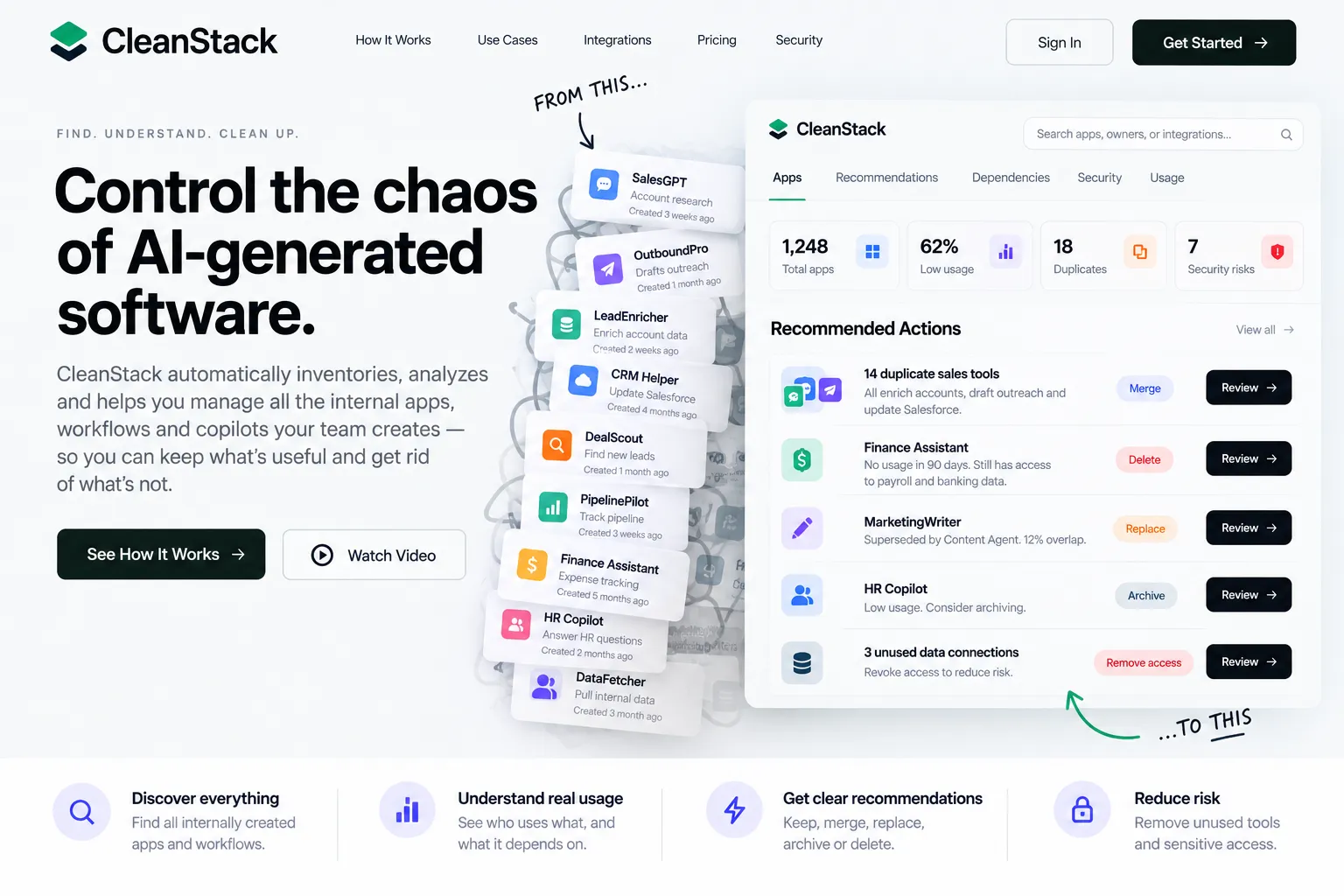
Description
No additional description provided.
The Pitch
This treats internal software not as a set of IT assets, but as a living ecology. When software becomes cheap enough to generate casually, the scarce resource is no longer engineering time; it is institutional coherence. Companies will not suffer because employees create too few tools. They will suffer because nobody can tell which tools matter, which ones duplicate each other, which ones are quietly dangerous, and which ones have become load-bearing by accident.
The non-obvious shift is that “shadow IT” stops being a policy violation and becomes normal work. A marketer making a campaign assistant, a finance analyst building a close checklist bot, or an ops manager wiring together an exception workflow will often be doing the rational thing. The old answer was to block this behavior or force it through central IT. That breaks when the volume rises by orders of magnitude. The better answer is to let creation happen at the edge, while making visibility and cleanup automatic in the center.
There is also a strong asymmetry in value: most of these tools will be small, but the risk and waste they create will not be small in aggregate. One unused workflow with stale permissions is a security problem. Ten similar copilots answering the same customer question are a consistency problem. A spreadsheet-to-app prototype that quietly becomes part of month-end close is an operational resilience problem. The business works because it does not need each individual tool to be important; it only needs the unmanaged mass of them to become impossible to ignore.
The most interesting wedge is that deletion becomes as valuable as creation. Software markets usually celebrate making more: more apps, more automations, more integrations. But in mature organizations, the hidden profit often comes from subtraction. A system that can say “this is redundant,” “this is unused,” or “this should not still have access to that database” gives companies something they rarely have: confidence to remove internal complexity without breaking the business.
Over time, the company that owns this layer could become the record of how work actually runs, not how leadership thinks it runs. Org charts, SaaS inventories, and process documents are all incomplete maps. The generated-tool layer would reveal the informal machinery employees build to get around bottlenecks, translate policies into action, and patch gaps between systems. That makes it more than governance. It becomes a mirror of the company’s operating reality.