Licensing Platform for Robot Skill Rights
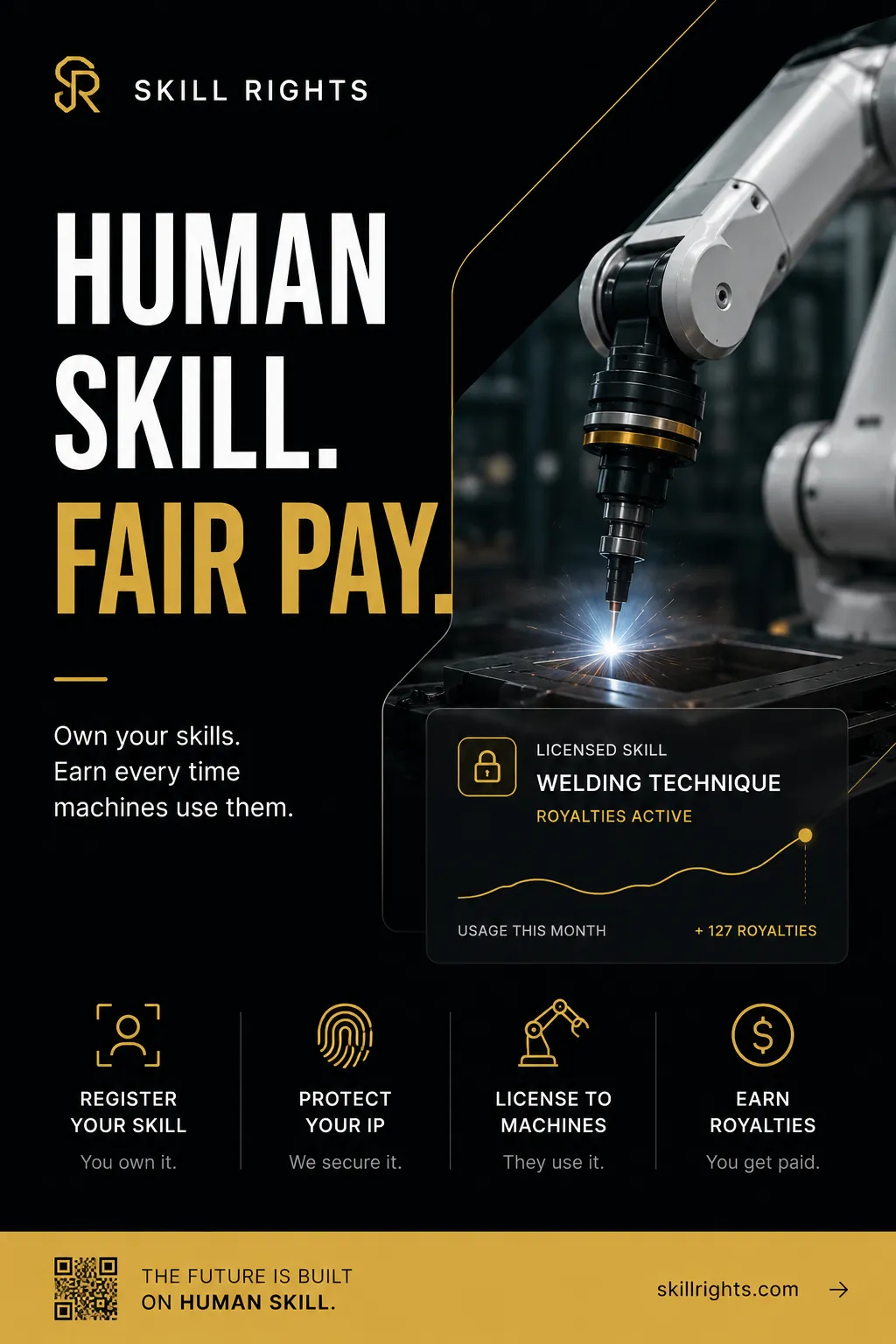
Robotics companies are already buying human-motion datasets, including platforms that compensate people for recording tasks. The bigger unanswered question appears after robots actually learn from them: who owns the resulting machine skill? Skill Rights would create a new intellectual-property primitive allowing a human or organization to register a distinctive physical process—an expert welding technique, surgical maneuver, manufacturing sequence or repair method—and license the right for machines to reproduce it. Rather than getting $20 once for a training video, an expert could receive royalties whenever a commercially deployed robot executes a certified skill derived from their registered process. As human demonstrations increasingly become executable robot behavior, copyright may prove poorly suited to the thing that matters. Skill Rights would turn human know-how itself into a licensable machine asset.
Description
No additional description provided.
The Pitch
Training data as a commodity and embodied expertise as a scarce productive asset. Video of a welder is cheap; the years of tacit adjustment in wrist angle, heat, pressure, timing, and recovery from small errors are not. If robots eventually perform valuable physical work by absorbing those patterns, the economic unit should not be the recording but the repeatable capability extracted from it.
The important shift is that automation changes the shape of labor ownership. In software, code can be copied endlessly, so licenses emerged around reproduction and use. In robotics, the copied object may be a gesture, a sequence, a feel for material behavior, or a way of solving edge cases in the physical world. Existing intellectual-property categories were built for inventions, brands, texts, and media, not for the operational signature of a skilled person’s hands. A company that defines, verifies, and enforces that missing category could become the registry of record for machine-usable human expertise.
This becomes more valuable as robots move from controlled demonstrations into commercial deployment. The moment a robot performs a task in a factory, hospital, shipyard, kitchen, or mine, someone will care whether that skill is safe, traceable, auditable, and legally clean. Buyers will not only want the best-performing behavior; they will want provenance. A licensed skill could function like a certified part in a supply chain: not just something that works, but something whose origin, permissions, and liability boundaries are legible.
The business is especially interesting because the best skills may be highly local and under-documented. Many of the most valuable physical processes are not patented, published, or formally taught; they live inside experienced technicians, surgeons, craft workers, mechanics, and operators who know how to handle ugly real-world variation. If those people can participate in the downstream economics of automation, the supply of high-quality demonstrations changes from reluctant extraction to active contribution.
The deeper thesis is that robots will not merely replace labor; they will create a market for the reusable fragments of human mastery. The companies that organize that market will not be selling data so much as legitimacy: a way for machines to inherit human skill without erasing the humans it came from.