Liability Network for AI Agent Transactions
AI agents are starting to get permission to spend money, change records, issue refunds and act across company systems, but most infrastructure only answers whether the agent is authenticated. That is no longer enough. A receiving system also needs to know who authorized the agent, what it is allowed to do, what limits apply and who is financially responsible if the action goes wrong. Build a Machine Liability Network that attaches identity, delegated authority, policy limits and financial backing to every consequential agent action before it executes. The receiving system can approve it, require human authorization or reject it, with a tamper-evident record created automatically. As agents become economic actors, the missing layer may be less about identity and more about accountability.
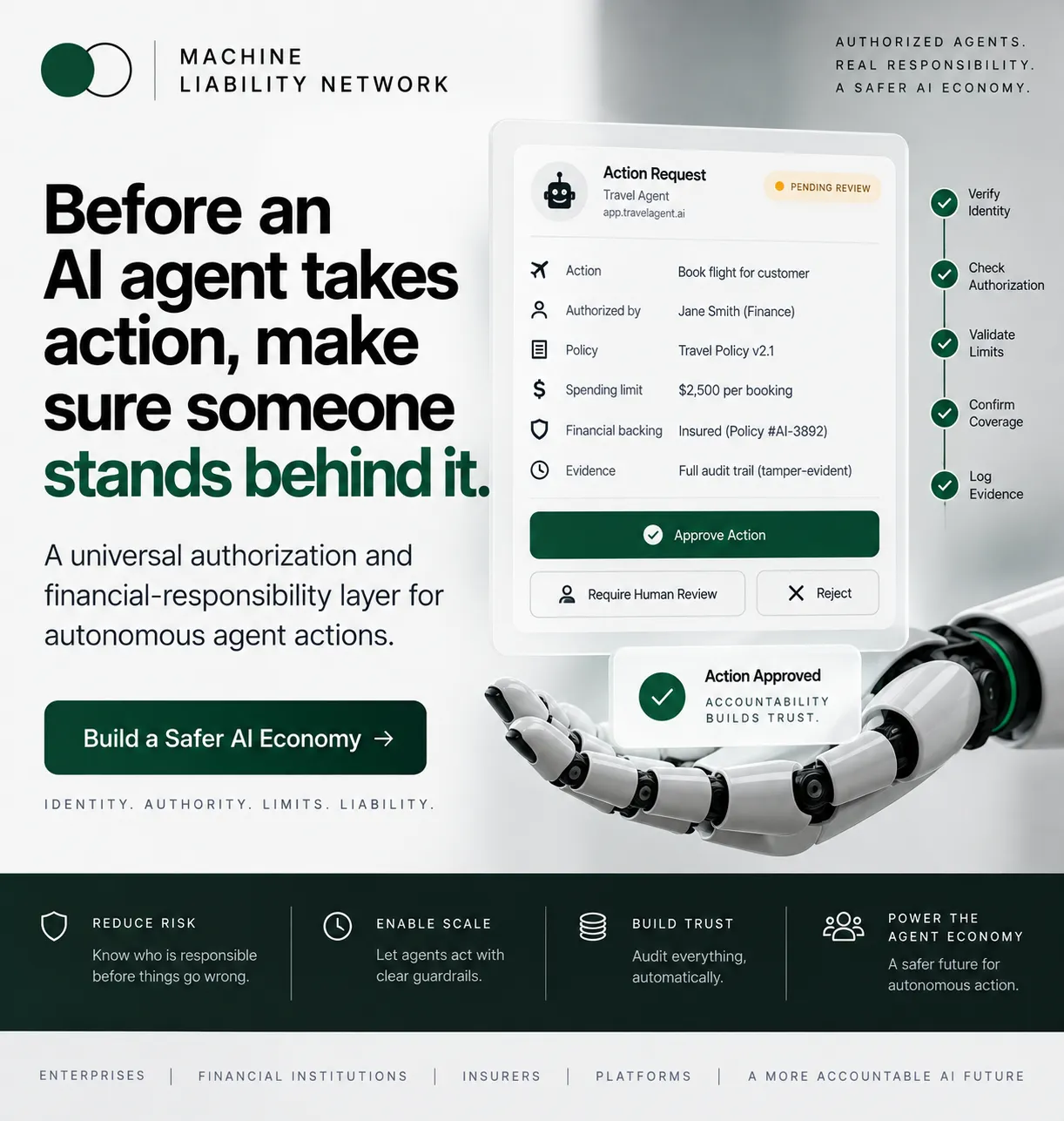
Description
No additional description provided.
The Pitch
This sits at the moment where software stops being merely a tool and starts becoming a counterparty. Companies are comfortable giving APIs keys, employees permissions, and vendors contracts, but an autonomous agent blurs all three categories at once. It may be operated by one company, instructed by another, acting inside a third system, and triggering obligations for a fourth. The valuable layer is not intelligence; it is the answer to a more commercial question: “If this machine does something consequential, whose promise is behind it?”
The interesting wedge is that trust between businesses is usually slow, bespoke, and legalistic, while agent activity will be fast, frequent, and machine-readable. Today, a risky action often falls back to human judgment because the surrounding trust context is unavailable in the transaction itself. If authorization, limits, auditability, and recourse can travel with the action, then many decisions that currently require review become safe enough to automate. The network would not make agents omnipotent; it would make their boundaries legible.
This could become more powerful as a shared network than as an internal control product. A company can define its own agent policies, but the harder problem is getting other companies to recognize them. The first time a marketplace, bank, insurer, SaaS platform, or logistics provider accepts an agent’s action because it carries standardized accountability, the network begins to resemble a commercial passport for machines. The defensibility comes from mutual recognition: every additional participant makes it easier for others to trust unfamiliar agents without negotiating from scratch.
The non-obvious economic insight is that liability can be a lubricant, not just a penalty. Many valuable automations are blocked not because the task is technically hard, but because no one wants to own the downside. If a machine action can arrive with a clear responsible party and predefined financial backstop, recipients can accept more automation without absorbing open-ended risk. That turns accountability from a compliance afterthought into an enabling primitive.
The business would matter most in domains where mistakes are expensive but human review is too slow: refunds, procurement, claims, payments, access changes, inventory commitments, contract operations. In those workflows, the bottleneck is rarely whether software can complete the action. It is whether the other side can trust the action enough to let it happen. A Machine Liability Network would monetize the gap between capability and permission, which may become one of the central constraints of the agent economy.