Knowledge Validation Software for Business Assumptions
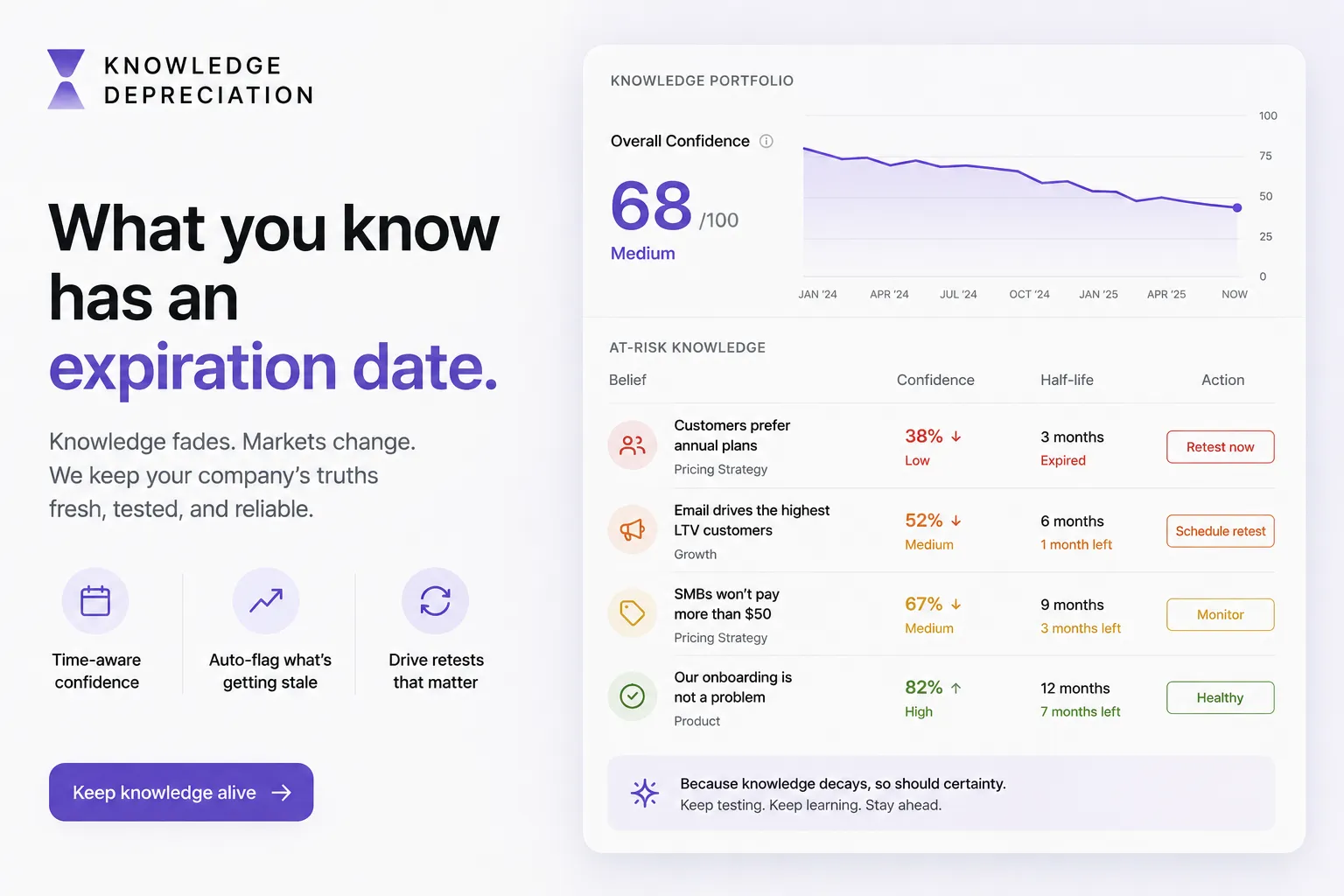
Companies accumulate thousands of facts they treat as permanently true: customers prefer annual plans, this channel doesn't convert, buyers won't pay above $50, this market isn't ready. But knowledge has a half-life—something already recognized academically. Knowledge Depreciation would assign an expiration curve to important organizational beliefs based on their evidence, age and how quickly the underlying environment changes. As confidence decays, beliefs automatically return to the experimentation queue. Companies wouldn't just maintain a knowledge base. They'd know when their knowledge stopped being knowledge.
Description
No additional description provided.
The Pitch
Most organizations are not limited by a lack of data; they are limited by the persistence of old conclusions. The dangerous artifact inside a company is not the document nobody reads, but the decision everyone still obeys because it was once correct. “We tried that” is often treated as timeless evidence, even though the market, product, team, brand, pricing, competitors, and customer expectations may all have changed since the trial. The business works if it can make expired certainty visible.
The most interesting insight is that companies already manage depreciation for physical assets, but not for beliefs. A laptop, server, or machine is assumed to lose usefulness over time; a market insight from eighteen months ago is often treated as if it has no decay function at all. That inversion is strange because beliefs can become obsolete faster than hardware. In fast-moving categories, the most expensive asset on the balance sheet may be a false internal memory that keeps preventing good experiments.
This would also turn experimentation from an ad hoc act of curiosity into a maintenance function. Most teams run tests to discover new things, but fewer run tests to verify that old things are still true. That distinction matters. The easiest growth opportunities are often not novel ideas but resurrected ideas whose timing was previously wrong. A channel that failed before attribution improved, a price point that failed before the brand matured, or a segment that failed before the product expanded can quietly become viable while the organization continues acting on the old rejection.
The product’s value would come from changing the status of internal claims. Instead of treating every past decision as tribal knowledge, it would force a company to ask what kind of fact it is dealing with: a physical constraint, a customer preference, a competitive assumption, a regulatory interpretation, a pricing belief. Each decays differently. “The API cannot support this” may expire after a release cycle; “CFOs need legal review” may decay slowly; “TikTok won’t work for B2B” may be rotten almost immediately.
The deeper business is a market for organizational doubt. Well-run companies do not merely know more than competitors; they forget more accurately. They can distinguish durable truths from stale opinions before those opinions harden into strategy. If this existed, it would make one of the most invisible forms of waste measurable: the revenue, speed, and imagination lost to beliefs that outlived their evidence.