Investor Incentive Platform for Startup Fundraising
Startup fundraising has a strange coordination problem: twenty investors may want into a round once somebody else commits first. Lead Bounties lets founders put explicit economics behind solving that problem. A company might offer an investor additional warrants or economics if its $2 million commitment causes another $5 million of capital to close within 30 days. The investor isn't being rewarded simply for investing; they're being paid for creating liquidity that otherwise wouldn't exist. Eventually the market could reveal something founders can't easily see today: which investors don't merely participate in rounds, but actually cause rounds to happen.
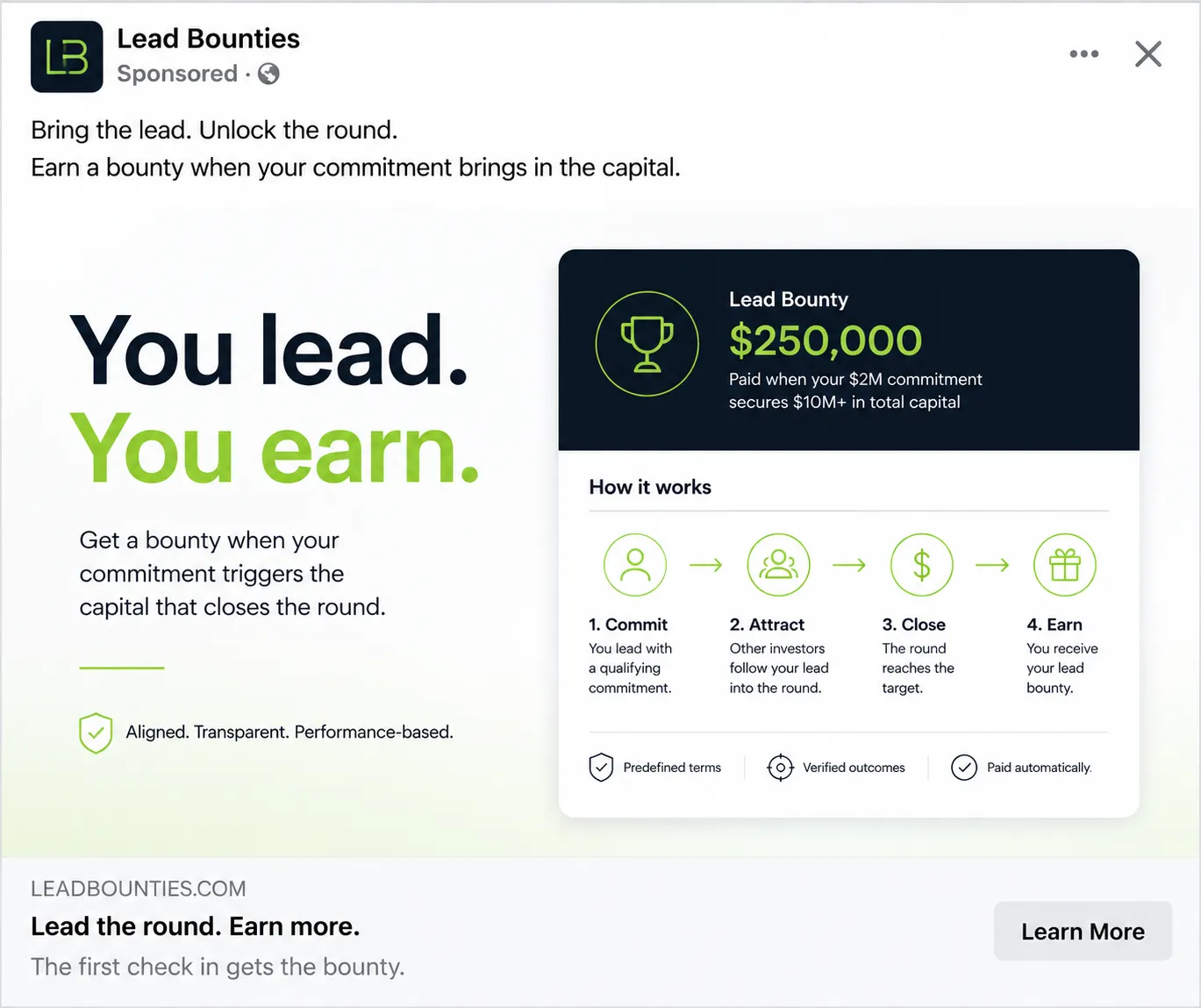
Description
No additional description provided.
The Pitch
Turns “lead investor” from a vague social status into a measurable economic function. In fundraising, the first serious check often has value far beyond its dollars because it converts private interest into public confidence. Today that value is captured informally through allocation, signaling, reputation, and access. Making it explicit would expose an uncomfortable truth: some investors are genuinely catalytic, while others are just fast followers who benefit from the work of conviction without paying for it.
This could matter because fundraising is not just a capital-raising process; it is a market for belief under uncertainty. The hardest thing a founder sells is not the company, but the idea that other credible people will also believe in it soon. A mechanism that rewards investors for creating that belief would price something that is currently treated as etiquette. The investor who helps a round close is not merely providing money; they are reducing perceived risk for everyone else. That risk reduction is economically valuable, even if startup culture has historically hidden it behind relationships and whispered endorsements.
It also changes the founder’s relationship with urgency. Many rounds fail not because nobody is interested, but because interest never becomes synchronized. Everyone is waiting for evidence that the round is real, and the founder is stuck manufacturing momentum one conversation at a time. If an investor can be compensated for breaking that stalemate, fundraising becomes less dependent on invisible favors and more like a market where coordination itself has a price. That is especially powerful in markets where good companies are overlooked because they lack the right social shortcuts.
The deeper opportunity is data. Over time, the company could build a record of who actually moves capital, not who tweets about supporting founders or appears on cap tables after rounds are already oversubscribed. That information would be valuable because venture is full of claimed influence and very little attribution. A founder deciding who to prioritize does not just need to know who can write a check; they need to know whose check changes everyone else’s behavior. If this existed at scale, it could create a new kind of investor reputation based on causality rather than branding.
The business works if it becomes normal to distinguish participation from momentum creation. Startup financing already pays for scarcity, access, and conviction. This would add a missing category: payment for making belief contagious.