Internet-Connected Miniature Robotic Band for Homes
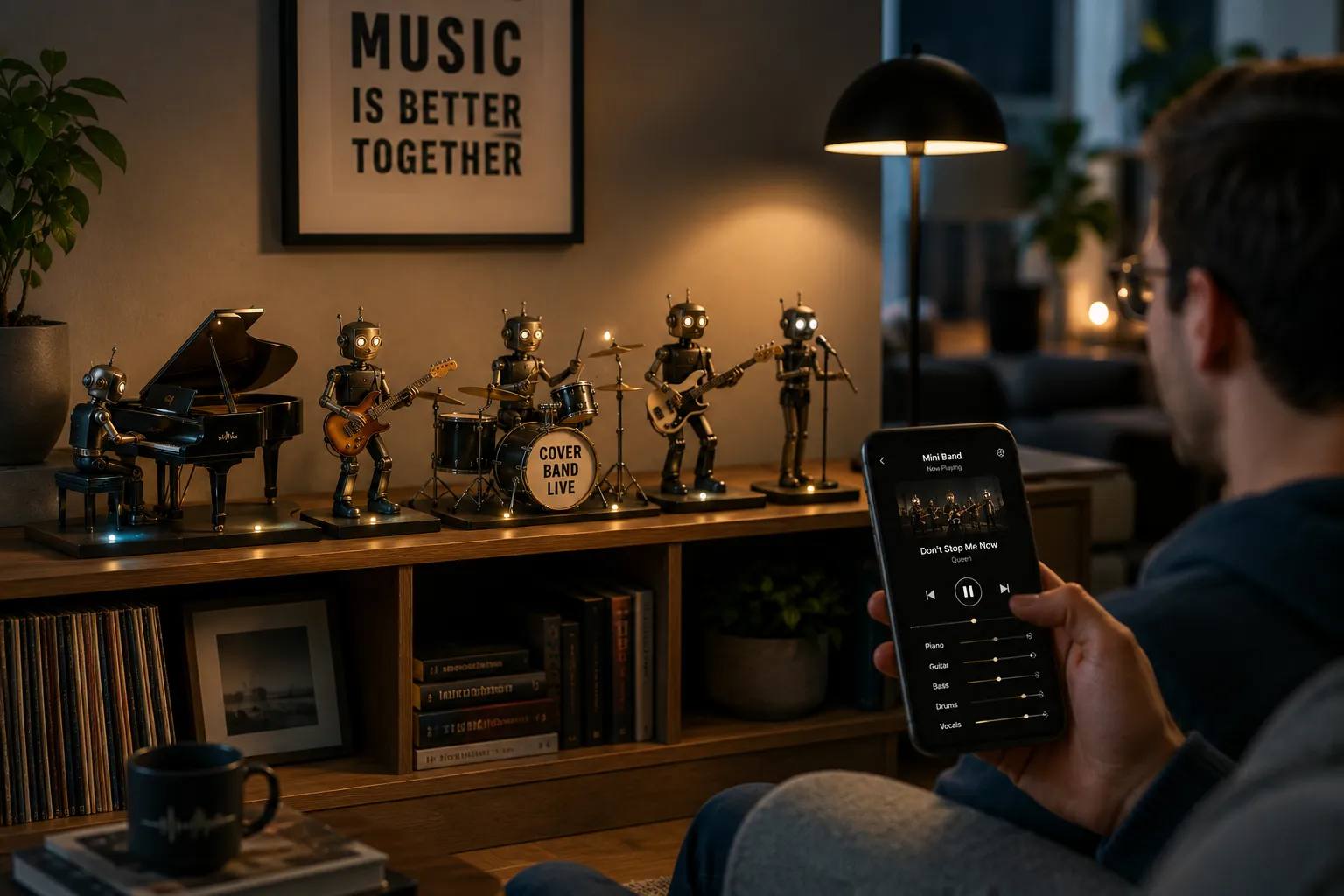
Streaming music has become perfectly digital, but in doing so it has lost the visual and physical magic of watching instruments actually perform. An Internet-Connected Miniature Band consists of tiny robotic instruments—a piano, guitar, drums, bass, and more—that physically play songs in your home rather than simply playing speakers. Whether connected to streaming services or even controlled remotely by musicians across the world, the experience turns passive listening into living art. Advances in affordable robotics, servos, connected devices, and AI-generated MIDI files make miniature automated instruments far more achievable than they once were. Imagine placing a tiny band on your bookshelf and asking it to play your favorite Beatles song, then watching each miniature instrument physically perform the music in perfect synchronization.
Description
No additional description provided.
The Pitch
The strange opportunity is that streaming made every song available and therefore made any single song feel less special. A miniature band reintroduces scarcity in the one place streaming cannot: the moment of performance. Even if the sound ultimately comes through small transducers or augmented speakers, the fact that something in the room is moving, striking, plucking, and keeping time changes the emotional category from playback to event.
The object also has a quality most consumer electronics have lost: it can be watched by people who are not actively using it. A phone is personal, headphones are private, and smart speakers disappear into the background. A tiny band on a shelf is ambient theater. It gives music a social surface again, something guests notice, children stare at, and owners keep on display even when it is off. That matters because the best home objects are not merely functional; they become part of how a room expresses taste.
Its defensibility would come less from robotics alone than from the translation layer between the world’s music and believable physical performance. A cheap robot can move on command; a magical one appears to understand the song. The hard and valuable asset would be the system that maps recordings into expressive, instrument-specific gestures: when the drummer hesitates, when the pianist’s hands cross, when the bassist looks busy during a walking line. The more convincing the choreography, the more the product escapes the toy category and becomes a new medium for recorded music.
There is also an unusual emotional wedge: people already pay for miniature versions of things they love when the miniature preserves the soul of the original. Model trains, mechanical watches, dollhouses, and music boxes are not rational substitutes for transportation, timekeeping, homes, or orchestras. They are compression artifacts of affection. A miniature band would sit in that lineage, but with an infinite catalog rather than a fixed tune.
If it worked, the company would be valuable because it would give recorded music a body. The history of music technology has repeatedly traded presence for convenience. This would be one of the rare products that uses software not to abstract the world further, but to put a little bit of it back into motion.