Internal Prediction Markets for Business Forecasting
Every company depends on forecasts, but most predictions disappear into spreadsheets, meetings, or executive opinions without ever being measured. Organizations rarely know who consistently makes accurate predictions or whether confidence should change as new information arrives. Outcome Futures creates internal prediction markets where employees continuously price the probability of important business events, turning collective judgment into a living forecast. As AI reduces the cost of operating thousands of small markets, businesses can replace static planning with dynamic probabilities that improve decision making. Before launching a new product, employees could trade contracts on whether first-year revenue targets will be achieved, giving leadership an objective signal for hiring, inventory, and marketing decisions.
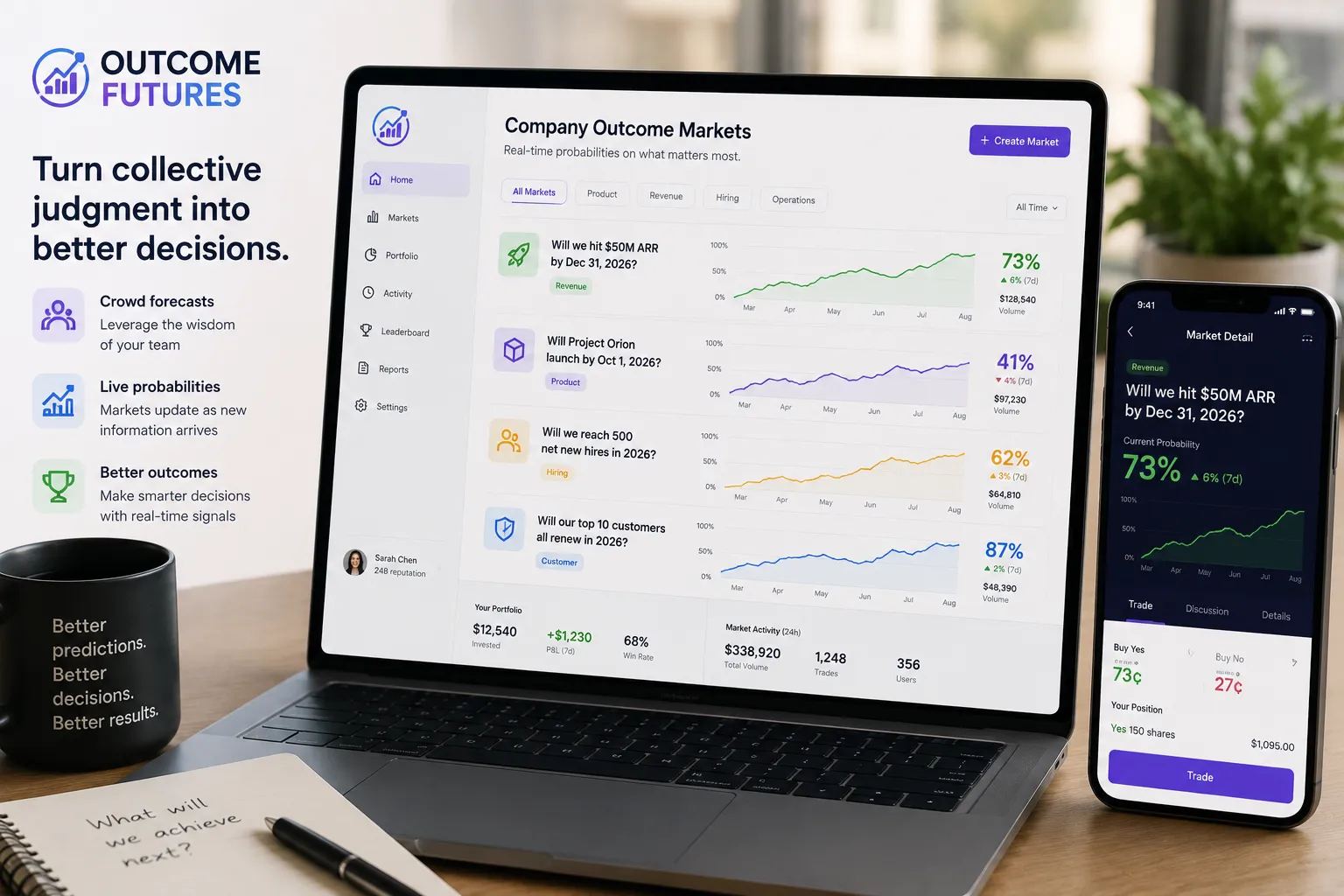
Description
No additional description provided.
The Pitch
The hidden asset inside most organizations is not data, but dispersed judgment. The person closest to a supply constraint, customer hesitation, regulatory delay, or sales cycle slippage often knows something valuable long before it becomes visible in official metrics. The problem is that companies are designed to launder that knowledge through hierarchy, where nuance becomes optimism, dissent becomes politics, and uncertainty becomes a single number in a deck.
The most interesting part is that prediction markets change the shape of internal truth. In a meeting, being early and wrong is costly, especially if the forecast contradicts the preferred plan. In a market, uncertainty can be expressed incrementally, anonymously if needed, and updated without forcing a public confrontation. That makes it possible for weak signals to accumulate before they are strong enough for someone to risk saying out loud. The business is not really selling forecasts; it is selling a less theatrical way for organizations to notice what they already know.
It also creates a memory system for judgment, which companies mostly lack. Executives remember the person who made the dramatic correct call, not the quiet employee who was consistently well-calibrated across dozens of decisions. Once predictions are tracked over time, credibility becomes earned rather than assumed. That has strange and powerful implications: expertise can be discovered in unexpected places, overconfident functions can be exposed, and planning can shift from who sounds most certain to who has actually been right under uncertainty.
The timing matters because prediction markets used to be too costly and awkward for everyday business questions. AI changes the granularity. Markets no longer need to be reserved for a few board-level questions; they can exist around hundreds of operational uncertainties, with contracts generated, clarified, summarized, and resolved at low cost. The result is a forecasting layer that sits between raw data and human decision-making, updating as the organization learns.
The deepest appeal is that this turns planning from an annual ritual into a continuous measurement of belief. Most companies pretend the future changes only when the spreadsheet is revised. A living probability makes disagreement useful, uncertainty visible, and changing one’s mind normal. In a world where speed increasingly depends on recognizing reality sooner than competitors do, that could be a very valuable habit.