Internal Marketplace for AI Compute Allocation
Companies are about to have thousands of AI tasks competing for finite compute, but almost no system for deciding which work is actually worth the cost. Compute Market is an internal allocation layer where every agentic task carries an expected business value, urgency, quality requirement, and compute price; the system then decides whether to run it, delay it, downgrade the model, or kill it entirely. A sales prospecting agent expected to generate $50,000 might get frontier-model access immediately, while rewriting an internal memo gets routed to a cheap model overnight. AWS is already worrying about CPU waste before most companies even have serious agent fleets. Eventually businesses may manage AI compute the way they manage capital: not “can we run this?” but “is this the highest-return use of the resource?”
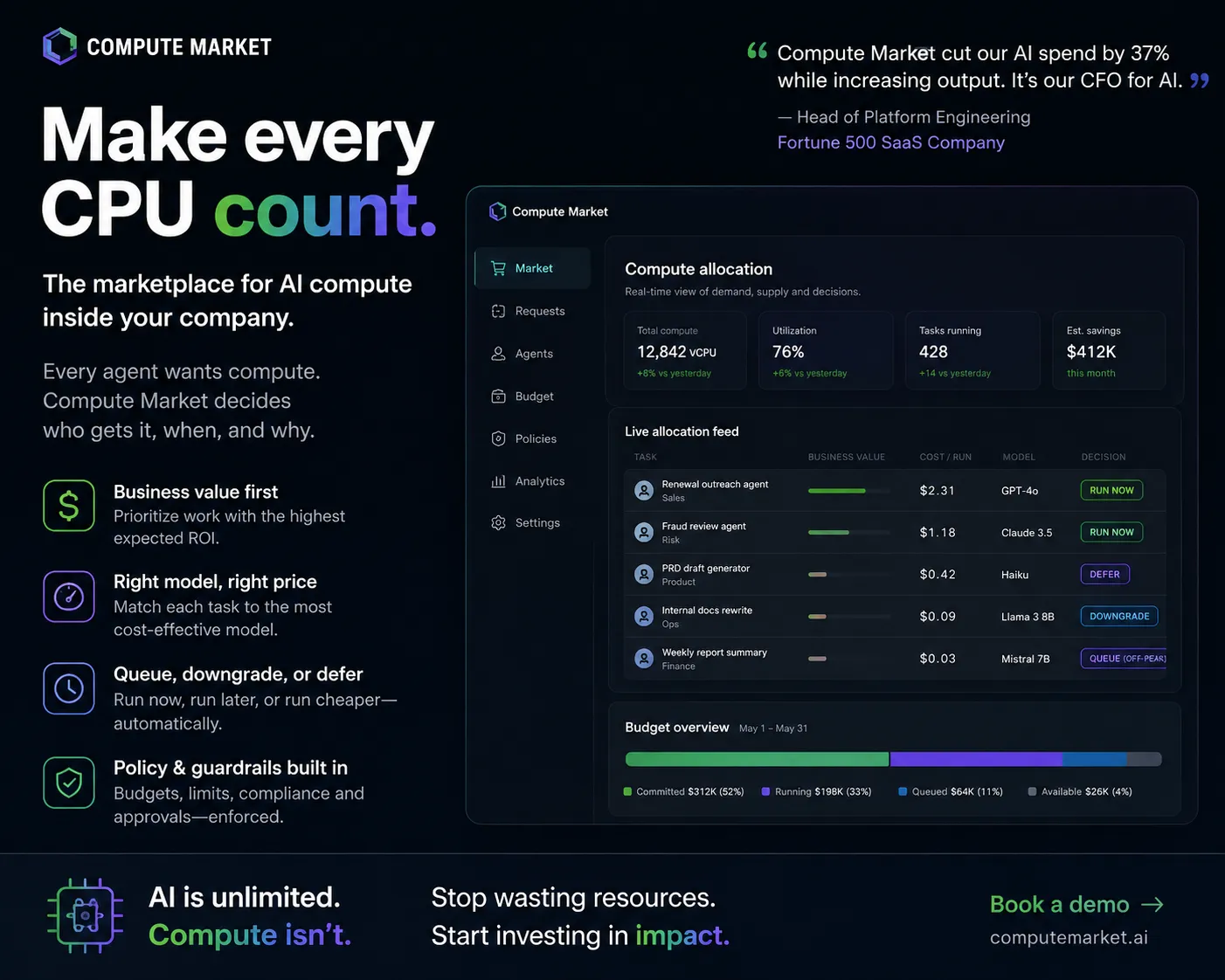
Description
No additional description provided.
The Pitch
This business is that it treats compute not as infrastructure, but as a new internal currency. As companies add agents, the bottleneck will not simply be model capability or cloud capacity; it will be judgment. Today, software systems mostly assume that if a task is triggered, it should run. In an agent-heavy company, that assumption becomes absurd. A thousand small automations can silently become a shadow workforce with no manager, no budget discipline, and no sense of opportunity cost.
The most interesting shift is that AI work has a marginal cost in a way traditional software often pretended not to. A human employee deciding whether to spend an hour on a task implicitly weighs importance, urgency, and expected payoff. Agents do not. They will happily spend expensive inference on low-value ambiguity unless something external imposes taste. The company that owns this decision layer becomes less like a cost-optimization tool and more like the mechanism by which an organization teaches its AI systems what matters.
This also creates a new kind of observability. Existing dashboards can tell a company where money went; they rarely say whether the work deserved to happen. Once each AI task is tagged with expected value and actual outcome, management gets a ledger of machine labor: which departments generate returns from compute, which workflows are noisy, which agents ask for too much intelligence, and which decisions were only worth making because models got cheaper. That is more revealing than a cloud bill because it connects spending to organizational intent.
The business becomes stronger as model choice gets more fragmented. In a world with one dominant model, routing is mostly procurement. In a world with dozens of models, context windows, latency profiles, tool-use abilities, and price points, every task becomes a tiny allocation decision. Most companies will not want every team improvising those decisions in code. They will need a neutral internal market that can translate business priority into machine execution without requiring every employee to understand inference economics.
The durable insight is that autonomous work requires autonomous budgeting. Once agents can initiate tasks, consume resources, and chain decisions together, companies need a way to say no at machine speed. The winning system will not merely reduce waste; it will make AI labor governable. That is a deeper and more valuable role than saving money, because unmanaged abundance often becomes its own form of scarcity.