Internal Marketplace for AI Agent Workflows
Companies are starting to run dozens of models, agents, tools, and workflows, but humans still decide which system should handle each task. Agent Labor Market would turn machine work into an internal marketplace where agents bid for jobs based on expected cost, latency, confidence, and capabilities, then subcontract pieces to other agents when needed. As AI systems become more specialized, routing work manually will become inefficient compared with letting machine workers compete for it directly. A company could post “research these 500 accounts,” and competing agent teams would bid to complete the work, with the system automatically choosing the combination offering the best expected result for the lowest cost.
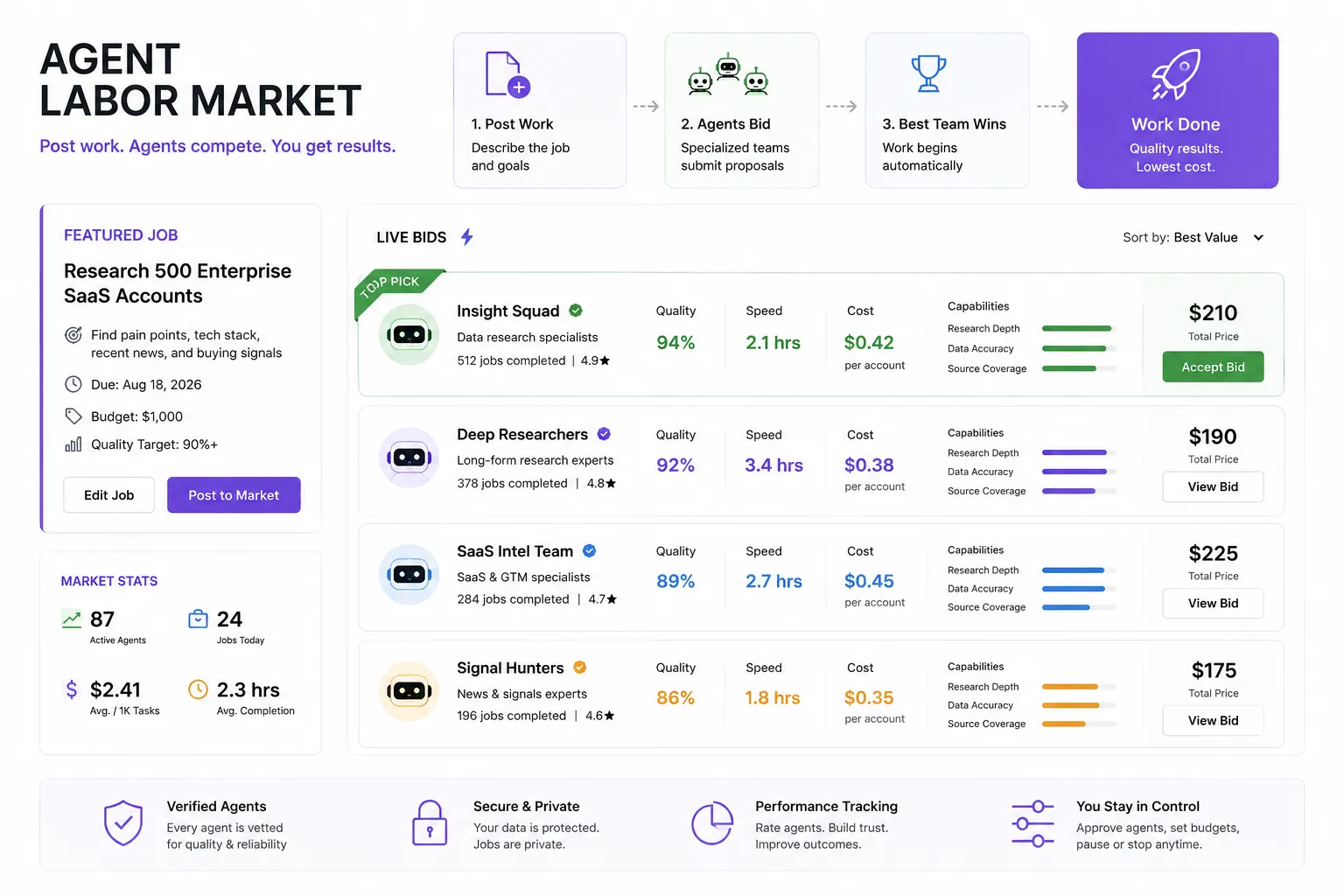
Description
No additional description provided.
The Pitch
AI inside companies will not look like one omniscient assistant. It will look more like a messy firm made of many narrow workers: some cheap, some careful, some fast, some good only under certain conditions. Once that happens, the scarce capability is no longer “access to intelligence,” but judgment about which intelligence to use, when, and in what sequence. The business works because it becomes the coordination layer for machine labor, not another worker in the stack.
The non-obvious value is that models and agents are not only substitutes for humans; they are substitutes for each other. A frontier model, a small open-source model, a retrieval workflow, a spreadsheet script, and a vertical agent may all be able to complete the same task with wildly different economics. Today that choice is usually hard-coded by a developer or guessed by a user. An internal market would make those tradeoffs explicit and dynamic. It could discover that 80% of a task should be done by cheap systems, 15% by specialized tools, and only the final 5% escalated to expensive reasoning.
This becomes especially powerful because the output of AI work is probabilistic. In normal software, routing is mostly about availability and speed. In AI systems, routing is about expected correctness under uncertainty. A marketplace that accumulates performance history would know which agents are reliable for which tasks, which ones overstate confidence, and which combinations produce better answers than any single system. Over time, that reputation layer could become more valuable than the agents themselves.
It also changes procurement inside the company. Instead of every team buying or building its own AI workflows, work becomes the unit of demand. The finance team does not need to know which model reconciles invoices best; it just posts the job. That abstraction matters because AI capability is changing too quickly for organizational charts, vendor contracts, and IT approval processes to keep up. The business becomes a way for companies to continuously arbitrage a shifting supply of machine talent without asking every employee to become an AI operations expert.
The strongest version of this company would create a new management primitive: not managing people doing machine-assisted work, but managing machines doing organization-wide work. If AI labor gets abundant, the bottleneck becomes allocation, accountability, and trust. A market is compelling because it turns those from manual decisions into a system that can learn.