Intent Firewall for Enterprise AI Agents
AI agents are beginning to execute work instead of simply answering questions. Existing security systems focus on what an agent is allowed to access, but almost nothing evaluates whether an action matches what the user actually intended. This creates a new category of risk where an AI follows instructions that are technically permitted but strategically wrong. An Intent Firewall sits between every AI agent and every action, evaluating requests against historical behavior, company policies, and stated objectives before execution. If something looks unusual, it pauses the action, explains why, and requests approval. As AI moves from copilots to autonomous workers with write access across enterprise systems, intent becomes a more important security primitive than permissions. A finance agent preparing to wire $750,000 to a new vendor could recognize that the transaction falls outside normal company behavior and stop the payment before it happens.
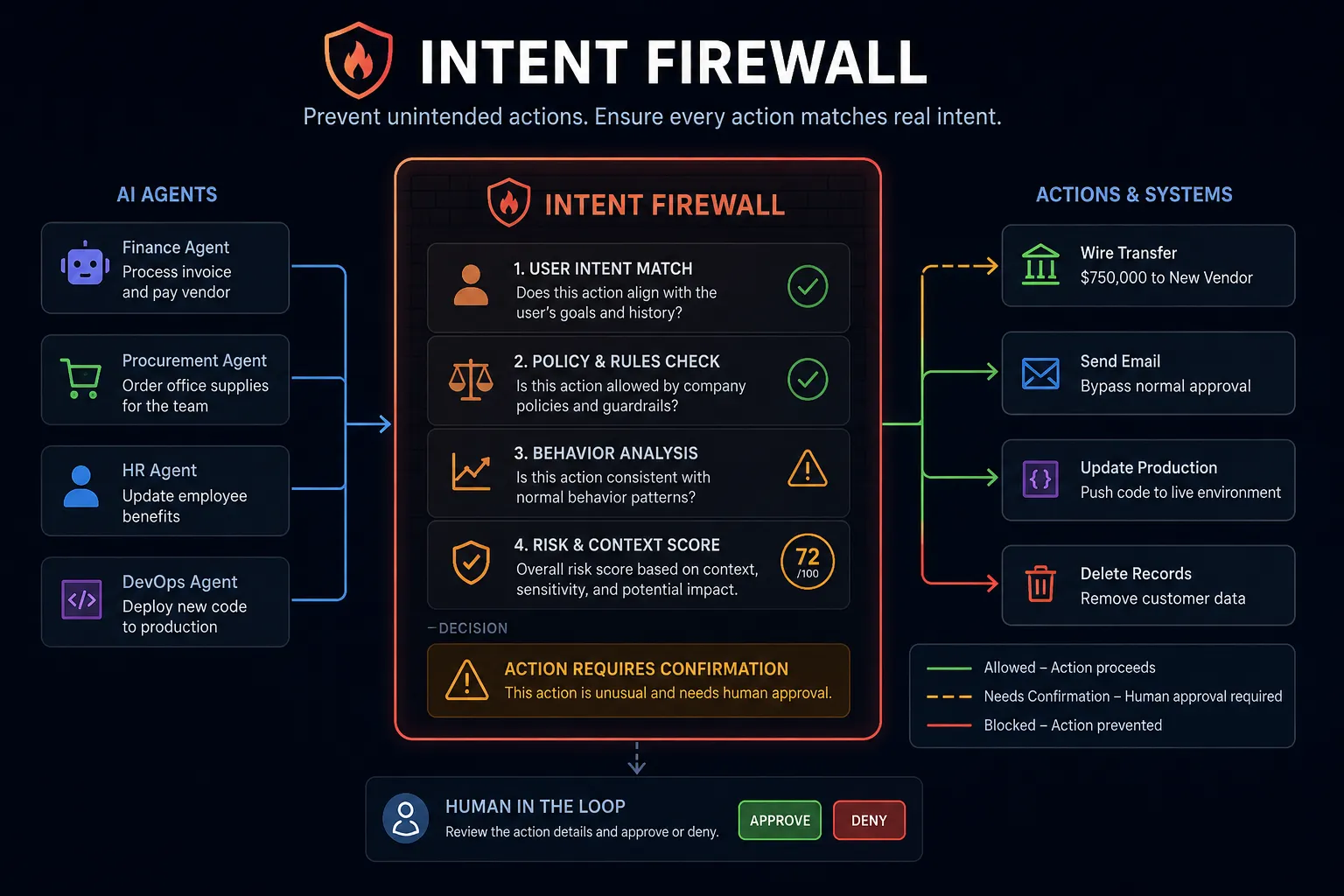
Description
No additional description provided.
The Pitch
Permissions were designed for humans, not software that improvises. A human employee with access to Salesforce, Workday, GitHub, and banking tools still carries context in their head: what the company is trying to do, what would be politically strange, what a normal customer refund looks like, which vendor names feel suspicious. An AI agent can be granted the same access without inheriting that judgment. The gap between “allowed” and “wise” becomes a product category the moment agents can act without waiting for a human click.
The important shift is that enterprise security has historically protected assets, while autonomous work requires protecting decisions. A database query, contract edit, refund, credential change, or outbound email may each be harmless in isolation, yet disastrous in context. The valuable control point is not another identity layer but a reasoning layer that asks whether the action makes sense given the actor, timing, history, counterparties, and stated goal. That makes the product less like a gate and more like institutional memory made executable.
This business also benefits from a rare asymmetry: the cost of stopping one bad action can be enormous, while the cost of adding a review moment is tolerable if the system is selective. Companies already accept friction around wire transfers, production deploys, legal approvals, and data exports because certain mistakes are not reversible. As agents expand into those workflows, the budget will come not from abstract AI fear but from very concrete anxiety: no executive wants to explain that the software did exactly what it was technically allowed to do.
The most interesting part is that the firewall improves as it watches normal work. Unlike static policy software, it can learn the texture of an organization: which approvals are ceremonial, which customers are sensitive, which vendors are routine, which actions only happen during quarter-end, which combinations of systems are unusual. Over time, that behavioral map becomes a defensible asset because it is specific to the company’s operating rhythm, not just its security rules.
If AI agents become a standard interface for enterprise labor, then intent verification becomes a background utility every serious company needs. The winning product would not be the one that blocks the most; it would be the one that knows when not to interrupt. Trust in autonomous work will depend less on making agents smarter in the abstract and more on giving organizations a way to say, “This may be possible, but it is not what we meant.”