Insurance for Digital Distribution Channel Risk
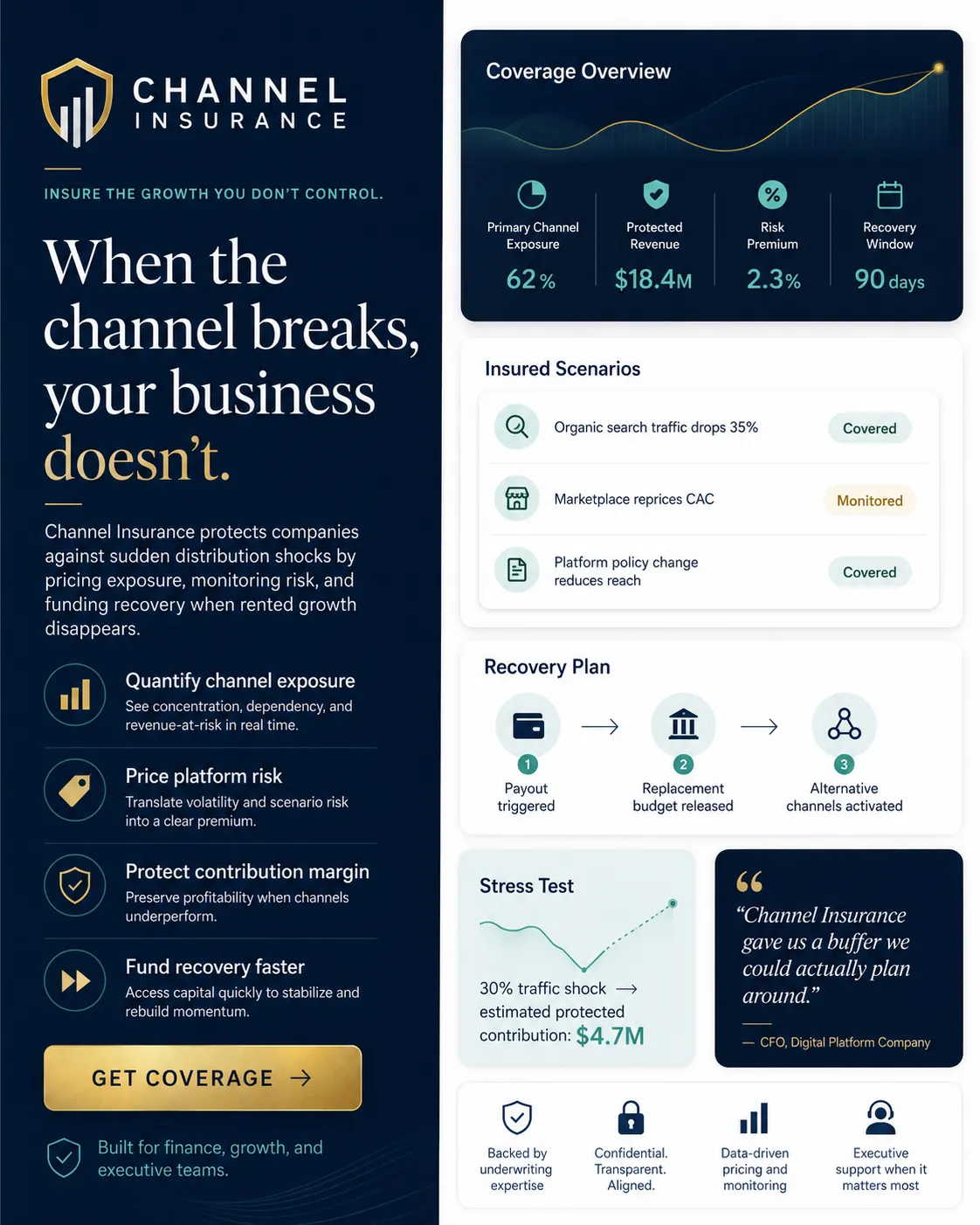
If dependence on Google, Meta, Amazon, TikTok or another platform can be quantified, it can potentially be underwritten. Channel Insurance would insure companies against material distribution shocks. The company pays a premium based on concentration, historical volatility, owned-channel coverage and replacement capacity. If a defined channel event occurs, the policy funds replacement acquisition or pays against lost contribution margin. The software underneath becomes extremely valuable because underwriting requires a proprietary model of distribution fragility. Example: 62% of a company's contribution margin depends on Google organic. Channel Insurance prices that exposure, requires the company to maintain minimum first-party capture and pays out if qualifying traffic falls more than 35% for a defined period. This is obviously much harder and regulated, but it is genuinely novel. And the insurance product itself creates an incentive for companies to install the risk software.
Description
No additional description provided.
The Pitch
Distribution has quietly become one of the largest uninsured balance-sheet risks in modern business. A factory can insure against fire, a retailer can insure against theft, and a software company can insure against downtime, but a brand whose economics depend on a search algorithm or ad auction is often exposed to a single opaque decision by another company. The strange thing is that many of the most valuable digital businesses are less fragile in operations than in access: their product may work perfectly while their revenue disappears.
This business would also turn a vague executive anxiety into a measurable financial object. Today, “platform risk” is usually discussed in hand-wavy terms, even though it behaves like a real hazard: concentrated exposure, observable volatility, correlated events, and recoverable losses. Once that risk is modeled, it stops being merely a strategic concern and becomes something companies can budget for, reduce, transfer, and compare. The act of underwriting would create a new category of management discipline around distribution, much the way cyber insurance forced companies to inventory systems they had previously ignored.
The most interesting wedge is that the insurer would learn things no individual company can see. One merchant knows its own Amazon exposure; one publisher knows its own Google exposure. But an underwriter looking across many companies could detect which types of dependence are genuinely dangerous, which mitigations actually matter, and which channel shifts are usually temporary versus existential. That pooled memory is the asset. Over time, the company would not just price risk; it would become one of the few institutions with a statistically grounded map of how platform power translates into business fragility.
It is also compelling because the product changes behavior before anything bad happens. A normal analytics tool can warn a company that it is overexposed, but warnings are easy to ignore. An insurance premium makes fragility expensive in a recurring, visible way. If a company can lower its cost by building direct customer relationships, diversifying acquisition, or improving replacement capacity, the financial incentive becomes concrete. The insurance mechanism turns resilience from a nice strategic aspiration into an operating habit.
The business would matter most because platform dependence is not going away; it is becoming more abstract. As discovery moves through marketplaces, feeds, app stores, AI answers, and automated agents, companies will have less direct control over how demand reaches them. The winners in that world will not necessarily be the firms with the most channels, but the ones that understand the failure modes of each channel. A company that can price those failure modes would sit at an unusually important intersection of data, risk, and distribution.