Insurance for AI Agent Decisions
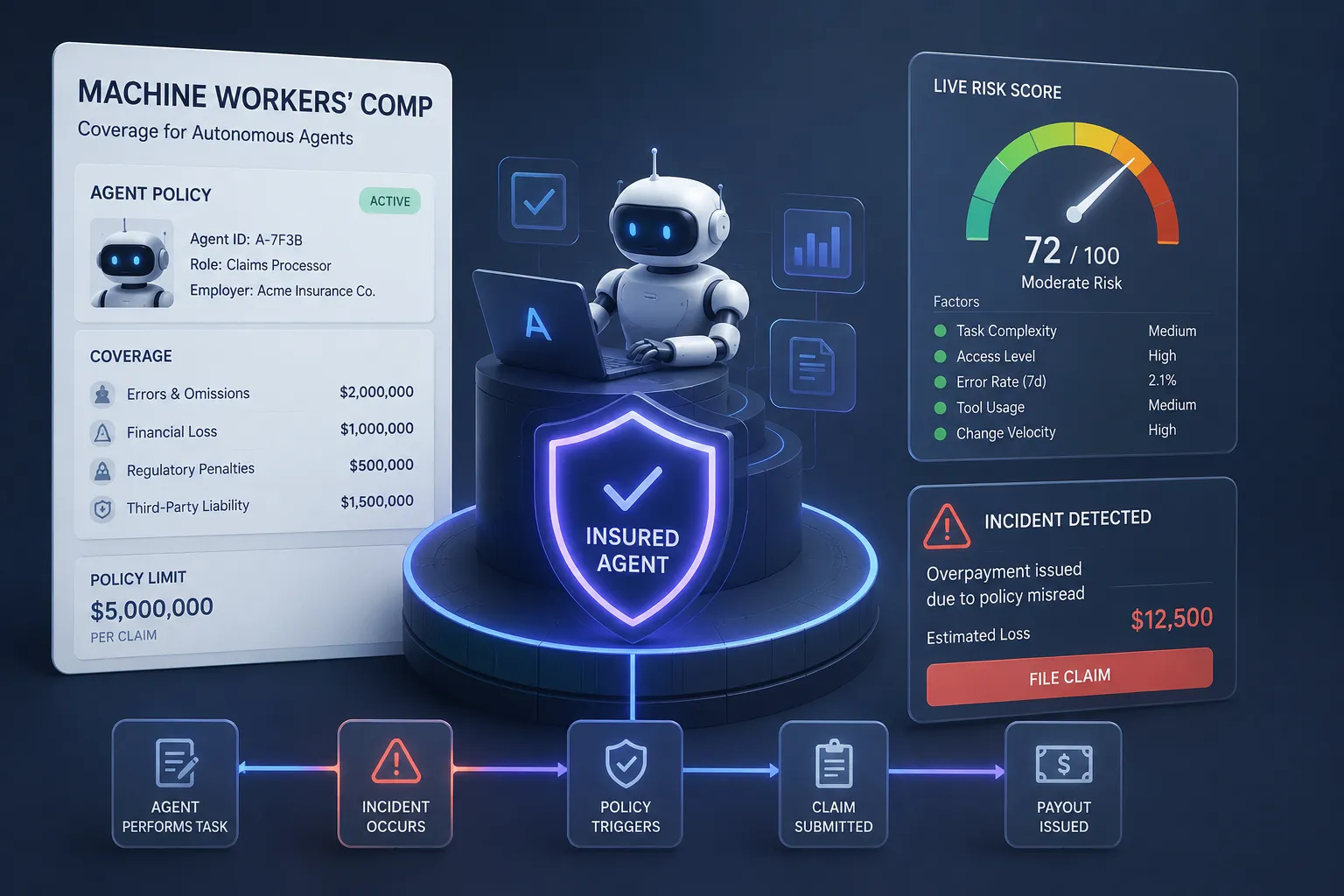
AI agents are starting to make decisions that can lose money, violate policy, or create liability, but companies still treat those failures like ordinary software bugs. Machine Workers’ Comp would insure autonomous agents at the task level, using live telemetry around the model, tools, permissions, historical error rate, and type of work being performed to price risk dynamically. As AI shifts from assisting employees to replacing pieces of labor, companies will need protection against machine mistakes just as they insure human professionals against errors. A lender could insure every AI underwriting decision for a few basis points, with premiums automatically rising if the agent starts deviating from expected behavior or using riskier tools.
Description
No additional description provided.
The Pitch
AI risk is becoming too granular, frequent, and operational to fit inside existing insurance categories. Traditional liability products assume incidents are exceptional and claims are reviewed after the fact. Agentic work will create millions of small, consequential decisions where the relevant question is not “is the software defective?” but “was this particular act within an acceptable risk envelope?” A company that can evaluate that envelope continuously becomes less like an insurer of products and more like a market maker for machine judgment.
The most interesting part is that insurance could become a control layer, not merely a financial backstop. If premiums change in real time based on what an agent is doing, the price of coverage becomes a signal that tells companies when an automated process has drifted from routine execution into dangerous improvisation. In human organizations, risk often hides in meetings, inboxes, and informal discretion. With agents, much of it is observable as tool calls, permissions, prompts, model versions, retrieval sources, and exception rates. That makes machine labor unusually insurable because its behavior can be measured at the moment risk is being created.
This business would also solve a trust problem that neither model vendors nor enterprises can easily solve alone. Vendors do not want open-ended responsibility for how customers deploy their models, while enterprises do not want to absorb every downstream mistake made by systems they only partially understand. A specialized insurer sits in the middle and translates technical uncertainty into an economic commitment. The existence of coverage would let buyers distinguish between an agent that merely demos well and one whose behavior is stable enough that someone is willing to carry its downside.
The deeper opportunity is that insuring agents could become a de facto certification system for automated work. Many companies will not know how to compare two agents that both claim high accuracy, but they will understand that one costs ten times more to insure for the same task. Over time, loss data would reveal which architectures, vendors, permissions, and workflows actually fail in the real world. That dataset would be extremely hard to replicate, because it would be built from the moments when automation stops being theoretical and starts touching money, customers, and law.