Instant Deployable Medical Structures for Emergency Use
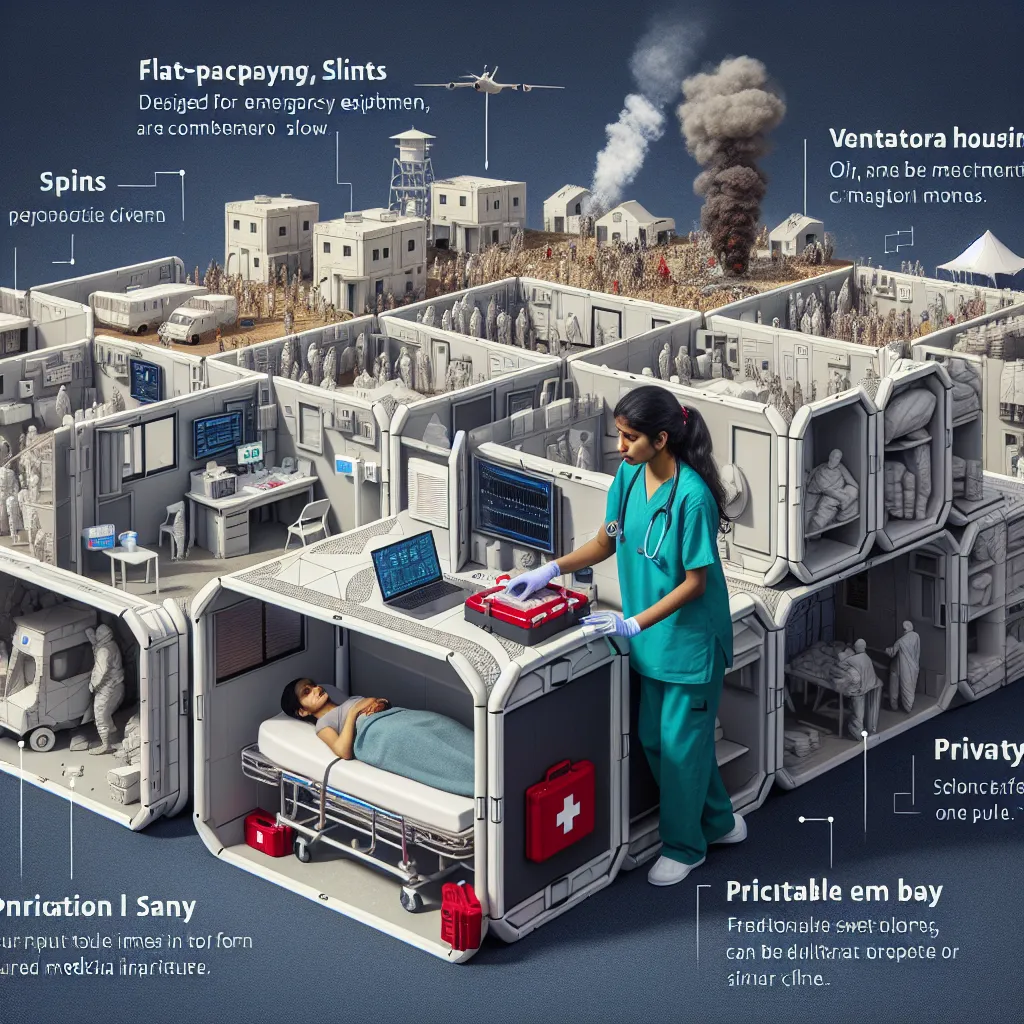
Emergency medicine breaks down when equipment is bulky, slow to assemble, or requires trained setup — exactly when speed matters most. In disasters, war zones, or rural clinics, even basic medical infrastructure like splints, ventilator housings, privacy partitions, or temporary exam bays are difficult to deploy quickly. Until now, complex medical tools had to be shipped pre-assembled or required tools and expertise. With single-string deployable structures, entire medical devices and rooms can ship flat and deploy instantly into rigid, functional forms. A medic pulls once and a triage station, orthopedic support, or isolation enclosure snaps into place. This creates a new category: software-designed, flat-packed medical infrastructure sold to governments, NGOs, and emergency responders. This exists now because computation can encode complexity into structure, eliminating assembly altogether.
Description
No additional description provided.
The Pitch
In emergency medicine, the most critical component is often speed. Unfortunately, conventional medical equipment can be cumbersome, slow to put together, and frequently requires specialized training for setup. These drawbacks become glaringly evident in urgent circumstances, such as natural disasters, conflict zones, or rural healthcare facilities where even fundamental medical infrastructure like splints, ventilator cases, privacy screens, or temporary examination areas are challenging to deploy swiftly.
Traditionally, complex medical equipment has needed to be transported in a pre-assembled form or required a suite of tools and trained personnel to assemble on-site, leading to delays in critical care delivery. Recognizing this gap, a new solution emerges through the innovation of single-string deployable structures. These structures offer the ability to transport entire medical devices and rooms flat and have them deploy instantly into rigid, functional forms upon activation. A simple pull by a medic can transform these flat-packed structures into fully functional triage stations, orthopedic supports, or isolation enclosures almost instantaneously.
This breakthrough heralds a new category of medical infrastructure that is both software-designed and flat-packed, targeted at governments, non-governmental organizations (NGOs), and emergency responders. This innovation is possible because of advanced computation that can now encode complexity directly into the structural design, completely eliminating the need for traditional assembly.
The product can be envisioned as a line of collapsible medical equipment, ranging from simple supports to more complex isolation chambers. Each unit is designed with pre-installed software-defined tension points that, when activated, automatically unfold and lock into place, providing immediate usability. Lightweight yet durable materials ensure easy transportation and robust performance under various conditions.
To bring this idea to life, several tools and technologies are essential. Computer-aided design (CAD) software will allow for precise structural encoding. Advanced materials such as lightweight composites or smart alloys ensure durability and ease of use. Manufacturing could leverage automated processes like 3D printing or laser cutting to ensure precision and scalability.
Launch of the Minimum Viable Product (MVP) could be strategically aimed at partnering with key stakeholders in the emergency response sector, particularly those with operational bases in challenging environments. A comprehensive go-to-market (GTM) strategy may include live demonstrations at emergency medicine and disaster recovery conferences, partnership with humanitarian organizations for pilot programs, and strong online and social media campaigns showcasing real-world applications.
The business model could be structured around a B2B (Business to Business) approach, focusing initially on large-scale purchasers such as international health organizations, military, and disaster response teams. Subscription or leasing models could be considered for sustainability, offering periodic updates or replacements tailored to specific field needs. Additionally, a direct sales channel could be established for smaller entities or developing nations requiring customized solutions.
By addressing the challenges of speed, transportability, and ease of use in emergency medical equipment, this innovation not only redefines how critical care can be administered in challenging settings but also paves the way for more agile responses to medical crises worldwide.