Independent Show Launch Platform for Media Personalities
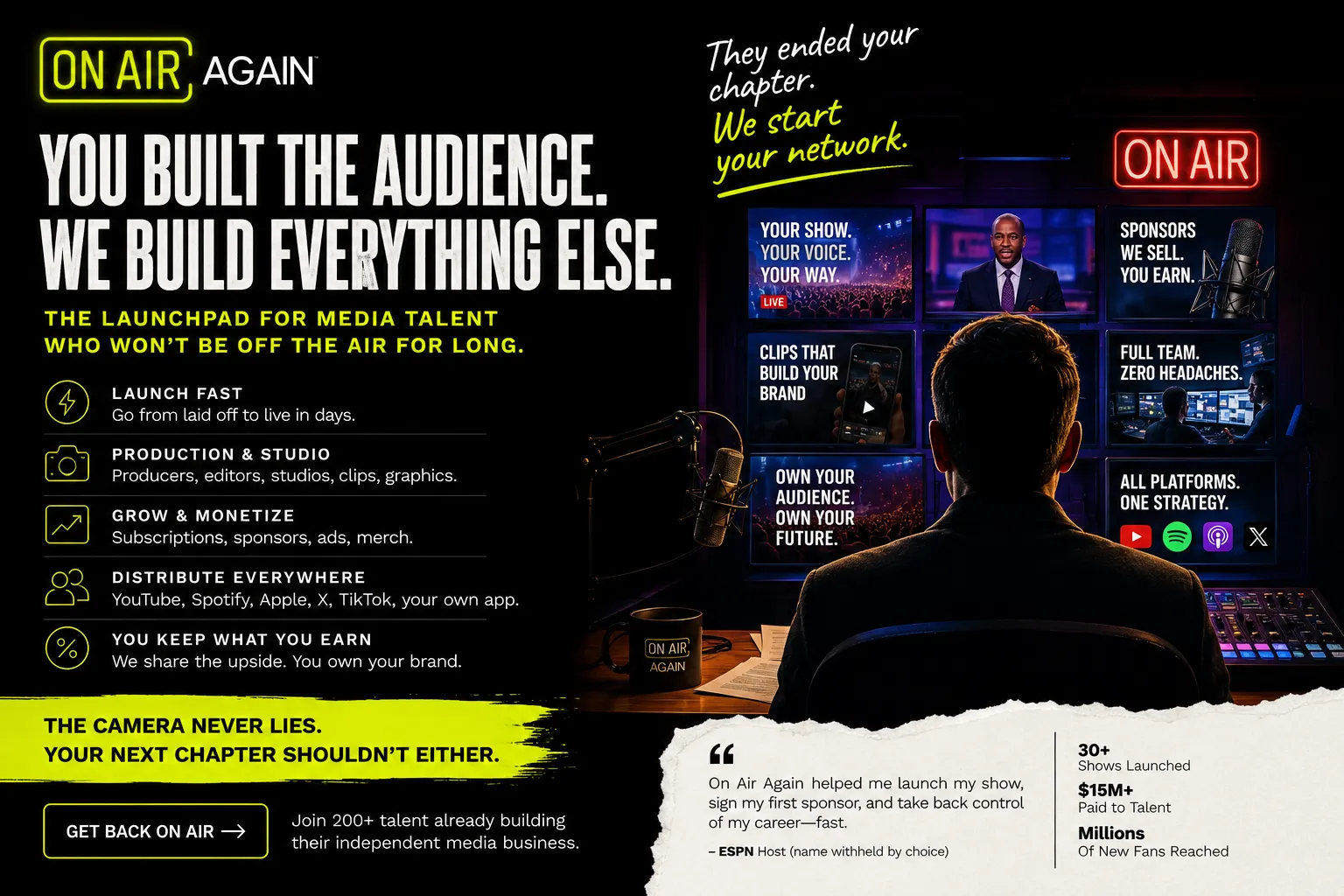
When a well-known television host or sports commentator loses their job, they often still have an audience but lose access to producers, studios, advertisers, editing teams, and distribution. A startup could help established media personalities launch independent shows within days. It would provide production, podcast and video distribution, sponsorship sales, subscriptions, social clips, and audience analytics in exchange for a share of revenue. Instead of signing another employment contract, a laid-off broadcaster could immediately launch a business they partly own. The opportunity is to become the operating system for recognizable talent leaving traditional television, radio, newspapers, and digital media companies.
Description
No additional description provided.
The Pitch
The audience usually leaves the institution more slowly than the institution believes. Media companies often treat hosts, reporters, commentators, and columnists as replaceable parts inside a larger machine, but in many categories the trust relationship is personal. A fired sports analyst, local news anchor, political interviewer, or niche industry journalist may no longer have a network badge, yet still has years of accumulated attention, credibility, and habit. The gap is not demand; it is operational capacity.
What makes the timing especially interesting is that the old media bundle is unbundling at the level of individual talent, but the work required to be independent has quietly become too complex for most talent to handle alone. A recognizable host can post a video immediately, but building a durable media business requires scheduling, editing, thumbnails, legal review, ad sales, subscriber management, platform optimization, rights clearance, guest booking, and constant analytics. Independence is emotionally appealing, but operationally exhausting. The company that absorbs that complexity would not be selling “tools”; it would be converting reputation into a functioning enterprise.
This business also benefits from a strange inefficiency in the labor market for media talent. Traditional employers often discard people abruptly because of budget cuts, political pressure, format changes, or executive turnover, not because the person’s audience disappeared. That creates moments when valuable personal brands are suddenly available, anxious, and motivated. The best time to form a new media business around a personality is not after a year of drifting; it is in the first week, while public curiosity is high and the story of the departure itself can become the launch event.
The economics could be unusually attractive because the company would not need to manufacture fame from scratch. Most creator businesses spend years trying to create attention; this one would harvest under-monetized attention that already exists. A modest number of successful personalities could support meaningful revenue because their audiences are older, more loyal, and often more commercially valuable than anonymous social traffic. Advertisers may also prefer these shows because the host provides a known voice and a known context, rather than an algorithmic placement beside whatever happens to be trending.
The deeper thesis is that media employment and media entrepreneurship are separating. For decades, talented people accepted institutional control because the institution owned distribution. Now distribution is fragmented, but operational infrastructure is the new dependency. A company that becomes the backstage crew for independent media figures could capture the moment when a public person stops being an employee and becomes an owner.