Independent Audits for Clinical AI Decisions
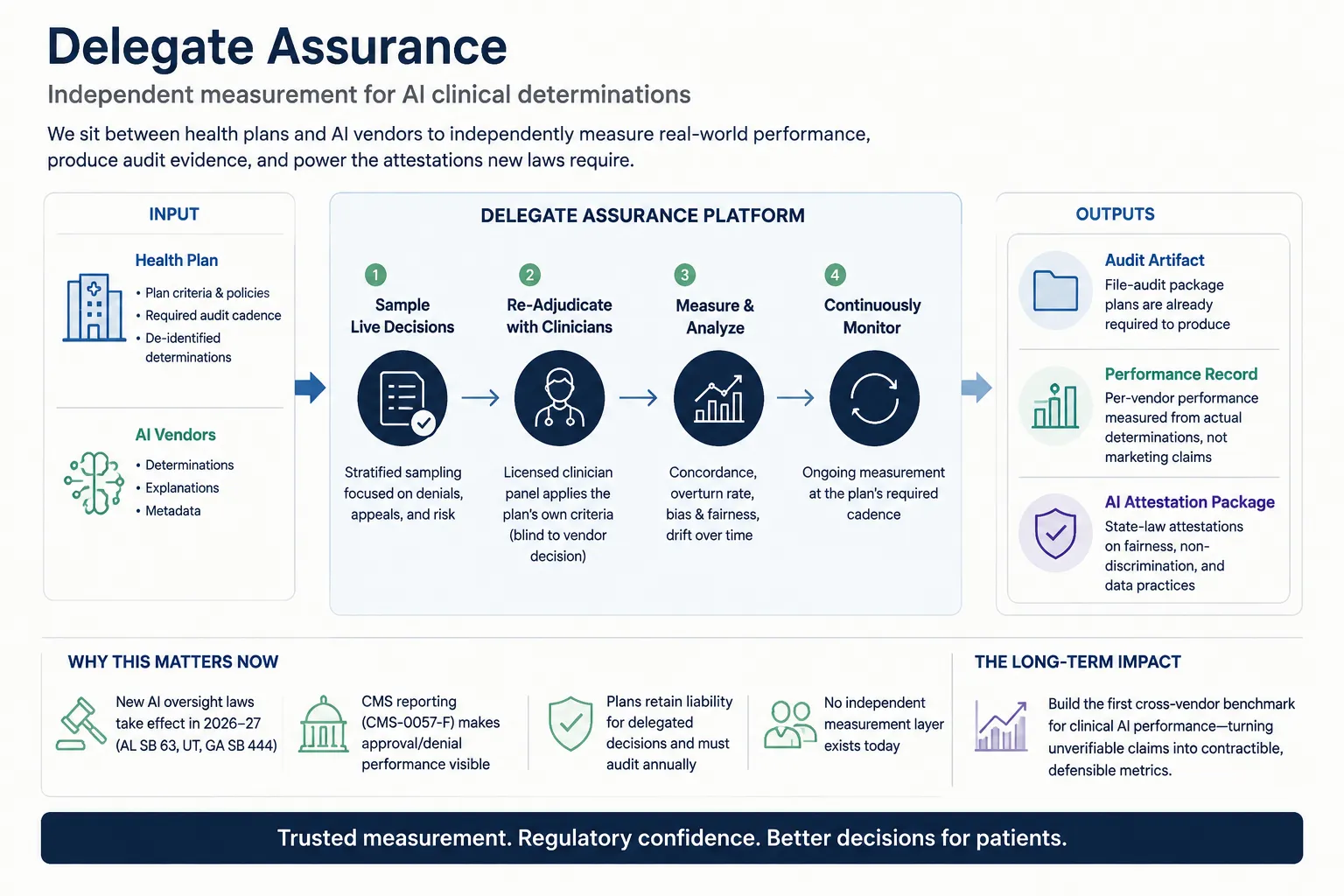
Health plans are handing clinical determinations to AI vendors without an independent way to know whether those systems perform as promised. Plans still carry the liability, annual delegate audits were designed for human reviewers, and new state laws are beginning to require attestations about AI behavior that plans cannot easily measure. Delegate Assurance would become the independent measurement layer for AI clinical decisions. It continuously samples real determinations, has licensed clinicians re-adjudicate them against the plan’s own criteria, and measures accuracy, denial overturns, bias, and performance drift. The output becomes both the plan’s required audit evidence and a verified performance record for each vendor. This matters now because new AI oversight laws take effect across states in 2026 and 2027 while CMS reporting makes approval and denial performance increasingly visible. A regional health plan using three AI vendors could receive quarterly independent scorecards and ready-to-file compliance attestations. Over time, Delegate Assurance could build the first cross-vendor benchmark for clinical AI performance, turning vendor claims like “99% accurate” into numbers buyers can independently verify.
Description
No additional description provided.
The Pitch
Health plans are discovering that AI does not eliminate judgment; it relocates it into systems they do not fully control. The economic buyer is not purchasing “better AI” in the abstract. It is purchasing a defensible answer to a much sharper question: if a regulator, journalist, member, provider, or court asks why a denial happened, can the plan prove that the machine behaved consistently with its own rules? That proof is hard to manufacture after the fact. It has to be collected continuously, in the ordinary course of operations.
The most interesting part is that the business sits between two forms of mistrust. Plans cannot simply trust vendors’ self-reported accuracy, because the vendor has every incentive to define success generously. Vendors also cannot easily prove they are being treated fairly by skeptical buyers, because each plan sees only its own messy slice of performance. An independent measurement layer becomes valuable precisely because it is not the decision-maker. Its neutrality is the product. In a market where everyone argues about whether the algorithm was right, the scarce asset is a trusted record of what actually happened.
There is also a strong asymmetry between the cost of being wrong and the cost of measurement. A single bad pattern in clinical denials can create regulatory exposure, provider abrasion, member harm, litigation risk, and reputational damage. Yet the unit being measured is abundant: every determination already exists as a structured event with criteria, documentation, and an outcome. That makes this a rare compliance business where oversight can become more powerful over time rather than more burdensome. The audit trail is not a static checklist; it becomes a living performance history.
The deeper opportunity is that clinical AI will not be judged only by aggregate accuracy. Two systems with the same headline performance can behave very differently on rare conditions, incomplete documentation, vulnerable populations, or borderline cases. Those edges are where public trust is won or lost. A company that can turn those hidden failure modes into comparable, longitudinal evidence changes the buying conversation from promises to proof.
If it worked, this business would become more useful as the market gets more crowded. Every new AI vendor increases the need for a common yardstick. Every new rule increases the value of independent evidence. And every plan that participates makes the benchmark harder to replicate, because the company would not merely know how vendors perform in demos; it would know how they perform in the wild.