Independent Audit Receipts for AI Agents
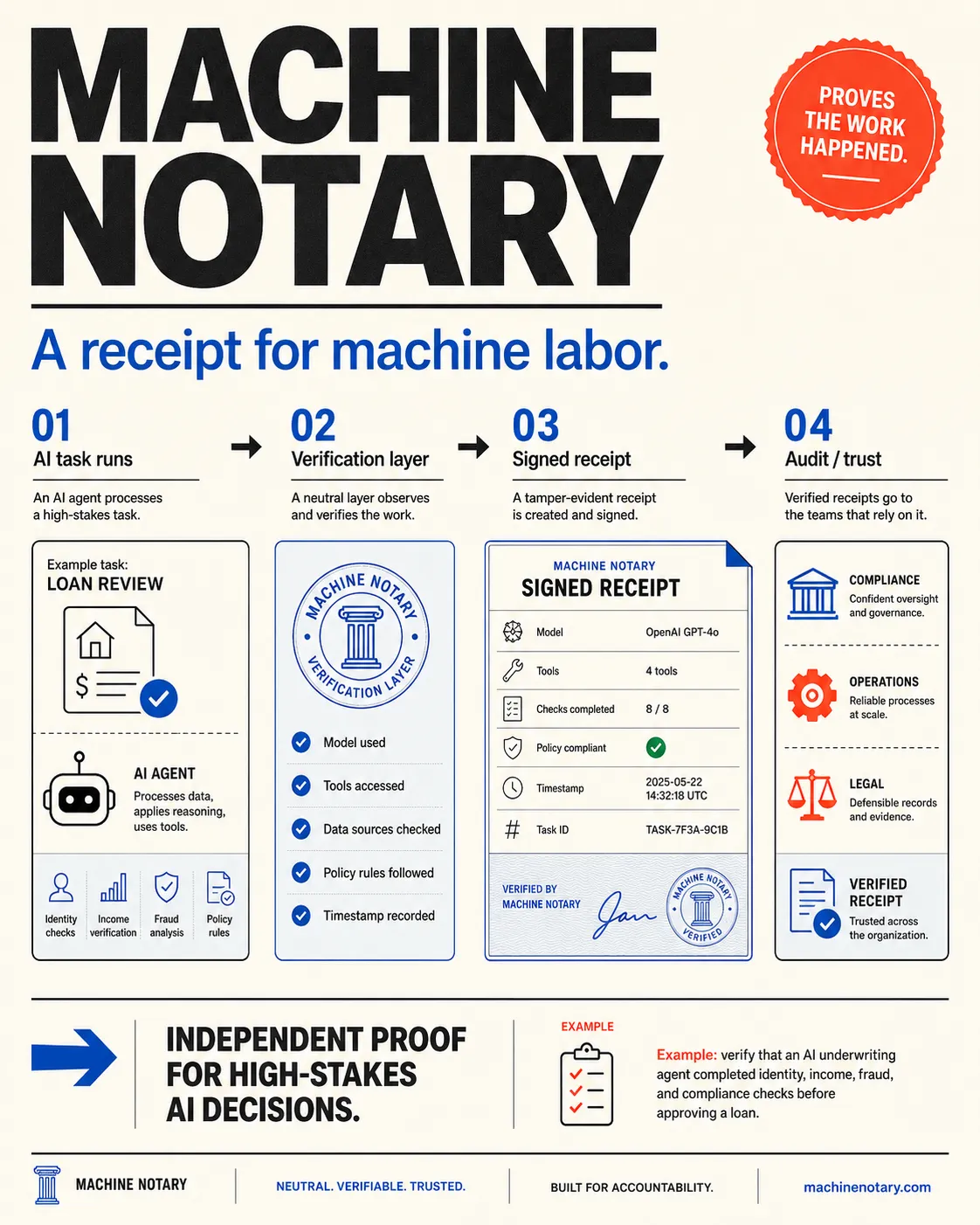
Companies are beginning to trust AI systems with work that has real financial, legal, and operational consequences, yet there is often no independent way to prove the machine actually performed the required steps. Machine Notary would sit alongside AI agents and issue a tamper-resistant receipt for every important task, certifying which model ran, what tools and data sources it accessed, which required checks were completed, when the work happened, and whether the system stayed within its permitted rules—without exposing private data or the model's internal reasoning. As machine labor becomes harder to observe, proof that the work actually happened becomes its own infrastructure layer. A bank could attach a Machine Notary receipt to every AI underwriting decision proving that required identity, income, fraud, and compliance checks were completed before the loan was approved.
Description
No additional description provided.
The Pitch
Mmachine notary turns AI from something you must supervise into something you can rely on after the fact. Human organizations have always solved trust in delegated work through records: signatures, timestamps, audit logs, approvals, chain-of-custody forms. AI breaks that pattern because the “worker” can act at software speed, across many systems, while leaving behind traces that are either too verbose, too fragile, or too easy for the operator to curate. A neutral receipt becomes valuable because it is not another dashboard; it is a portable fact about what happened.
The deepest market pull would come from accountability gaps between parties. The company using an AI system wants evidence that it behaved properly. The regulator wants proof without needing access to sensitive data. The customer wants recourse if something goes wrong. The AI vendor wants to show that failure was caused by bad inputs, missing permissions, or downstream misuse rather than the model itself. Today those parties are often arguing from screenshots, logs, and policy documents. A trusted record could become the shared object everyone points to when responsibility needs to be assigned.
This is especially powerful because AI work will increasingly be bundled into other services and become invisible. A loan approval, insurance quote, medical prior authorization, contract review, or procurement decision may involve dozens of automated subtasks that no end user ever sees. As soon as that happens, trust moves from “I understand how this was done” to “someone can prove the required process was followed.” The less visible the labor becomes, the more valuable independent process evidence becomes.
The business also benefits from a rare asymmetry: it does not need to judge whether the AI’s answer was correct in every case. It only needs to attest to the execution of agreed-upon conditions. That makes the product more durable than an AI evaluator trying to define truth across domains. It can become useful wherever the question is not “was this the perfect decision?” but “did the system do what it was authorized and required to do?”
If machine labor becomes a normal part of regulated commerce, notarization may become one of the quiet control points that lets adoption continue. Companies do not merely need smarter AI; they need AI actions that can survive audit, dispute, insurance review, and litigation. The company that supplies that proof sits at the boundary where automation becomes institutionally acceptable.