Independent AI ROI Audit Service
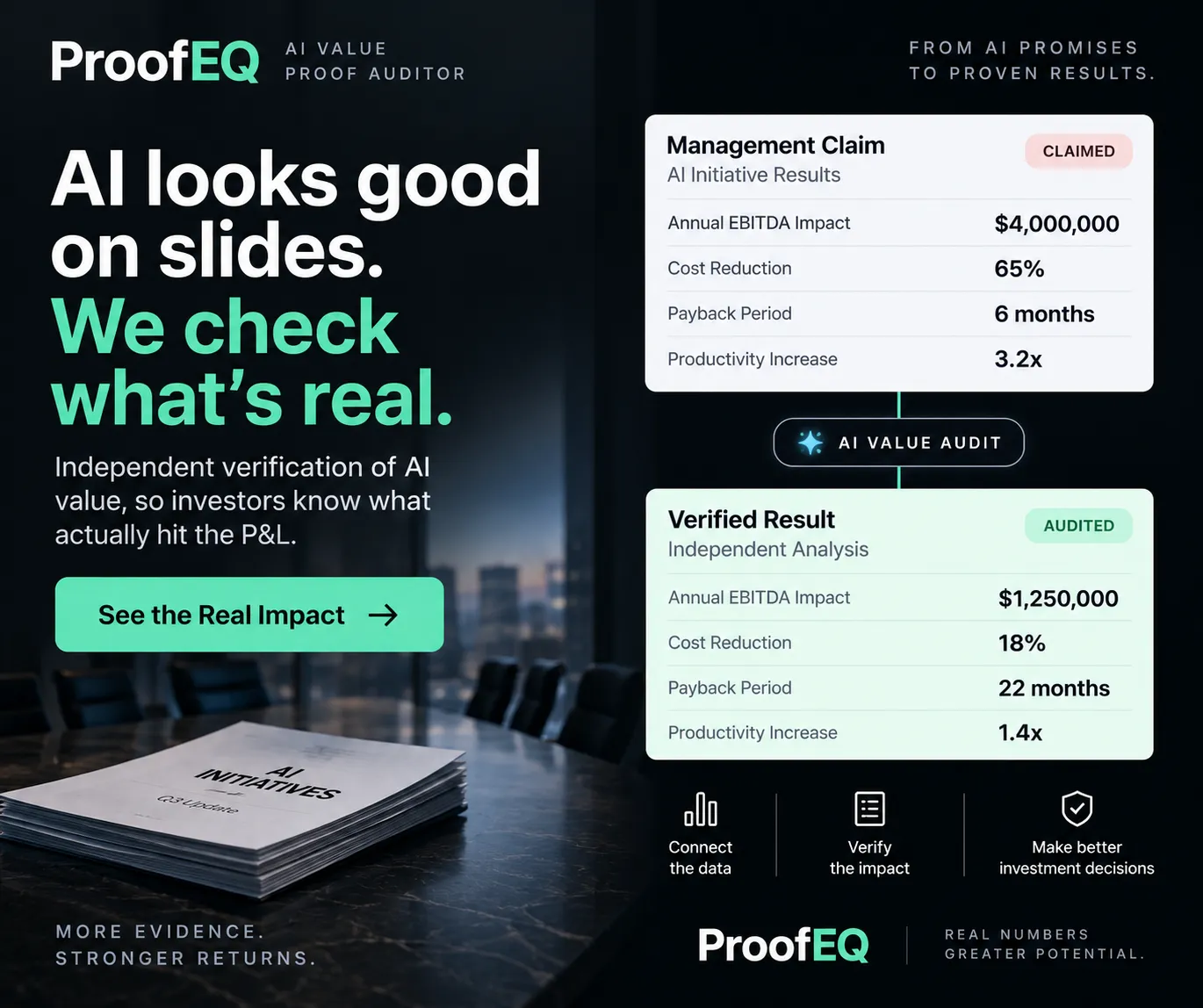
Every private equity firm wants its portfolio companies using AI. Soon every management team will have a presentation showing how much money those projects supposedly saved. The harder question will be whether any of it actually hit the P&L. Build an independent AI value auditor. Connect the project’s baseline, implementation costs, staffing changes, revenue, model usage and operating metrics, then reconcile the promised ROI against what actually happened. The buyer isn’t the company selling the AI project. It’s the investor, board or future acquirer that needs to know whether the claimed $4 million of “AI-created EBITDA” is real. As AI spending explodes, proving the value may become almost as important as creating it.
Description
No additional description provided.
The Pitch
AI will create a new category of accounting problem: not whether software was purchased, but whether the gains attributed to it are real. Most AI projects will sit in the messy middle between automation, process redesign, headcount planning, vendor claims, and management optimism. That makes them unusually easy to overstate. A team can claim a chatbot reduced support costs while ticket volume fell for unrelated reasons, hiring was frozen, service quality declined, or the “savings” never left the budget. The value is not in another dashboard; it is in giving boards and owners a disciplined way to separate actual economic impact from narrative.
This is compelling because AI benefits will become a form of managerial currency. Executives will be rewarded for showing they adopted AI, consultants will package transformation stories, and vendors will quote case studies with heroic payback periods. In that environment, an independent auditor becomes useful precisely because everyone else in the chain has an incentive to round up. The more AI becomes expected, the more suspicious every success story becomes. Verification turns from a nice-to-have into a control system.
The strongest wedge is private equity because small differences in claimed EBITDA have large consequences. If a portfolio company says AI added $4 million of EBITDA, that may imply tens of millions of dollars of enterprise value at exit. A buyer who cannot diligence that claim will discount it; a seller who can prove it may preserve value. The auditor does not need to make AI better to be valuable. It only needs to make AI’s financial contribution legible enough for people transacting around the company to trust it.
There is also a deeper reason this could endure: AI impact is not a one-time measurement. Models drift, usage decays, workflows revert, costs creep, and employees quietly rebuild manual workarounds. The original business case may be true for three months and false by month twelve. A credible measurement layer becomes a continuing source of truth, closer to revenue recognition or cost accounting than to project management. As AI moves from experiments to operating infrastructure, the question will shift from “did we deploy it?” to “what does it reliably earn?” A company that can answer that question with authority would sit at a valuable intersection of finance, governance, and technology.