Income Protection Insurance for Content Creators
Creators can spend years building reliable income on YouTube, Spotify, TikTok, SiriusXM, or other platforms, only to see that revenue collapse overnight because of an algorithm change, programming decision, demonetization, or shift in platform strategy. Build a revenue-continuity product that tracks a creator’s historical earnings and platform concentration, then temporarily replaces part of their lost income when a qualifying platform decision causes a sudden drop. This becomes more valuable as more people depend on creator income while the platforms controlling distribution can still change the rules without warning. Imagine a comedian earning $6,000 a month from radio royalties suddenly dropping to $1,500 after a programming change and receiving four months of partial income replacement while they rebuild through direct subscriptions, touring, and other channels.
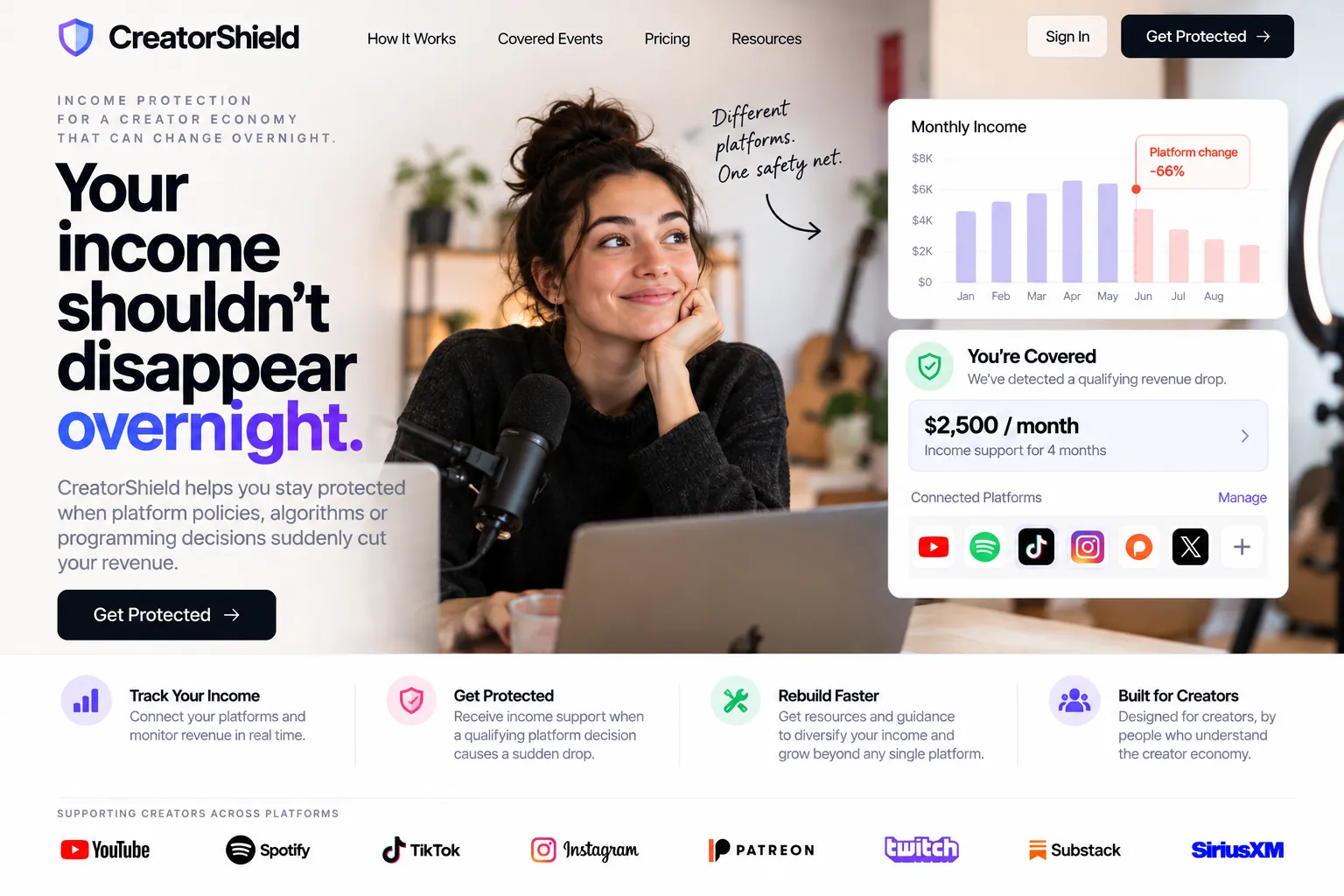
Description
No additional description provided.
The Pitch
Creator income now looks less like entrepreneurship and more like employment without labor protections. Many creators have one or two dominant “employers,” except those employers call themselves platforms, avoid long-term obligations, and can alter compensation through opaque decisions. That mismatch creates a strange new risk category: people with real recurring income, real financial commitments, and no continuity mechanism when the distribution layer changes its mind.
This business would work because the risk is both emotionally acute and increasingly measurable. A creator does not need to be convinced that platform dependency is dangerous; most already feel it every time a dashboard changes, a policy update lands, or a format stops being favored. But unlike generic career anxiety, this risk leaves a data trail. Earnings histories, traffic sources, royalty statements, monetization notices, and audience concentration can be turned into a reasonably clear picture of exposure. The product is compelling because it gives financial shape to a fear that creators usually discuss only in anecdotes.
The most interesting part is that it would not merely sell protection against lost income; it would reward creators for becoming more resilient. Traditional insurance often prices risk and then disappears into the background. Here, the act of measuring platform concentration could change behavior. A creator who sees that 80% of income depends on one recommendation system may be more likely to build a mailing list, sell direct, diversify distribution, or renegotiate deals. The product becomes a mirror as much as a safety net, and that makes it useful even before anything goes wrong.
There is also a structural asymmetry in the creator economy that makes this feel overdue. Platforms have sophisticated models for managing creator supply, content risk, churn, and monetization; individual creators mostly have screenshots, spreadsheets, and panic. A company that aggregates income-risk data across many creators could understand platform volatility in a way no single creator can. Over time, it could become one of the few independent institutions watching how platform decisions translate into household financial shocks.
The deeper business is trust in an economy where distribution is rented, not owned. As more creative work becomes dependent on intermediaries, creators will need financial products built around unstable access rather than steady employment. The company that understands creator income continuity could become the default layer between creative labor and platform power.